

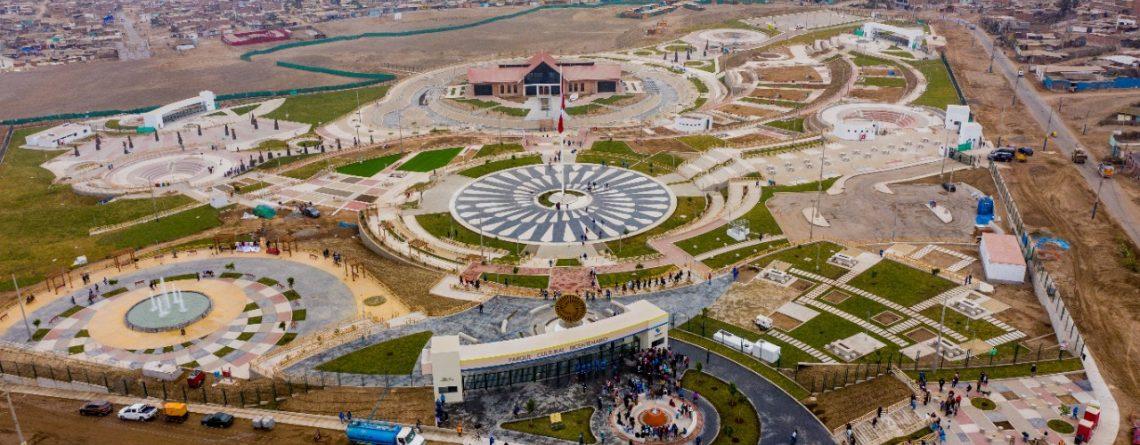
This mega-project is part of the Agenda for the Commemoration of the Bicentenary of the Independence of Peru (3). It is the new ecological lung of Ventanilla where families have free access to a meeting point where they can carry out sports, recreational, leisure and cultural activities (1, 2, 3). This park is the largest emblematic work carried out in Callao and one of the largest in extension at the national level, built in commemoration of the 200 years of independence (1, 2, 3). It was built on vacant land, where there was no possibility of meeting or recreation for the neighbours (1). In addition to offering recreational spaces, it is a cultural work that seeks to teach the population about the history of independence, making the public space a commitment to a citizen-centred public policy with an intercultural approach (3). In addition, its financing was part of the second phase of the economic reactivation plan for public investment, encouraging local economic development and generating more than 1,300 direct and indirect jobs (3). This work is an investment of the Executive together with the Regional Government of Callao and the labour force of the municipality of Ventanilla (1, 2). Its facilities are freely accessible and will contribute to the social development and well-being of the citizens (3). Inaugurated in 2022, it has cultural components, such as squares and amphitheatres, playgrounds, campsites and more than 30,000 m2 of green and blue areas (1).
Overview
Nature-based solution
- Blue infrastructure
- Lakes/ponds
- Parks and urban forests
- Large urban parks or forests
Key challenges
- Green space, habitats and biodiversity (SDG 15)
- Green space creation and/or management
- Cultural heritage and cultural diversity
- Protection of historic and cultural landscape/infrastructure
- Preservation of historic traditions
- Health and well-being (SDG 3)
- Creation of opportunities for recreation
- Enabling opportunities for physical activity
- Social justice, cohesion and equity (SDG 10)
- Social interaction
- Economic development and employment (SDG 8)
- Employment/job creation
Principal problems in Functional Urban Area (FUA)
- Land use and Socio-economic change
- Rapid urbanization
- Unequal availability and access to public green spaces
- Health, Well-being and Social cohesion
- Inadequate access to recreational opportunities
Key priorities
Focus
Project objectives
Implementation activities
Main beneficiaries
- Local government/Municipality
- Citizens or community groups
Governance
Management set-up
- Government-led
Type of initiating organisation
- Local government/municipality
Participatory approaches/ community involvement
- Unknown
Details on the roles of the organisations involved in the project
Project implemented in response to ...
Type of enablers
Financing
Total cost
Source(s) of funding
- Public local authority budget
- Public national budget
- Public regional budget
Type of funding
- Earmarked public budget
Non-financial contribution
Impacts and Monitoring
Environmental impacts
- Environmental quality
- Improved air quality
- Achieved improved air quality
- Green space and habitat
- Increased green space area
- Achieved increased green space area
Economic impacts
- Generation of other type of work opportunities (e.g. voluntary, work for rehabilitation)
- Achieved generation of other type of work opportunities (e.g. voluntary, work for rehabilitation)
- More sustainable tourism
- Expected more sustainable tourism
- Attraction of business and investment
- Expected attraction of business and investment
Socio-cultural impacts
- Social justice and cohesion
- Improved access to urban green space
- Achieved improved access to urban green space
- Health and wellbeing
- Gain in activities for recreation and exercise
- Achieved gain in activities for recreation and exercise
- Cultural heritage and sense of place
- Increased sense of place identity, memory and belonging
- Achieved increased sense of place identity, memory and belonging
Type of reported impacts
Presence of formal monitoring system
Presence of indicators used in reporting
Presence of monitoring/ evaluation reports
Availability of a web-based monitoring tool
Potential risks of implementation and trade-offs
References
 Information about this nature-based solution was collected as part of the Naturescapes project funded by the European Union under Grant Agreement No 101084341.