

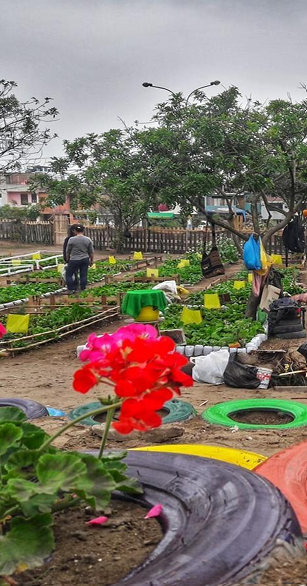
In 2018, a group of residents from Sector II in the Villa El Salvador district initiated a communal effort to transform an abandoned space into an urban garden (3). This is how Ayllu 21, the first community-based agroecological garden in Villa El Salvador, was born. The project was spearheaded by a group of mostly migrant senior women who decided to dedicate their time and labour to reclaiming a landfill space, to turn it into a productive green area (1). Their philosophy is rooted in the concept of "ayllu," a Quechua word signifying family, collective identity, solidarity, and respect for the environment to foster harmonious coexistence (3). Today, Ayllu 21 spans 1400 square meters and features 40 plots where agroecological practices are employed (1, 3). The garden aims to become a space for comprehensive development, through promoting environmental awareness, political advocacy, and the fight against gender-based violence in a district that ranks third in the number of violence cases (1). The vegetables produced are primarily for self-consumption, with any surplus distributed among neighbouring families. If there are any sales, the profits are shared among the members, who work an average of two days per week in the garden (3). This space seeks to strengthen socialization among women and seniors and foster learning and community-building among neighbours through agriculture. It was initiated with the support of IPES Promotion of Sustainable Development as part of the Sowing in the Desert program (3, 6), and it has received support from a diversity of programmes, such as the framework of the Women United for Food and Environmental Security (MUSA) (1).

Overview
Nature-based solution
- Community gardens and allotments
- Community gardens
Key challenges
- Green space, habitats and biodiversity (SDG 15)
- Green space creation and/or management
- Inclusive and effective governance (SDG 16)
- Inclusive governance
- Social justice, cohesion and equity (SDG 10)
- Social cohesion
- Social justice and equity
- Social interaction
- Environmental education
- Sense of community and community engagement
- Economic development and employment (SDG 8)
- Economic development: agriculture
- Sustainable consumption and production (SDG 12)
- Sustainable consumption
- Sustainable production
Principal problems in Functional Urban Area (FUA)
- Land use and Socio-economic change
- Limited economic opportunities and local livelihoods
- Health, Well-being and Social cohesion
- Social fragmentation and isolation
- Insecurity in public spaces
Key priorities
Focus
Project objectives
Implementation activities
Main beneficiaries
- Local government/Municipality
- Citizens or community groups
- Young people and children
- Marginalized groups: Elderly people, Women
Governance
Management set-up
- Led by non-government actors
Type of initiating organisation
- Non-government organisation/civil society
- Citizens or community group
- Private sector/corporate actor/company
Participatory approaches/ community involvement
- Co-planning (e.g. stakeholder workshops, focus groups, participatory mapping)
- Deliberative decision-making processes (e.g., consensus building, deliberative polling)
- Joint implementation (e.g. tree planting)
- Co-management/Joint management
Details on the roles of the organisations involved in the project
Project implemented in response to ...
Type of enablers
Financing
Total cost
Source(s) of funding
- Funds provided by non-governmental organization (NGO)
Type of funding
- Direct funding (grants, subsidies, or self-financed projects by private entities)
Non-financial contribution
- Provision of land
- Provision of labour
- Provision of expertise
- Public authorities (e.g. land, utility services)
- Citizens (e.g. volunteering)
- Private sector (businesses, financial institution)
Impacts and Monitoring
Environmental impacts
- Green space and habitat
- Increased green space area
- Achieved increased green space area
- Increased number of species present
- Achieved increased number of species present
- Restoration of derelict areas
- Achieved restoration of derelict areas
Economic impacts
- Generation of other type of work opportunities (e.g. voluntary, work for rehabilitation)
- Achieved generation of other type of work opportunities (e.g. voluntary, work for rehabilitation)
- Increase in agricultural production (for profit or not)
- Achieved increase in agricultural production (for profit or not)
- Generation of income from NBS
- Achieved generation of income from NBS
Socio-cultural impacts
- Social justice and cohesion
- Improved access to urban green space
- Achieved improved access to urban green space
- Increased opportunities for social interaction
- Achieved increased opportunities for social interaction
- Health and wellbeing
- Improved mental health
- Achieved improved mental health
- Cultural heritage and sense of place
- Increased sense of place identity, memory and belonging
- Achieved increased sense of place identity, memory and belonging
- Safety
- Increased perception of safety
- Achieved increased perception of safety
- Decreased crime rates
- Achieved decreased crime rates
Type of reported impacts
Presence of formal monitoring system
Presence of indicators used in reporting
Presence of monitoring/ evaluation reports
Availability of a web-based monitoring tool
Potential risks of implementation and trade-offs
References

 Information about this nature-based solution was collected as part of the Naturescapes project funded by the European Union under Grant Agreement No 101084341.