

Last updated: October 2021
The community garden is located in the midst of a housing quarter and in the city district of Grünau, a former Plattenbau-area and forms part of a wider area redevelopment project which turns former brownfield (from the DDR era) into generationally mixed housing units with higher living standards. The idea for the garden arose among its residents, who determined its design and elements. It consists of multi-use zones for young and old residents: a central square, a pond with special flora, plant beds for gardening and harvesting, a wild meadow for recreation and picnics (2,3).
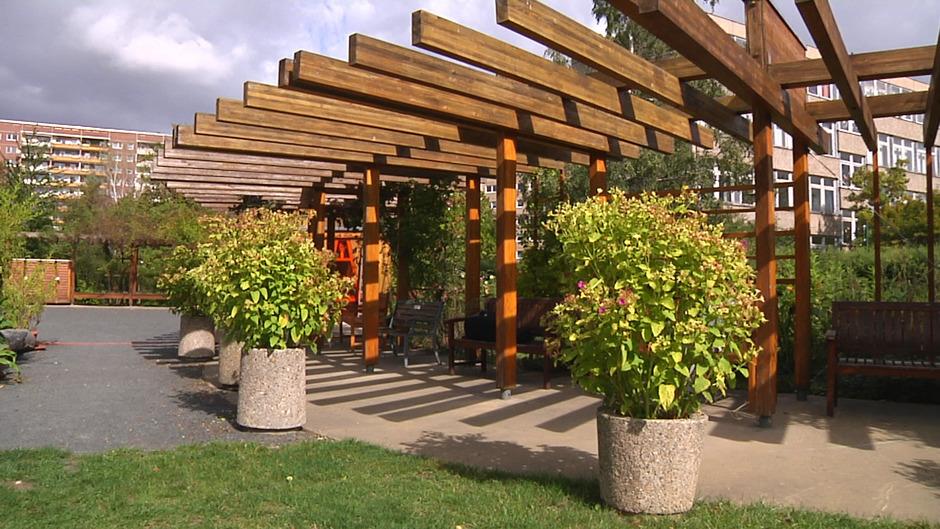
Source: https://www.sachsen-fernsehen.de/eine-oase-inmitten-der-platte-der-kolonnadengarten-gruenau-663728/#
Overview
Nature-based solution
- Parks and urban forests
- Pocket parks/neighbourhood green spaces
- Community gardens and allotments
- Allotments
- Community gardens
- Blue infrastructure
- Lakes/ponds
Key challenges
- Green space, habitats and biodiversity (SDG 15)
- Green space creation and/or management
- Environmental quality
- Regeneration, land-use and urban development
- Conversion of former industrial areas
- Promote natural styles of landscape design for urban development
- Inclusive and effective governance (SDG 16)
- Inclusive governance
- Social justice, cohesion and equity (SDG 10)
- Social cohesion
- Social interaction
- Health and well-being (SDG 3)
- Creation of opportunities for recreation
Focus
Creation of new green areas, Maintenance and management of urban nature, Transformation of previously derelict areas
Project objectives
- Enhancing living standards in inner-city districts across all generations via creating (green) ope spaces for individualistic and communal use next to a housing quarter (3);
- Promoting relationships among residents across generations and the development of joint initiatives across age groups for which the community garden is one example (2, 3);
- With allotments for gardening activities and the option to participate in the garden committee, personal involvement in co-creating the open space and its use is facilitated which aims at the wider goal of stabilizing the resident structure and creating a sense of belonging (3);
- Creating a garden/park with multiple uses for all residents (2);
- Implementation of adequate vegetation for small animals and insects to thrive (2);
- Implementation of water elements for relaxation and the well-being of its residents (2).
Implementation activities
The planting plan was formulated based on democratic decision-making. The following elements were decided on and implemented in a step-wise process:
- Creation of a central square at the entrance
- Installation of a pergola covering the whole pathways to provide shade for elderly people and children's playing areas
- Creation of plantations with flowers, herbs, vegetables and fruits for individual use including raised beds for gardening activities for less mobile elderly people
- Creation of a pond surrounded by a planted wall and reed with a filter function and a sun-bathing lawn.
Following the principle of multiple uses, the garden/park areas are used differently by its adjacent residents, either for gardening and maintaining plant beds, enjoying its aesthetics, for relaxation or for joint events. Also, maintenance of the gardens is left to the residents (1, 2, 3, 4).
Main beneficiaries
- Citizens or community groups
Governance
Management set-up
- Co-governance with government and non-government actors
Type of initiating organisation
- Local government/municipality
- Business association or network
Participatory approaches/ community involvement
- Co-planning (e.g. stakeholder workshops, focus groups, participatory mapping)
- Taskforce groups
- Consultation (e.g. workshop, surveys, community meetings, town halls)
- Joint implementation (e.g. tree planting)
- Co-management/Joint management
- Citizen oversight (e.g. boards, advisory)
Details on the roles of the organisations involved in the project
Upon demolition of the former living quarters in the district, the housing association Pro Leipzig aimed at creating new living quarters with high quality green public spaces on a surface area of 3,260 sqm that had become vacant (3). To generate the required funds, a project design was submitted by the housing association together with the city department for urban renewal and housing construction to the Federal Ministry for Research on construction, urban and spatial development which hosted the competition on urban innovation for living quarters which won funds to implement the initiative (2)
Project implemented in response to ...
... an EU policy or strategy?
Unknown
... a national policy or strategy?
Yes
(The urban development funding programme "Social City - Investments in the quarter" which targets city districts exhibiting development requirements all over Germany was initiated in 1999 by the National Ministry for Traffic, Construction and Urban Development (BMVBS) in collaboration with federal authorities. Its goal was to improve living, housing and economic conditions in poor and socially deprived city districts while improving the residents' identification via community involvement activities and introducing a so-called quarter management. Next to other city districts in the East of Leipzig which is a focus area for urban redevelopment, Leipzig-Grünau and its prefab block housing estate became part of the programme with issuing a specific action plan (Handlungskonzept) in 2005 (5).)
... a local policy or strategy?
Yes
(The Integrated Urban Development Concept for Leipzig ("integriertes Stadtentwicklungskonzept") determines the objectives, urban areas and focus areas for development and contains a set of central measures; it provides the base for cross-departmental administrative action, collaboration and participation of non-governmental actors. The West of Leipzig and its prefab housing estate originating in the DDR era form part of the urban focal areas and its stated implementation strategy is based on active residents' and citizens' involvement in the steps of the redevelopment process (8)
The second relevant local plan is the Development Strategy for Grünau that was formulated by the city administration together with the housing association in close exchange with residents. As a formal guiding principle for district development, it is a more concrete formulation of the integrated urban development concept which determines investments of funds and public resources (7, 9).)
Financing
Total cost
€100,000 - €500,000
Source(s) of funding
- Public national budget
- Public regional budget
- Corporate investment
Type of funding
- Earmarked public budget
- Direct funding (grants, subsidies, or self-financed projects by private entities)
Non-financial contribution
Type of non-financial contribution
- Provision of land
Who provided the non-financial contribution?
- Public authorities (e.g. land, utility services)
Impacts and Monitoring
Environmental impacts
- Green space and habitat
- Promotion of naturalistic styles of landscape design for urban development
- Increased green space area
- Increased conversion of degraded land or soil
- Restoration of derelict areas
Economic impacts
- Unknown
Socio-cultural impacts
- Social justice and cohesion
- Improved social cohesion
- Improved access to urban green space
- Increased opportunities for social interaction
- Increased involvement of locals in the management of green spaces
- Increased access to healthy/affordable food
- Health and wellbeing
- Gain in activities for recreation and exercise
- Cultural heritage and sense of place
- Increased sense of place identity, memory and belonging
Type of reported impacts
Expected impacts, Achieved impacts
Presence of formal monitoring system
Unknown
Presence of indicators used in reporting
No evidence in public records
Presence of monitoring/ evaluation reports
No evidence in public records
Availability of a web-based monitoring tool
No evidence in public records
References
1. Wohnungsgenossenschaft Pro Leipzig e.G. (n/a). Der Kolonnadengarten. Menschen, Garten, Möglichkeiten. Website unavailable
2. Wohnungsgenossenschaft Pro Leipzig e.G. (n/a) Der Kolonnadengarten. Menschen, Garten, Möglichkeiten. Der Ausgangspunkt. Website unavailable
3. Bundesminiterium für Umwelt / Naturschutz / Bau und Reaktorsicherheit (n/a) Kolonnaden ‘Alte Salzstraße’ - innerstädtisches Quartier als Wohnort und Erlebnisraum. Accessed on October 9, 2020, Source link
4. Bundesministerium für Verkehr / Bau und Stadtentwicklung (BMVBS) (2010) ‘Werkstatt: Praxis Heft 71 Stadtquartiere für Jung und Alt – eine Zukunftsaufgabe Ergebnisse aus dem ExWoSt-Forschungsfeld „Innovationen für familien- und altengerechte Stadtquartiere“’, Werkstatt: Praxisheft 71.Website unavailable
5. Stadt Leipzig. (2017). Bund-Länder-Programm Soziale Stadt - Investitionen im Quartier. Accessed on October 9, 2020, Source link
6. Stadt Leipzig. (2017). Fördergebiete der Stadterneuerung im Leipziger Osten. Accessed on October 9, 2020, Source link
7. Stadt Leipzig. (2017). Stadterneuerungsschwerunt Leipzig-Grünau. Accessed on October 9, 2020, Source link
8. Dezernat Stadtentwicklung und -bau. (2009). Integriertes Stadtentwicklungskonzept Leipzig 2020 (SEKo). Leipzig. Accessed on October 9, 2020, Source link
9. Stadt Leipzig Dezernat Stadtentwicklung und Bau. (2007). Entwicklungsstrategie Grünau 2020. Leipzig. Accessed on October 9, 2020, Source link
2. Wohnungsgenossenschaft Pro Leipzig e.G. (n/a) Der Kolonnadengarten. Menschen, Garten, Möglichkeiten. Der Ausgangspunkt. Website unavailable
3. Bundesminiterium für Umwelt / Naturschutz / Bau und Reaktorsicherheit (n/a) Kolonnaden ‘Alte Salzstraße’ - innerstädtisches Quartier als Wohnort und Erlebnisraum. Accessed on October 9, 2020, Source link
4. Bundesministerium für Verkehr / Bau und Stadtentwicklung (BMVBS) (2010) ‘Werkstatt: Praxis Heft 71 Stadtquartiere für Jung und Alt – eine Zukunftsaufgabe Ergebnisse aus dem ExWoSt-Forschungsfeld „Innovationen für familien- und altengerechte Stadtquartiere“’, Werkstatt: Praxisheft 71.Website unavailable
5. Stadt Leipzig. (2017). Bund-Länder-Programm Soziale Stadt - Investitionen im Quartier. Accessed on October 9, 2020, Source link
6. Stadt Leipzig. (2017). Fördergebiete der Stadterneuerung im Leipziger Osten. Accessed on October 9, 2020, Source link
7. Stadt Leipzig. (2017). Stadterneuerungsschwerunt Leipzig-Grünau. Accessed on October 9, 2020, Source link
8. Dezernat Stadtentwicklung und -bau. (2009). Integriertes Stadtentwicklungskonzept Leipzig 2020 (SEKo). Leipzig. Accessed on October 9, 2020, Source link
9. Stadt Leipzig Dezernat Stadtentwicklung und Bau. (2007). Entwicklungsstrategie Grünau 2020. Leipzig. Accessed on October 9, 2020, Source link

Source: https://www.sachsen-fernsehen.de/eine-oase-inmitten-der-platte-der-kolonnadengarten-gruenau-663728/#