

Last updated: October 2021
The district will initially incorporate 516 new low carbon homes alongside manufacturing, leisure, offices and climate-resilient public realm. (2) The overall approach to landscaping, amenity space and public realm in the scheme is to make use of sustainable drainage techniques, enhance the biodiversity value of the River Aire corridor, provide an appropriate level of landscaped publicly accessible open space, and contribute positively to the overall distinctive sense of place at the site. (12)
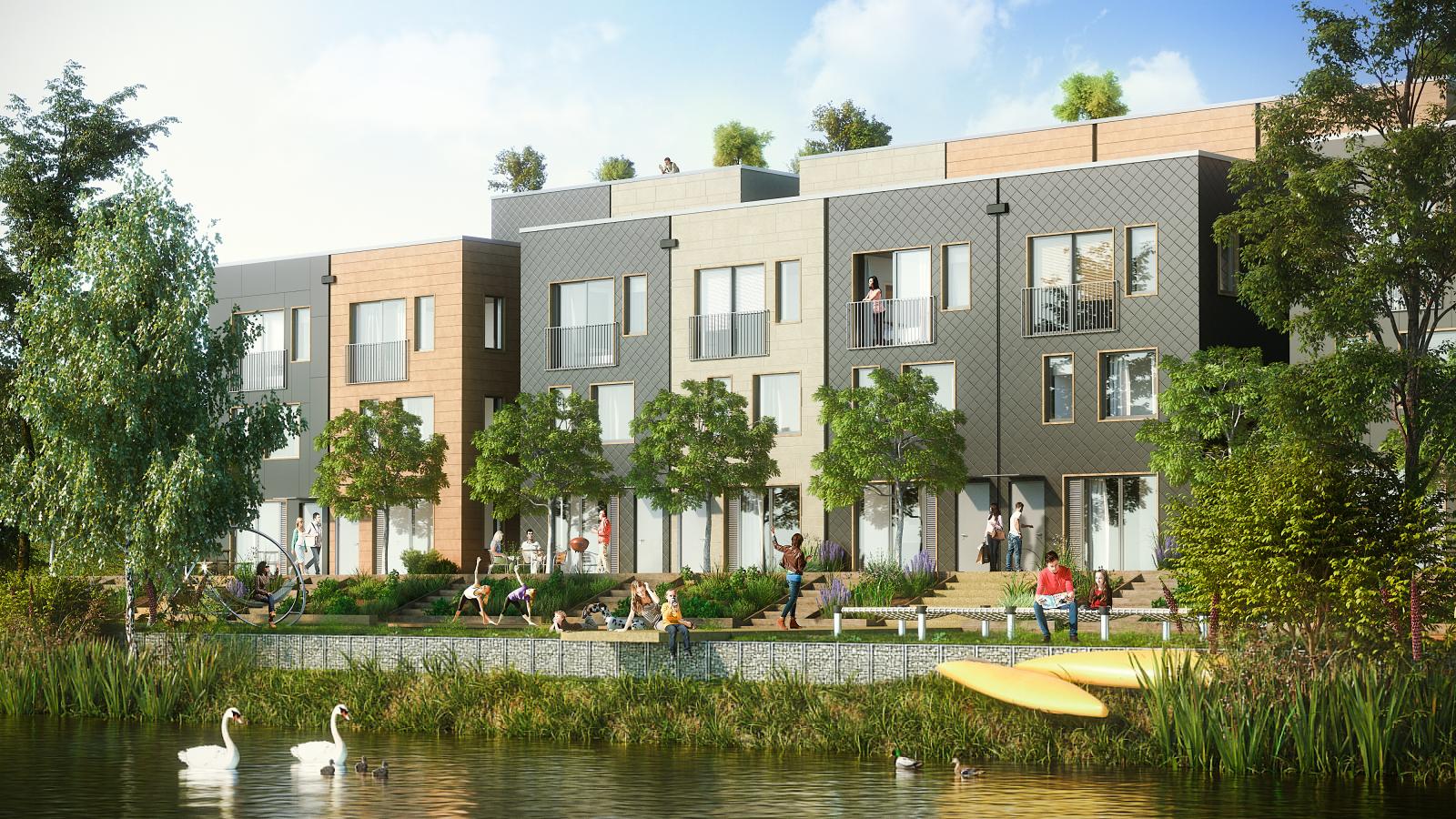
Climate Innovation District (2017)
CITU Group Ltd., retrieved 08/15/2018 from Robert Allen
Overview
Nature-based solution
- Grey infrastructure featuring greens
- Alley or street trees and other street vegetation
- House gardens
- Blue infrastructure
- Riverbank/Lakeside greens
- Parks and urban forests
- Pocket parks/neighbourhood green spaces
- Green areas for water management
- Sustainable urban drainage systems
Key challenges
- Water management (SDG 6)
- Flood protection
- Stormwater and rainfall management and storage
- Green space, habitats and biodiversity (SDG 15)
- Green space creation and/or management
- Regeneration, land-use and urban development
- Promote natural styles of landscape design for urban development
- Health and well-being (SDG 3)
- Creation of opportunities for recreation
Focus
Creation of new green areas, Maintenance and management of urban nature, Transformation of previously derelict areas
Project objectives
-The Climate Innovation District scheme intends to forge collaboration with local and international partners to deliver an exemplar model of how to economically build zero-carbon neighbourhoods that also provide healthier, smarter and better-connected places and cities. (5)
-The infrastructure has been designed to add as much value to the development as possible through enhanced biodiversity and the exemplar Sustainable Urban Drainage System's will see stormwater managed at source, attenuated and conveyed through the functional landscape. This has been designed to add interest and animation, as well as providing the District's necessary drainage function. (3)
-The District is also integrated into green infrastructure and in proximity to surrounding nature. Due to the associated health benefits of green space, the Climate Innovation District is therefore designed to ensure that residents are never far from a green space. (5) It will also lift dwellings above flood risk. (8)
Implementation activities
The first residents occupied homes from early 2017. (1) This constitutes Phase 1 of the development and will consist of 312 homes. This Phase will be manufactured to Passivhaus principles in the factory that Citu have established in Leeds South Bank. The infrastructure has been designed to add as much value to the development as possible through enhanced biodiversity and amenity and the Sustainable Urban Drainage System's exemplar will see stormwater managed at source, attenuated and conveyed through the functional landscape. This has been designed to add interest and animation, as well as providing the necessary drainage function. (3) Phase 2 remains in its planning stage and will respond to flood risk; providing a riverside public garden; reconnect the site and access the river; create low-carbon housing. (4) Final completion of the project is due by 2022. (1)
The scheme is being built on 15 acres of brownfield land in the city’s former industrial heartlands. (1)
Main beneficiaries
- Citizens or community groups
Governance
Management set-up
- Co-governance with government and non-government actors
Type of initiating organisation
- Local government/municipality
- Private sector/corporate actor/company
Participatory approaches/ community involvement
- Crowd-sourcing/Crowd-funding/Participatory budget
Details on the roles of the organisations involved in the project
The scheme is a collaboration with local and international partners. Construction company Citu have installed an on-site manufacturing facility Citu Works, which will manufacture the timber frame housing system for the district’s 516 Passive House homes. Citu has collaborated with the Scandinavian Architectural firm White Arkitekter in the development of the District. Citu also developed the Citu House on the basis of research conducted with Leeds Beckett University and University of Leeds. (5, 6) The building contractor company Sirius are responsible for building the District. Leeds City Region Revolving Investment Fund and Leeds City Region Enterprise Partnership have provided support to the project in the form of loans and grants. (7) Also included are: Bauman Lyons Architects, Ollier Smurthwaite Architects, Gagarin (architects), Civic Engineers (engineering), DP2 (structural engineer), Max Fordham (services engineer), Optima Transport (highways and transport engineer). (9)
Project implemented in response to ...
... an EU policy or strategy?
Unknown
... a national policy or strategy?
Yes
(The National Planning Policy Framework (NPPF) came into force in March 2012 and represents the government’s commitment to sustainable development, through its intention to make the planning system more streamlined, localised and less restrictive. It aims to do this by reducing regulatory burdens and by placing sustainability at the heart of development process. The National Planning Policy Framework (NPPF) sets out the Governments planning policies for England and how these are expected to be applied, only to the extent that it is relevant, proportionate and necessary to do so. The housing application filed in relation to the Climate Innovation District is considered within the context of and legally compelled to oblige the NPPF. (12))
... a local policy or strategy?
Unknown
Financing
Total cost
More than €4,000,000
Source(s) of funding
- Public local authority budget
- Corporate investment
- Crowdfunding
Type of funding
- Earmarked public budget
- Direct funding (grants, subsidies, or self-financed projects by private entities)
- Loan
Non-financial contribution
Unknown
Impacts and Monitoring
Environmental impacts
- Water management and blue areas
- Increased protection against flooding
- Improved stormwater management
- Green space and habitat
- Promotion of naturalistic styles of landscape design for urban development
- Increased green space area
- Reduced biodiversity loss
Economic impacts
- Unknown
Socio-cultural impacts
- Social justice and cohesion
- Improved access to urban green space
Type of reported impacts
Expected impacts, Achieved impacts
Presence of formal monitoring system
Unknown
Presence of indicators used in reporting
No evidence in public records
Presence of monitoring/ evaluation reports
No evidence in public records
Availability of a web-based monitoring tool
No evidence in public records
References
(1) Iqbal, Aisha. (2016). £125m ‘eco village’ plan for Leeds. Source link [Accessed 7 October 2020]
(2) Huddersfield Civic Society. (2017). Leeds Climate Innovation District. [Website unavailable in 2020]
(3) Civic Engineers. (2016). Climate Innovation District, Leeds. Source link [Accessed 7 October 2020]
(4) Northern Design Awards. [no date]. Leeds Climate Innovation District. [Website unavailable in 2020]
(5) White Arkitekter. [no date]. Climate Innovation Source link unavailable in 2020]
(6) The Yorkshire Post. (2017). Can green living thrive in Leeds city centre? Source link [Accessed 7 October 2020]
(7) Hill, Nick. (2016). Work begins on Citu’s £125m Climate Innovation District in Leeds. Source link [Accessed 7 October 2020]
(8) Waite, Richard. (2016). Go-ahead for Ollier Smurthwaite's super-green Leeds housing district. Source link
(9) Rootstock. [no date]. 03.5 Leeds Climate Innovation District. Source link [Accessed on 7 October 2020]
(10) LetLeeds. (2016). Climate Innovation District Plans for Leeds South Bank. [Website Unavailable in 2020]
(11) Source link. (2016). Citu | Low Fold & Clarence Road sites | multiple bldgs up to 16 fl | Site preparation. Source link [Accessed 7 October 2020]
(12) Briggs, C. (2016). Planning application reference 16/02420/FU for a multi-level development comprising 204 dwellings and two commercial units, car parking, landscaping and public realm at Clarence Road, Hunslet, Leeds LS10 1ND. [Document Attached]
(13) Greenland, Rob. (2017). We're not waiting for the govt to solve the housing crisis – we'll do it ourselves. Source link [Accessed 7 October 2020]
(14) White(2020) Climate Innovation District wins Housing Design Award. Source link [Accessed 7 October 2020]
(2) Huddersfield Civic Society. (2017). Leeds Climate Innovation District. [Website unavailable in 2020]
(3) Civic Engineers. (2016). Climate Innovation District, Leeds. Source link [Accessed 7 October 2020]
(4) Northern Design Awards. [no date]. Leeds Climate Innovation District. [Website unavailable in 2020]
(5) White Arkitekter. [no date]. Climate Innovation Source link unavailable in 2020]
(6) The Yorkshire Post. (2017). Can green living thrive in Leeds city centre? Source link [Accessed 7 October 2020]
(7) Hill, Nick. (2016). Work begins on Citu’s £125m Climate Innovation District in Leeds. Source link [Accessed 7 October 2020]
(8) Waite, Richard. (2016). Go-ahead for Ollier Smurthwaite's super-green Leeds housing district. Source link
(9) Rootstock. [no date]. 03.5 Leeds Climate Innovation District. Source link [Accessed on 7 October 2020]
(10) LetLeeds. (2016). Climate Innovation District Plans for Leeds South Bank. [Website Unavailable in 2020]
(11) Source link. (2016). Citu | Low Fold & Clarence Road sites | multiple bldgs up to 16 fl | Site preparation. Source link [Accessed 7 October 2020]
(12) Briggs, C. (2016). Planning application reference 16/02420/FU for a multi-level development comprising 204 dwellings and two commercial units, car parking, landscaping and public realm at Clarence Road, Hunslet, Leeds LS10 1ND. [Document Attached]
(13) Greenland, Rob. (2017). We're not waiting for the govt to solve the housing crisis – we'll do it ourselves. Source link [Accessed 7 October 2020]
(14) White(2020) Climate Innovation District wins Housing Design Award. Source link [Accessed 7 October 2020]