

Last updated: October 2021
A greening project in Laval aimed to replace impermeable surfaces such as asphalt with vegetation. This process would allow water to infiltrate the soil on a surface area of 3000 square meters and plant 7200 plants on land located near or inside urban heat island zones of the city (Ref. 1,2,3,7). The project takes an integrated approach to mitigate the impact of urban heat islands, which make up 12-13% of the territory in Laval (Ref. 1,7). Particular focus of this project is placed on planting on sites of vulnerable communities (Ref. 1,3).

Demineralization and Greening of Laval
Source: Ref. 11, Sophie Poliquin
Overview
Nature-based solution
- Grey infrastructure featuring greens
- Alley or street trees and other street vegetation
- Green areas for water management
- Sustainable urban drainage systems
- Other
Key challenges
- Climate action for adaptation, resilience and mitigation (SDG 13)
- Climate change adaptation
- Water management (SDG 6)
- Stormwater and rainfall management and storage
- Green space, habitats and biodiversity (SDG 15)
- Habitat and biodiversity conservation
- Green space creation and/or management
- Environmental quality
- Air quality improvement
- Social justice, cohesion and equity (SDG 10)
- Environmental and climate justice
Focus
Creation of new green areas, Knowledge creation and awareness raising
Project objectives
‘The project aims to reduce the community’s vulnerability to heatwaves and increase the city’s canopy index’ (Ref. 7), through the replacement of impermeable surfaces such as asphalt with vegetation. This process would also allow water to infiltrate the soil on a large surface area (3000 square meters) on an area located near or inside urban heat island zones of the city (Ref. 1,2,3,7).
Additionally, the project aimed to document the effectiveness of greening on the reduction of ambient outdoor temperature and on urban heat islands, to assess the impacts of the project in terms of adaptation to climate change (Ref. 1,7).
This particular project also aimed at targeting populational areas particularly vulnerable or exposed to heatwaves (Ref. 13), in order to effectively protect vulnerable communities (Ref. 1).
This project is also in line with an effort to "Promote the resilience of natural environments in the face of climate change; protect biodiversity; favor the quality of life of the Laval population" as part of the Laval 2035 strategic vision: Urban by nature ." (Ref 12.)
Implementation activities
‘At the start of the project, [the City] approached large organizations in the health and education networks (CISSS de Laval, Laval School Services Center and Sir Wilfrid Laurier School Board). Each of them gave [the City] a list of potential establishments. [The City] analyzed each site according to two criteria, namely the presence of urban heat islands and the population's vulnerability index to heat waves’ (Ref. 13). The Université du Québec à Montréal, the public health directorate of Laval and OURANOS lent their expertise to targeting priority sites in order to effectively protect vulnerable populations (Ref. 1).
Owners of private and institutional land were allowed to benefit from a cost reduction of up to 60% (Ref. 7,12).
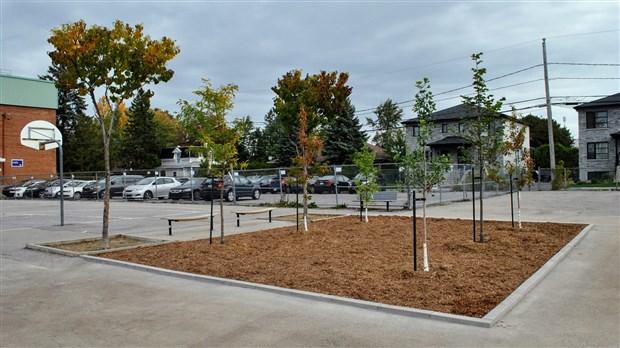
After the sites were selected, the City conducted a field visit with stakeholders to assess the demineralization and greening potentials. For each project, development plans were created and took into account the constraints, needs, and future intentions of the sites. ‘For example, for the development of schoolyards, [the City] questioned the management, as well as the environmental committees in place, to know the current and projected use of the yard. In schools, each demineralization project was different to meet different needs (natural air conditioning at the edge of a building, creation of shaded areas in the middle of the courtyard, planting of trees with a view to create a green classroom , etc.)’ (Ref. 13).
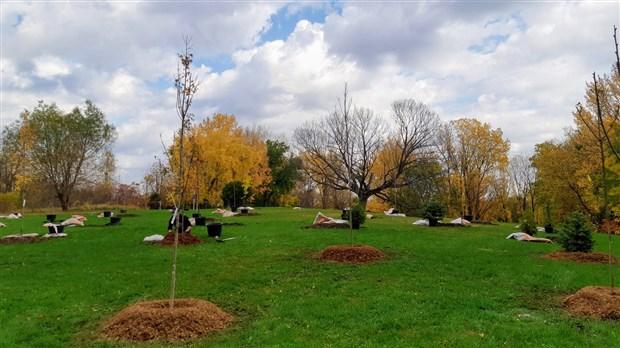
In 2020, 3000 square meters of asphalt were removed, and 6400 trees were planted at over 30 locations, including 15 schoolyards, 7 health centres, 5 private or institutional establishments, and 10 municipal sites (Ref. 6,7,8). Air temperature sensors were installed and 140,000 air temperature measurements were taken on sites vulnerable to heat islands as part of a study conducted by UQAM (Université du Québec à Montréal) (Ref. 8)
During the projects, a large variety of tree species were planted and Soverdi remains involved in the project until 2022 to ensure the monitoring and maintenance of the plants. (Ref. 11).
Climate-focused activities
Climate change adaptation:
- Increase or improve urban vegetation cover to help reduce outdoor temperature
- Implement sustainable urban drainage infrastructure (e.g. to make space for water)
Biodiversity conservation or restoration-focused activities
Biodiversity conservation:
- Protect species
- Undertake specific measures to protect species
Main beneficiaries
- Local government/Municipality
- Public sector institution (e.g. school or hospital)
- Citizens or community groups
- Marginalized groups: Socio-economically disadvantaged populations (e.g. low-income households, unemployed)
Governance
Management set-up
- Co-governance with government and non-government actors
Type of initiating organisation
- Local government/municipality
Participatory approaches/ community involvement
- Unknown
Details on the roles of the organisations involved in the project
The City of Laval (local government) was in charge of implementing the project. The Federation of Canadian Municipalities (regional advocacy network) and the Government of Canada (national government) were the primary funders of the project (Ref. 1,2). Other funding came from the Laval School Service Center, the Sir Wilfrid Laurier School Board, and the Laval Integrated Health and Social Services Center (Ref. 11). Additionally, donations were provided by Crœsus (private sector) and the TD Bank Group (private sector) (Ref. 6). The tree planting aspects of the project implementation were supported by Société de verdissement du Montréal métropolitain (Soverdi) (NGO), Canopée (local organization), and PlantAction (NGO) (Ref. 1,4,7). Additionally, the project implantation was supported by Université du Québec à Montréal (university), the public health directorate of Laval (local government) and OURANOS (NGO) to target priority sites in order to effectively protect vulnerable populations (Ref. 1).
Project implemented in response to ...
... an EU policy or strategy?
No
... a national policy or strategy?
Unknown
... a local policy or strategy?
Yes
(City of Laval’s 2016-2020 Climate Change Adaptation Plan (Ref. 2,3))
Financing
Total cost
€500,000 - €2,000,000
Source(s) of funding
- Public national budget
- Public local authority budget
- Corporate investment
- Other
Type of funding
- Earmarked public budget
- Direct funding (grants, subsidies, or self-financed projects by private entities)
- Donations
Non-financial contribution
Unknown
Impacts and Monitoring
Environmental impacts
- Climate change
- Lowered local temperature
- Green space and habitat
- Increased green space area
- Increased number of species present
Economic impacts
- Unknown
Socio-cultural impacts
- Social justice and cohesion
- Improved liveability
- Education
- Increased awareness of NBS and their benefits
Type of reported impacts
Achieved impacts
Presence of formal monitoring system
Yes
Presence of indicators used in reporting
Yes
Presence of monitoring/ evaluation reports
No evidence in public records
Availability of a web-based monitoring tool
No evidence in public records
References
1. Infrastructure Canada. (2019). Backgrounder: Four projects to enhance climate change resiliency in the Greater Montreal area. Government of Canada. Available at: Source link [Accessed: 21 September 2021].
2. Ceausu, J. (2019). Laval meets 63% of climate adaptation scorecard at mid-term. The Suburban. Available at: Source link [Accessed: 21 September 2021].
3. Natural Environments Division. (2019). BILAN 2016-2017-2018 ADAPTATION AUX CHANGEMENTS CLIMATIQUES DE LA VILLE DE LAVAL. [Report 2016-2017-2018 Adaptation to Climate Change in the City of Laval]. Retrieved from: Source link [Document provided].
4. Ville de Laval. (2020). Vivre à Laval: Municipal news bulletin – Spring 2020. Ville de Laval. Retrieved from: Source link [Document provided].
5. Bakoyannis, G. (2020). More trees expected to grow in City of Laval. Laval News. Available at: Source link [Accessed: 21 September 2021].
6. Ville de Laval. (2020). Vivre à Laval: Municipal news bulletin – Winter 2020-2021. Ville de Laval. Retrieved from: Source link [Document provided].
7. Ville de Laval. (2021). Projets de déminéralisation et verdissement des terrains privés et institutionnels [Demineralization and greening projects for private and institutional land]. Ville de Laval. Available at: Source link [Accessed: 21 September 2021].
8. Ville de Laval. (2020). Déminéralisation et verdissement Bilan 2020 [Demineralization and greening – 2020 Review]. Ville de Laval. Retrieved from: Source link [Document provided].
9. Ville de Laval. (n.d.). Liste des sites de plantation [List of planting sites]. Ville de Laval. Retrieved from: Source link [Document provided].
10. Ville de Laval. (2021). Arbres [Trees]. Ville de Laval. Available at: Source link [Accessed: 22 September 2021].
11. L’Echo de Laval. (2020). Lutte aux îlots de chaleur : projet majeur de déminéralisation et de verdissement à Laval [Fight against heat islands: major demineralization and greening project in Laval]. L’Echo de Laval. Available at: Source link [Accessed: 22 September 2021].
12. Le pointeur. (2021). Laval: Urbaine de nature et humaine de culture. [Laval: Urban by nature and human by culture]. Ministry of Health and Social Services and the Ministry of Education and Higher Education. Available at: Source link [Accessed: 25 September 2021].
13. Répert'eau. (2021). Une bonne pratique sur Répert'eau : Projets de déminéralisation et verdissement des terrains privés et institutionnels de Laval [A good practice on Répert'eau: Demineralization and greening projects for private and institutional land in Laval]. Répert'eau. Available at: Source link [Accessed: 25 September 2021].
2. Ceausu, J. (2019). Laval meets 63% of climate adaptation scorecard at mid-term. The Suburban. Available at: Source link [Accessed: 21 September 2021].
3. Natural Environments Division. (2019). BILAN 2016-2017-2018 ADAPTATION AUX CHANGEMENTS CLIMATIQUES DE LA VILLE DE LAVAL. [Report 2016-2017-2018 Adaptation to Climate Change in the City of Laval]. Retrieved from: Source link [Document provided].
4. Ville de Laval. (2020). Vivre à Laval: Municipal news bulletin – Spring 2020. Ville de Laval. Retrieved from: Source link [Document provided].
5. Bakoyannis, G. (2020). More trees expected to grow in City of Laval. Laval News. Available at: Source link [Accessed: 21 September 2021].
6. Ville de Laval. (2020). Vivre à Laval: Municipal news bulletin – Winter 2020-2021. Ville de Laval. Retrieved from: Source link [Document provided].
7. Ville de Laval. (2021). Projets de déminéralisation et verdissement des terrains privés et institutionnels [Demineralization and greening projects for private and institutional land]. Ville de Laval. Available at: Source link [Accessed: 21 September 2021].
8. Ville de Laval. (2020). Déminéralisation et verdissement Bilan 2020 [Demineralization and greening – 2020 Review]. Ville de Laval. Retrieved from: Source link [Document provided].
9. Ville de Laval. (n.d.). Liste des sites de plantation [List of planting sites]. Ville de Laval. Retrieved from: Source link [Document provided].
10. Ville de Laval. (2021). Arbres [Trees]. Ville de Laval. Available at: Source link [Accessed: 22 September 2021].
11. L’Echo de Laval. (2020). Lutte aux îlots de chaleur : projet majeur de déminéralisation et de verdissement à Laval [Fight against heat islands: major demineralization and greening project in Laval]. L’Echo de Laval. Available at: Source link [Accessed: 22 September 2021].
12. Le pointeur. (2021). Laval: Urbaine de nature et humaine de culture. [Laval: Urban by nature and human by culture]. Ministry of Health and Social Services and the Ministry of Education and Higher Education. Available at: Source link [Accessed: 25 September 2021].
13. Répert'eau. (2021). Une bonne pratique sur Répert'eau : Projets de déminéralisation et verdissement des terrains privés et institutionnels de Laval [A good practice on Répert'eau: Demineralization and greening projects for private and institutional land in Laval]. Répert'eau. Available at: Source link [Accessed: 25 September 2021].
Demineralization and Greening of Laval
Source: Ref. 11, TD Bank Group
Source: Ref. 11, TD Bank Group

Source: Ref. 11, TD Bank Group

Source: Ref. 11, TD Bank Group

Demineralization and Greening of Laval
Source: Ref. 11, TD Bank Group

Source: Ref. 11, TD Bank Group
Information about this nature-based solution was collected as part of the UNA global extension project funded by the British Academy.