

Last updated: October 2021
The project resulted in new greenery (shrubs and various types of vines) at acoustic screens on two busy streets (Grota-Roweckiego and Bobrzyńskiego) in Kraków. It used over a dozen species of ivy, vines and shrubs, which would lushly cover the screens, absorb the dust and help to fight city smog in a span of a few years. The initiative was implemented with the help of the citizens – residents and employees of surrounding companies, who planted the greenery under the experts' supervision [1,2]. The pilot project was implemented in 2016, whereas the main project is still ongoing with an aim to cover more screens across the city [1,3].

Green Acoustic Screens by Grota-Roweckiego Street
Katarzyna Przyjemska-Grzesik („Cracow in Green” Team), retrieved 0/15/2018
Overview
Nature-based solution
- Nature on buildings (external)
- Green walls or facades
- Other
- Grey infrastructure featuring greens
- Alley or street trees and other street vegetation
Key challenges
- Green space, habitats and biodiversity (SDG 15)
- Green space creation and/or management
- Environmental quality
- Air quality improvement
- Inclusive and effective governance (SDG 16)
- Inclusive governance
Focus
Creation of new green areas, Other
Project objectives
1) To improve the local quality of air by busy roads protected by screens;
2) To radically enhance the perception of the whole district;
3) To provide a natural solution to absorb dust and pollution;
4) To engage the local community in the implementation [4].
Implementation activities
1. Planting over a dozen species of ivy, vines and shrubs on the acoustic screens along the communication lines in the city [4].
2. During the pilot stage of the project, 1,5 km of the acoustic screens were covered with around a thousand seedlings. As soon as they grow, one square meter of such plants will be able to absorb up to 6 grams of harmful dust from the air per day [5].
Main beneficiaries
- Citizens or community groups
Governance
Management set-up
- Co-governance with government and non-government actors
Type of initiating organisation
- Local government/municipality
- Citizens or community group
Participatory approaches/ community involvement
- Co-planning (e.g. stakeholder workshops, focus groups, participatory mapping)
- Crowd-sourcing/Crowd-funding/Participatory budget
- Consultation (e.g. workshop, surveys, community meetings, town halls)
- Joint implementation (e.g. tree planting)
Details on the roles of the organisations involved in the project
The citizens' group developed the project proposal and applied for funding from the participatory city budget. The local citizens' initiatives were also involved in the project's implementation - both during its pilot and main stages (the latter with the supervision of the city's urban green management body) [1,3].
Project implemented in response to ...
... an EU policy or strategy?
Unknown
... a national policy or strategy?
Unknown
... a local policy or strategy?
Yes
(All the projects submitted to the Cracow participatory budget have to be compatible with the statue of the city district in which they would be implemented, as well as with the city plans, policies and programs (including spatial development plans, City Council resolutions and decrees of the city mayor), with law (including property rights law), and they have to be implemented on the lands belonging to the municipality.(8)
Additionally, this particular initiative is referred to as a part of a bigger plan to plant dust-absorbing greens along the communication lines in Cracow.(2)
)
Financing
Total cost
€10,000 - €50,000
Source(s) of funding
- Public local authority budget
Type of funding
- Earmarked public budget
Non-financial contribution
Type of non-financial contribution
- Provision of labour
Who provided the non-financial contribution?
- Citizens (e.g. volunteering)
Impacts and Monitoring
Environmental impacts
- Environmental quality
- Improved air quality
- Reduced noise exposure
- Green space and habitat
- Promotion of naturalistic styles of landscape design for urban development
Economic impacts
- Unknown
Socio-cultural impacts
- Social justice and cohesion
- Increased involvement of locals in the management of green spaces
Type of reported impacts
Expected impacts, Achieved impacts
Presence of formal monitoring system
Yes
Presence of indicators used in reporting
No evidence in public records
Presence of monitoring/ evaluation reports
Yes
Availability of a web-based monitoring tool
No evidence in public records
References
1. City council projects' progress webpage,(2017) 'State of implementation of projects from the III edition of the participatory budget' ('Stan realizacji zadań III edycji budżetu obywatelskiego'), Source link (Accessed: 29 August 2020).
2.Online article on Source link, (2016), 'Plants will help to fight the smog' ('Rośliny pomogą walczyć z pyłami'),Source link (Accessed: 29 August 2020).
3. Source link, 'Local Initiative Let's plant Screens - sample profile' ('Inicjatywa Lokalna Wysadzamy Ekrany - profil przykładowy'),
Source link (Accessed: 29 August 2020).
4. Source link, (2016) 'Civic budget project 2016 - planting greenery' ('Projekt do Budżetu Obywatelskiego 2016 - nasadzenia roślin'), Source link Accessed: 20 July 2017). Link not available in 2020.
5. Gruca., J., 'Green screens will be planted to dimish smog' ('Obsadzają ekrany by zmniejszyć smog'), Source link (Accessed: 29 August 2020).
6. Rąpalski,P., (2016) 'Cracow: plants that will help to fight smog' ('Kraków. Rośliny pomogą w walce ze smogiem'), Source link (Accessed: 29 August 2020).
7. Gurgul, A., (2016), 'They plant acoustic screens on Ruczaj. To absorb dust' ('Obsadzą roślinami ekrany akustyczne na Ruczaju. By chłonęły pyły'), Source link (Accessed: 29 August 2020).
8.(See attachment) 'RESOLUTION NO. XXXIV / 566/15 CITY COUNCIL OF KRAKOW December 16, 2015 On the Regulations of Citizens' Budget of the City of Cracow' ('UCHWAŁA NR XXXIV/566/15 RADY MIASTA KRAKOWA z dnia 16 grudnia 2015 r. w sprawie Regulaminu budżetu obywatelskiego Miasta Krakowa')
2.Online article on Source link, (2016), 'Plants will help to fight the smog' ('Rośliny pomogą walczyć z pyłami'),Source link (Accessed: 29 August 2020).
3. Source link, 'Local Initiative Let's plant Screens - sample profile' ('Inicjatywa Lokalna Wysadzamy Ekrany - profil przykładowy'),
Source link (Accessed: 29 August 2020).
4. Source link, (2016) 'Civic budget project 2016 - planting greenery' ('Projekt do Budżetu Obywatelskiego 2016 - nasadzenia roślin'), Source link Accessed: 20 July 2017). Link not available in 2020.
5. Gruca., J., 'Green screens will be planted to dimish smog' ('Obsadzają ekrany by zmniejszyć smog'), Source link (Accessed: 29 August 2020).
6. Rąpalski,P., (2016) 'Cracow: plants that will help to fight smog' ('Kraków. Rośliny pomogą w walce ze smogiem'), Source link (Accessed: 29 August 2020).
7. Gurgul, A., (2016), 'They plant acoustic screens on Ruczaj. To absorb dust' ('Obsadzą roślinami ekrany akustyczne na Ruczaju. By chłonęły pyły'), Source link (Accessed: 29 August 2020).
8.(See attachment) 'RESOLUTION NO. XXXIV / 566/15 CITY COUNCIL OF KRAKOW December 16, 2015 On the Regulations of Citizens' Budget of the City of Cracow' ('UCHWAŁA NR XXXIV/566/15 RADY MIASTA KRAKOWA z dnia 16 grudnia 2015 r. w sprawie Regulaminu budżetu obywatelskiego Miasta Krakowa')
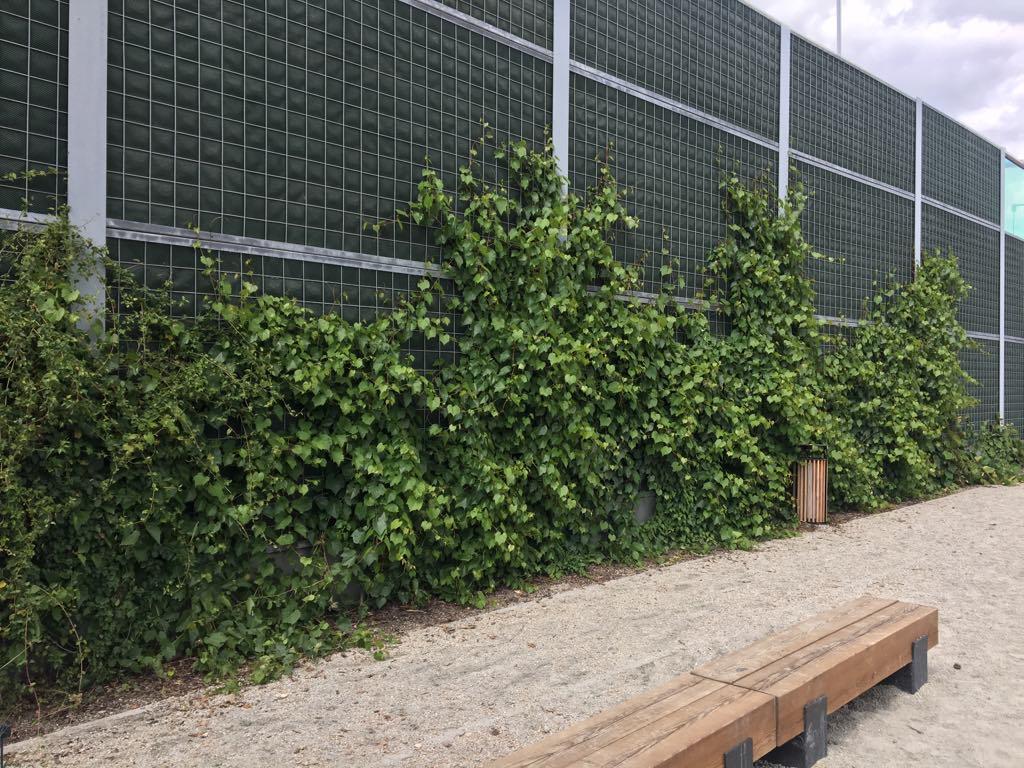
Green Acoustic Screens by Grota-Roweckiego Street
Katarzyna Przyjemska-Grzesik („Cracow in Green” Team), retrieved 0/15/2018

Green Acoustic Screens by Grota-Roweckiego Street
Katarzyna Przyjemska-Grzesik („Cracow in Green” Team), retrieved 0/15/2018