

Last updated: October 2021
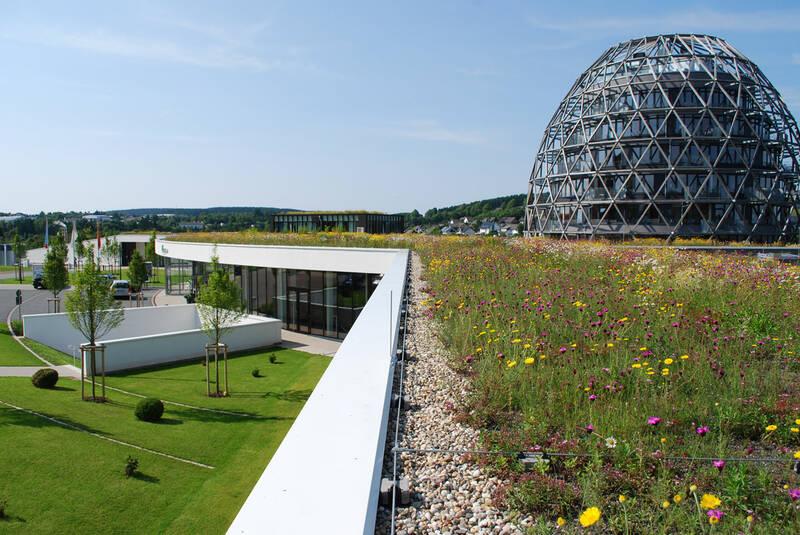
The renewal of the 220 sqm roof terrace of the Ministry of the Environment in 2010 focused on improving the thermal insulation of the building and the remaking of its green roof. The project was planned by the city council’s department for urban nature in collaboration with a landscape architect and implemented by a professional outdoor greening company (Ref. 2). The green roof won the award “green roof of the year 2013” and is also actively promoted as a model for green roofs, frequently shown to international guests of the Ministry. (Ref. 1).
"NATURAL ROOF" GREEN ROOF
Source:https://www.optigruen.de/systemloesungen/naturdach/systemaufbau/
Overview
Nature-based solution
- Nature on buildings (external)
- Green roofs
- Grey infrastructure featuring greens
- Institutional green space
Key challenges
- Water management (SDG 6)
- Stormwater and rainfall management and storage
- Green space, habitats and biodiversity (SDG 15)
- Habitat and biodiversity conservation
- Green space creation and/or management
- Health and well-being (SDG 3)
- Creation of opportunities for recreation
Focus
Creation of new green areas
Project objectives
Absorption of rainwater and efficiently use it for plant watering. (Ref. 1)
Creating a space for biodiversity and habitat creation, especially for small animals (Ref. 1)
Creating recreational green spaces that are used by employees while requiring minimal maintenance (Ref. 2)
Implementation activities
The regreening of the roof was performed by a professional gardening company called “Garten Moser”, making use of the „Optigrün System 2010”. The surface area was discerned into different green areas combining different vegetation patches with leisure, recreation areas and canopy walks. As the green roof has several layers with up to 20cm of substrate base underneath, vegetation suitable for an intensive green roof was planted. There is a large variety of more than 50 types of plants, which includes hedges, trees and herbs. These plant types were strategically selected for their rainwater retention capacity. In addition to the species-rich vegetation, different habitats for small animals were created by means of dry-stone walls and stone beds consisting of shell limestone and deadwood. The garden is used by all employees from different companies and institutions in the building as a recreational and meeting area. (Ref. 1).
Biodiversity conservation or restoration-focused activities
Biodiversity conservation:
- Protect and enhance urban habitats
- Create new habitats
- Protect species
- Undertake specific measures to protect species
Main beneficiaries
- Public sector institution (e.g. school or hospital)
- Private sector/Corporate/Company
- Other
Governance
Management set-up
- Government-led
Type of initiating organisation
- Public sector institution
Participatory approaches/ community involvement
- Unknown
Details on the roles of the organisations involved in the project
The project was initiated by the Federal Ministry of Environment, planned by the city council’s department for urban green and parks in collaboration with a landscape architect, and implemented by a professional outdoor greening company (Ref. 2)
Project implemented in response to ...
... an EU policy or strategy?
Unknown
... a national policy or strategy?
Unknown
... a local policy or strategy?
Unknown
Financing
Total cost
€10,000 - €50,000
Source(s) of funding
- Public local authority budget
Type of funding
- Direct funding (grants, subsidies, or self-financed projects by private entities)
Non-financial contribution
Unknown
Impacts and Monitoring
Environmental impacts
- Green space and habitat
- Increased green space area
- Increased number of species present
Economic impacts
- Unknown
Socio-cultural impacts
- Health and wellbeing
- Gain in activities for recreation and exercise
Type of reported impacts
Achieved impacts
Presence of formal monitoring system
No
Presence of indicators used in reporting
No
Presence of monitoring/ evaluation reports
No
Availability of a web-based monitoring tool
No
References
1. Fachvereinigung Bauwerksbegrünung e.V. (FBB) (2015) Pressemitteilungen Dachbegrünung. Artenreiche Extensivbegrünung FBB-Gründach des Jahres 2013. Available at: Source link 25 Oct. 2020].
2. Widmann, B. (2015) Umweltamt Karlsruhe - Dachbegrünung Projektdaten. Karlsruhe.
3. n.a. (2015) ‘Übersichtsplan Dachbegrünung Umweltamt Karlsruhe’. Karlsruhe: Umweltamt Karlsruhe.
4. Stadt Karlsruhe (2016) Grüne Höfe, Dächer und Fassaden für Karlsruhe. Available at: Source link 25 Oct. 2020].
5. Optigrün International AG (2017) Dachbegrünung „Naturdach“ Lösung 1: 0 - 5° (mit mit Drän- und Wasserspeicherelement). Available at: Source link 25 Oct. 2020].
2. Widmann, B. (2015) Umweltamt Karlsruhe - Dachbegrünung Projektdaten. Karlsruhe.
3. n.a. (2015) ‘Übersichtsplan Dachbegrünung Umweltamt Karlsruhe’. Karlsruhe: Umweltamt Karlsruhe.
4. Stadt Karlsruhe (2016) Grüne Höfe, Dächer und Fassaden für Karlsruhe. Available at: Source link 25 Oct. 2020].
5. Optigrün International AG (2017) Dachbegrünung „Naturdach“ Lösung 1: 0 - 5° (mit mit Drän- und Wasserspeicherelement). Available at: Source link 25 Oct. 2020].

"NATURAL ROOF" GREEN ROOF
Source:https://www.optigruen.de/systemloesungen/naturdach/systemaufbau/