

Last updated: October 2021
This NBS refers to a curtain protection forest that was planted 6 km out of the city of Iasi in 2015 by the mayor of a commune next to the city. The benefits of this NBS embrace also the city of Iasi as a method to prevent flooding and to avoid strong winds in the area. Afforestation was seen also as a response to the existence of arid soil and abandoned crop fields in the area due to a large population movement of immigration towards Western countries (1)
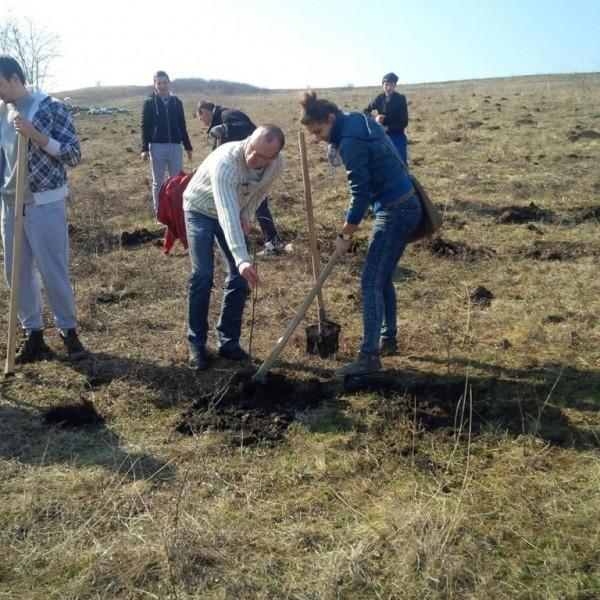
Implementation stage of the NBS
https://s1.ziareromania.ro/?mmid=6abcf1e0c1f28fb4b0
Overview
Nature-based solution
- Parks and urban forests
- Green corridors and green belts
Key challenges
- Climate action for adaptation, resilience and mitigation (SDG 13)
- Climate change adaptation
- Water management (SDG 6)
- Flood protection
- Green space, habitats and biodiversity (SDG 15)
- Green space creation and/or management
- Environmental quality
- Air quality improvement
- Soil quality improvement
- Health and well-being (SDG 3)
- Creation of opportunities for recreation
Focus
Creation of new green areas, Transformation of previously derelict areas
Project objectives
1. The protection curtains is a rich source of industrial and food products (fruits, mushrooms, medicinal and bee products), improves living conditions, purifies the air, tame the climate, beautifies the landscape and improves the water regime;
2. To prevent landslides;
3. To prevent floods;
4. To improve air quality;
5. To increase green surfaces which will have an important role in the sustainable development of communities that are bordering the city, contributing to a better microclimate, by reducing wind speed, improving conditions for growth and development of crops, reducing erosion;
6. Increases soil water reserves, improves daily temperature by amplitude reduction;
7. Trees and shrubs of the forest curtains attenuate noise. (1, 4)
Implementation activities
The volunteers started to plant first grade seedlings/acacia trees in March of 2015 in order to have clean air, and secondly to stop landfall. 500 trees were planted and they hoped that this action will have an effect on all young people and trees will continue to be planted. (3)
Climate-focused activities
Climate change adaptation:
- Increase or improve urban vegetation cover to help reduce outdoor temperature
- Create or improve outdoor spaces to help people escape from urban heat
Main beneficiaries
- Local government/Municipality
- Citizens or community groups
Governance
Management set-up
- Government-led
Type of initiating organisation
- Local government/municipality
Participatory approaches/ community involvement
- Joint implementation (e.g. tree planting)
Details on the roles of the organisations involved in the project
This NBS has been initiated by the Miroslava commune with the help of local volunteers. (3)
Project implemented in response to ...
... an EU policy or strategy?
Unknown
... a national policy or strategy?
Yes
(This NBS is in connection with Law 100/2010 on the afforestation of degraded lands. (5))
... a local policy or strategy?
Yes
(This NBS was mentioned in the "Sustainable Development Strategy of Miroslava commune for 2014-2020", a plan that describes the intervention and its expected outcomes (5) )
Financing
Total cost
Unknown
Source(s) of funding
- Public national budget
Type of funding
- Direct funding (grants, subsidies, or self-financed projects by private entities)
Non-financial contribution
Type of non-financial contribution
- Provision of land
- Provision of goods
- Provision of labour
- Provision of expertise
Who provided the non-financial contribution?
- Public authorities (e.g. land, utility services)
- Citizens (e.g. volunteering)
Impacts and Monitoring
Environmental impacts
- Environmental quality
- Improved soil quality
- Water management and blue areas
- Increased protection against flooding
Economic impacts
- Unknown
Socio-cultural impacts
- Unknown
Type of reported impacts
Expected impacts, No impacts reported
Presence of formal monitoring system
Unknown
Presence of indicators used in reporting
No evidence in public records
Presence of monitoring/ evaluation reports
No evidence in public records
Availability of a web-based monitoring tool
No evidence in public records
References
1. Ziarul de Iasi (2015), Mii de puieţi de salcâm, plantaţi pe versanţii de la Miroslava. Vor fi perdea de protecţie, Available at Source link (Accessed 23-8-2020)
2. Primaria Miroslava, PROIECTELE REALIZATE SI IN CURS DE REALIZARE IN COMUNA MIROSLAVA, JUDETUL IASI - 2015, Available at Source link (Accessed 23-8-2020)
3. TopIasi (2015), Perdea verde de protectie la Miroslava, Available at Source link, (Accessed 23-8-2020)
4. Scientific Papers Series Management, Economic Engineering in Agriculture and Rural Development, Vol. 15, Issue 4, 2015, IMPROVING ROMANIA’S GREEN COVER BY PLANTING FOREST PROTECTION CURTAINS, IN THE CONTEXT OF CURRENT CLIMATE CHANGES, Available at Source link (Accessed 23-8-2020)
5. Primaria Miroslava, "Sustainable Development Strategy of Miroslava commune for 2014-2020", (Website not available in 2020)
6. Ministerul Padurilor si Apelor, Programe de Mediu, Available at Source link, (Accessed 23-8-2020)
2. Primaria Miroslava, PROIECTELE REALIZATE SI IN CURS DE REALIZARE IN COMUNA MIROSLAVA, JUDETUL IASI - 2015, Available at Source link (Accessed 23-8-2020)
3. TopIasi (2015), Perdea verde de protectie la Miroslava, Available at Source link, (Accessed 23-8-2020)
4. Scientific Papers Series Management, Economic Engineering in Agriculture and Rural Development, Vol. 15, Issue 4, 2015, IMPROVING ROMANIA’S GREEN COVER BY PLANTING FOREST PROTECTION CURTAINS, IN THE CONTEXT OF CURRENT CLIMATE CHANGES, Available at Source link (Accessed 23-8-2020)
5. Primaria Miroslava, "Sustainable Development Strategy of Miroslava commune for 2014-2020", (Website not available in 2020)
6. Ministerul Padurilor si Apelor, Programe de Mediu, Available at Source link, (Accessed 23-8-2020)