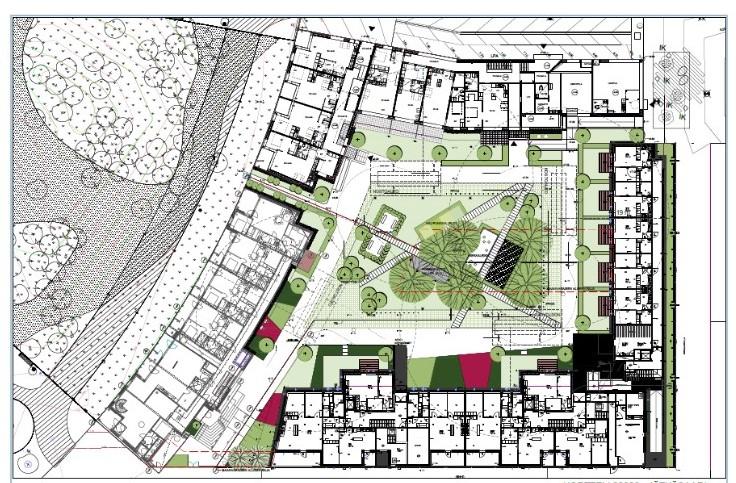
To test the newly developed Green Factor Tool for the City of Helsinki, with a focus on water management, two test sites (ätkäsaari pilot block and the three model yards in Kuninkaantammi) were created at residential blocks in Jätkäsaari and Kuninkaantammi. The tool itself is an Excel interface that calculates the quantity and quality of the city's green spaces per unit of area, It is part of the larger iWATER (integrated stormwater management) project (Ref 2). Specifically, after testing it on these two pilot sites, it is to support land use planning processes by providing a way to account for the quantity and quality of green space. The project aimed to analyze the cost-benefit of implemented sustainable stormwater solutions, compile stormwater-related planning tools as well as increase and strengthen the capacity of cities to work with stormwater issues (ref. 2). One of the key objectives of developing the green factor method was to create green urban environments that have social value. Also, functionality was the second most important and cityscape (or landscape value) was the third most important category in green factor scoring.

Overview
Nature-based solution
- Nature on buildings (external)
- Green roofs
- Green walls or facades
- Grey infrastructure featuring greens
- House gardens
- Green parking lots
- Community gardens and allotments
- Community gardens
- Blue infrastructure
- Lakes/ponds
- Coastal wetland, mangroves and salt marshes
- Green areas for water management
- Rain gardens
- Swales and filter strips
Key challenges
- Climate action for adaptation, resilience and mitigation (SDG 13)
- Climate change adaptation
- Water management (SDG 6)
- Flood protection
- Stormwater and rainfall management and storage
- Green space, habitats and biodiversity (SDG 15)
- Habitat and biodiversity conservation
- Green space creation and/or management
Focus
Project objectives
Implementation activities
Climate-focused activities
Climate change adaptation:
- Increase or improve urban vegetation cover to help reduce outdoor temperature
- Implement green walls or roofs to lower indoor temperature and provide insulation
- Restore wetlands and/or coastal ecosystems to dissipate the effects of flooding and/or storms
- Implement sustainable urban drainage infrastructure (e.g. to make space for water)
Biodiversity conservation or restoration-focused activities
Biodiversity conservation:
- Protect and enhance urban habitats
- Preserve and strengthen existing habitats and ecosystems
- Create new habitats
- Preserve and strengthen habitat connectivity
- Reduce negative impacts and avoid the alteration/damage of ecosystem
- Protect species
- Undertake specific measures to protect species
- Undertake specific measures to protect native species
- Undertake specific measures to protect endangered species
Biodiversity restoration:
- Rehabilitate and restore damaged or destroyed ecosystems
- Restore species (native, endangered, or unspecified)
- Restore native species
- Restore endangered species
- Restore ecological connectivity
Main beneficiaries
- Local government/Municipality
- Private sector/Corporate/Company
- Citizens or community groups
Governance
Management set-up
- Government-led
Type of initiating organisation
- Local government/municipality
Participatory approaches/ community involvement
- Unknown
Details on the roles of the organisations involved in the project
Project implemented in response to ...
Financing
Total cost
Source(s) of funding
- EU funds
- Public regional budget
- Public local authority budget
Type of funding
- Direct funding (grants, subsidies, or self-financed projects by private entities)
Non-financial contribution
Impacts and Monitoring
Environmental impacts
- Climate change
- Lowered local temperature
- Enhanced carbon sequestration
- Water management and blue areas
- Increased protection against flooding
- Improved stormwater management
- Green space and habitat
- Increased green space area
- Increased number of species present
- Enhanced support of pollination
Economic impacts
- Unknown
Socio-cultural impacts
Type of reported impacts
Presence of formal monitoring system
Presence of indicators used in reporting
Presence of monitoring/ evaluation reports
Availability of a web-based monitoring tool
References
2: Stadin Ilmasto. (n.d.). iWater - Integrated storm water management. Retrieved from Source link (Accessed 23 July 2020)
3: Ariluoma, M. (2016). What is Green Factor? Site-scale solutions for stormwater management. Retrieved from Source link (Accessed 23 July 2020)
4: iWater. (n.d.). iWater cities and pilot sites. Retrieved from Source link (Accessed 23 July 2020)
5: iWater. (n.d.). Green Area Factor Tool materials from iWater. Retrieved from Source link (Accessed 23 July 2020)
6: Inkiläinen, E. (2016). Developing the Green Factor tool for the City of Helsinki: iWater kick-off. Retrieved from Source link (Accessed 23 July 2020)
7: Rakennusvirasto Byggnadskontoret. (2008). Helsingin kaupungin hulevesistrategia. Retrieved from Source link (Accessed 23 July 2020)
8: HSY. (2012). Helsinki Metropolitan Area Climate Change Adaptation Strategy. Retrieved from Source link (Accessed 23 July 2020)
9: Stadin Ilmasto. (n.d.). Adapting to climate change. Retrieved from Source link (Accessed 23 July 2020)
10: City of Helsinki. (n.d.). Kuninkaantammi and Honkasuo. Retrieved from Source link (Accessed 23 July 2020)
11: Juhola, S. (2018). Planning for a green city: The Green Factor tool. Science Direct. Available at: Source link (Accessed 20 August 2020)