

Last updated: October 2021
As part of the Fifth Dimension research program of the University of Helsinki that examines green roofs from the perspectives of biodiversity and the three dimensions of sustainable development (ecological, social and economical sustainability), 8 green roofs were installed in Helsinki. The aim was to find economically viable solutions that are applicable to Helsinki’s and Finland’s conditions. The project experimented with green roofs in different parts of the country, over half of which are in Helsinki (ref. 1, 2, 3).
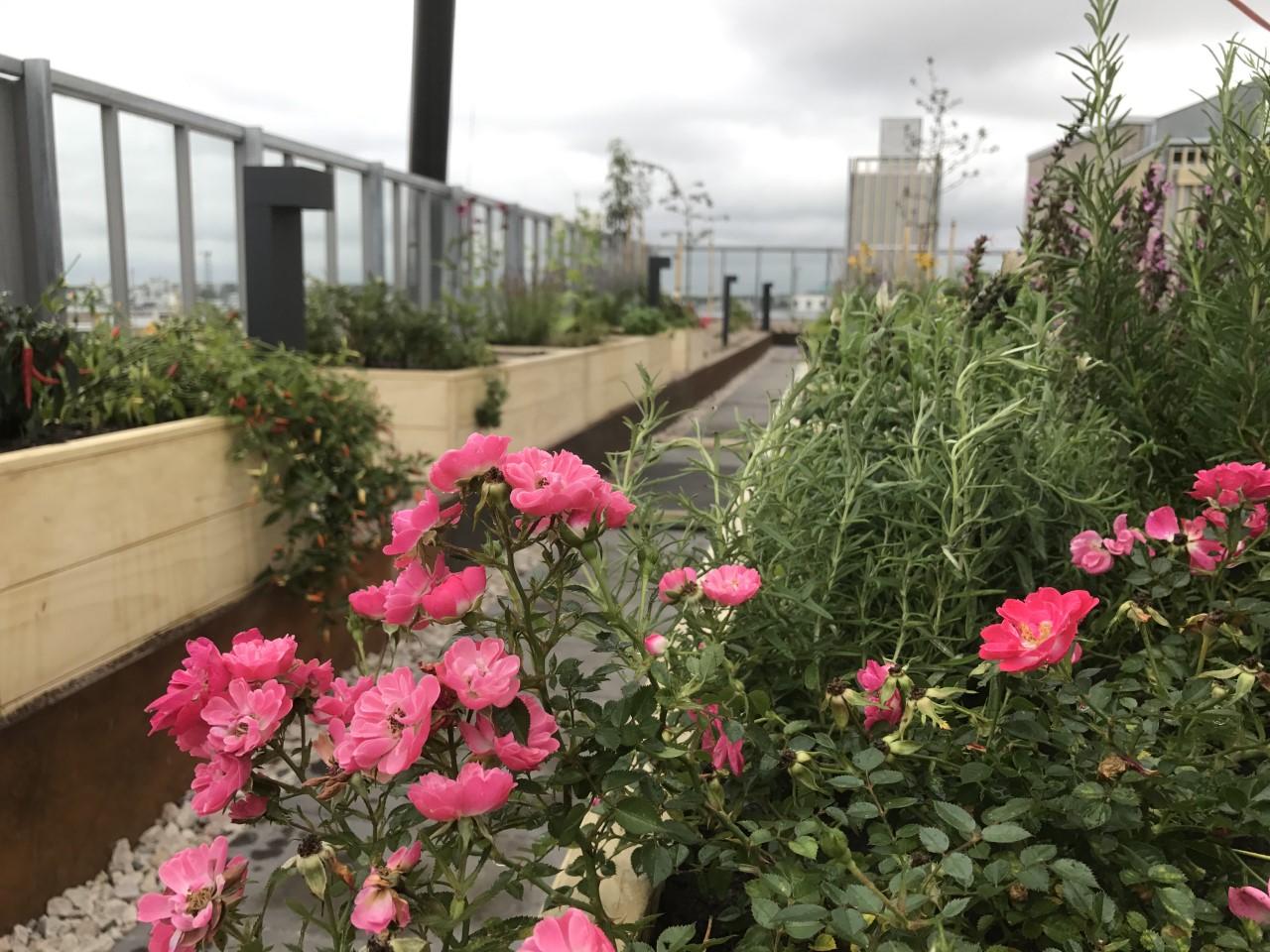
The Greenest of the Green block, Helsinki, Finland
Source: Ref. 6
Overview
Nature-based solution
- Nature on buildings (external)
- Green roofs
- Community gardens and allotments
- Community gardens
- Green areas for water management
- Rain gardens
Key challenges
- Water management (SDG 6)
- Stormwater and rainfall management and storage
- Green space, habitats and biodiversity (SDG 15)
- Habitat and biodiversity conservation
- Green space creation and/or management
- Environmental quality
- Soil quality improvement
- Social justice, cohesion and equity (SDG 10)
- Environmental education
Focus
Creation of new green areas, Knowledge creation and awareness raising, Monitoring and maintenance of habitats and/or biodiversity
Project objectives
The aim of the Fifth Dimension project was to evaluate the various benefits green roofs may offer and to develop optimal solutions and designs for green roofs that deliver the best possible services for urban residents (Ref 1, 2). It also aimed at producing high-level scientific and broadly applicable knowledge on optimal green roof solutions in Finland (ref. 2).
More specifically, the project aimed at studying key factors related to green roofs:
1. Vegetation: habitat creation to support plant diversity, and the existence of rare and threatened, indigenous plant species, such as dry meadow plants. Create opportunities for gardening and food production in kitchen gardens, and study the most suitable species for harsh, roof conditions.
2. Invertebrates: provide supplementary habitat for invertebrate species in order to serve as habitat for locally threatened species and to investigate the colonization success of invertebrates.
3. Substrate properties and soil animals: build up knowledge for solutions that improve the health of green roof soil ecosystem, effective (closed) nutrient cycling and sustain plant communities on green roofs.
4. Stormwater management: study the functioning of green roofs in terms of their ability to retain rainwater in Finnish climate, as well as searching for solutions to prevent the leaching of nutrients from the green roof.
5. Restorative and aesthetic experiences on green roofs: create recreational experiences and well-being for urbanites, and how people experience green roofs aesthetically, and whether green roofs provide restoration, escape from every stressor of urban life. (ref. 2)
Implementation activities
The creation of green roofs, 8 of which are in Helsinki: Kumpula, Vuorikatu, Fabianinkatu, Johannes sport field, Lauttasaari sport field, Hakaniemi, Kaisaniemi, Meilahti sports centre (Ref 2). Some of these gardens include opportunities for gardening and food production (Ref 2).
Biodiversity conservation or restoration-focused activities
Biodiversity conservation:
- Protect and enhance urban habitats
- Preserve and strengthen existing habitats and ecosystems
- Create new habitats
- Protect species
- Undertake specific measures to protect species
- Undertake specific measures to protect native species
- Undertake specific measures to protect endangered species
- Means for conservation governance
- Create and use scientific knowledge for conservation
Main beneficiaries
- Researchers/University
Governance
Management set-up
- Led by non-government actors
Type of initiating organisation
- Researchers/university
Participatory approaches/ community involvement
- Unknown
Details on the roles of the organisations involved in the project
The research project is lead by Helsinki University (Ref 3), but the roofs are implemented at buildings of various private enterprises (Ref 4). The intervention is a research project (Ref 2) and partly funded by ThinkNature EU Horizon 2020 project (Ref 4).
Funding comes from the Kone Foundation, ThinkNature, Pro aere aqua terra, University of Helsinki, Nessling Foundation, Helsinki University Centre for Environment, ENSURE, Uusimaa Regional Council, Helsinki Metropolitan Region Urban Research Program, City of Vantaa, Maiju and Yrjö Rikala Foundation, Real Estate Foundation Kiinko, Kansainvälinen designsäätiö (Ref 4).
Project implemented in response to ...
... an EU policy or strategy?
Unknown
... a national policy or strategy?
Unknown
... a local policy or strategy?
Yes
(The City of Helsinki's policy on green roofs of 2013 (supplemented and translated to English in 2017) (Ref 5, 6). )
Financing
Total cost
Unknown
Source(s) of funding
- EU funds
- Public regional budget
- Private Foundation/Trust
Type of funding
- Earmarked public budget
- Direct funding (grants, subsidies, or self-financed projects by private entities)
Non-financial contribution
Unknown
Impacts and Monitoring
Environmental impacts
- Climate change
- Lowered local temperature
- Water management and blue areas
- Improved stormwater management
- Green space and habitat
- Increased green space area
- Increased protection of threatened species
Economic impacts
- Unknown
Socio-cultural impacts
- Education
- Increased support for education and scientific research
Type of reported impacts
Achieved impacts
Presence of formal monitoring system
Yes
Presence of indicators used in reporting
Yes
Presence of monitoring/ evaluation reports
Yes
Availability of a web-based monitoring tool
No evidence in public records
References
1: City of Helsinki. n.d. Fifth dimension - Green roofs and walls in urban areas. Retrieved from Source link (Accessed 23 July 2020)
2: City of Helsinki. n.d. Fifth dimension - Green roofs and walls in urban areas: Research. Retrieved from Source link (Accessed 23 July 2020)
3: EIP Water. n.d. NWRM case study 122 - urban green roofs in Helsinki, Finland. Retrieved from Source link (Accessed 23 July 2020)
4: Luomus Finnish museum of natural history. n.d. Fifth dimension green roofs in urban areas. Retrieved from Source link (Accessed 23 July 2020)
5: Scandinavian Green Infrastructure Association. n.d. The winner of The Scandinavian Green Roof Award 2018 is TA Companies Ltd (TA-yhtiöt) for their project The Greenest of the Green in Helsinki, Finland. Retrieved from Source link (Accessed 23 July 2020)
6: Think Nature. n.d. The Greenest of the Green block, Helsinki, Finland. Retrieved from Source link (Accessed 23 July 2020)
7: City of Helsinki. 2013. Helsinki city plan vision 2050. Retrieved from Source link (Accessed 23 July 2020)
2: City of Helsinki. n.d. Fifth dimension - Green roofs and walls in urban areas: Research. Retrieved from Source link (Accessed 23 July 2020)
3: EIP Water. n.d. NWRM case study 122 - urban green roofs in Helsinki, Finland. Retrieved from Source link (Accessed 23 July 2020)
4: Luomus Finnish museum of natural history. n.d. Fifth dimension green roofs in urban areas. Retrieved from Source link (Accessed 23 July 2020)
5: Scandinavian Green Infrastructure Association. n.d. The winner of The Scandinavian Green Roof Award 2018 is TA Companies Ltd (TA-yhtiöt) for their project The Greenest of the Green in Helsinki, Finland. Retrieved from Source link (Accessed 23 July 2020)
6: Think Nature. n.d. The Greenest of the Green block, Helsinki, Finland. Retrieved from Source link (Accessed 23 July 2020)
7: City of Helsinki. 2013. Helsinki city plan vision 2050. Retrieved from Source link (Accessed 23 July 2020)