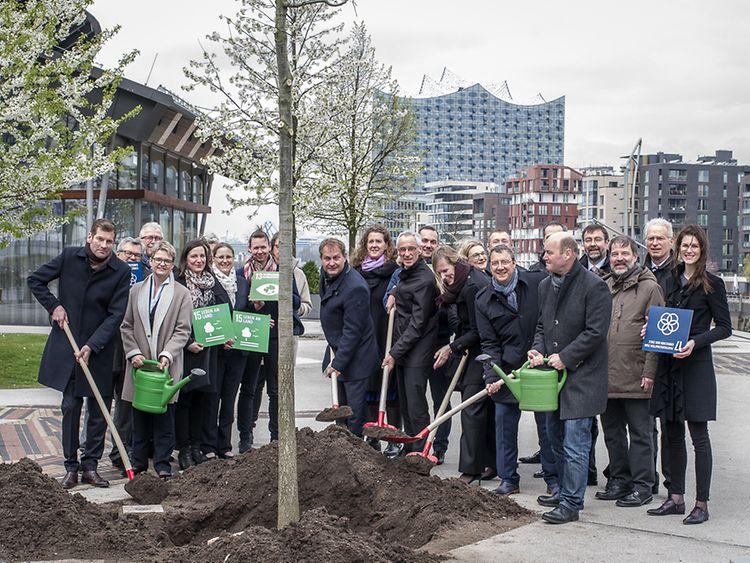
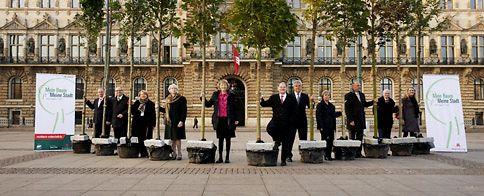
Hamburg decided to increase the number of trees in the city, however, the budget was not enough to completely fulfil this goal. Therefore, the city not only tripled the municipal budget dedicated to tree planting and but began encouraging the citizens to contribute to greening the city through the donation campaign "My tree - My city”. The project was launched in 2011 as part of the European Green Capital programme of Hamburg. Citizens can donate and by using an interactive map, can choose a site and a tree species to be planted, and follow-up the implementation of their tree. (Reference 1, 3) The City of Hamburg gave for each tree that reached donations of 500 Euro the same amount on top to cover the average costs of 1.000 Euro per tree, which includes the preparation of the planting pit, the planting itself and maintenance. (Reference 4) The campaign was so successful that it continued even after Hamburg’s year as the European Green Capital and is still going on in 2020. (Reference 2, 7)
Overview
Nature-based solution
- Grey infrastructure featuring greens
- Alley or street trees and other street vegetation
- Parks and urban forests
- Pocket parks/neighbourhood green spaces
Key challenges
- Climate action for adaptation, resilience and mitigation (SDG 13)
- Climate change adaptation
- Green space, habitats and biodiversity (SDG 15)
- Habitat and biodiversity conservation
- Green space creation and/or management
- Environmental quality
- Air quality improvement
Focus
Project objectives
Implementation activities
Climate-focused activities
Climate change adaptation:
- Increase or improve urban vegetation cover to help reduce outdoor temperature
- Create or improve outdoor spaces to help people escape from urban heat
Biodiversity conservation or restoration-focused activities
Biodiversity conservation:
- Protect and enhance urban habitats
- Preserve and strengthen existing habitats and ecosystems
- Create new habitats
- Means for conservation governance
- Public engagement
- Capacity building
Main beneficiaries
- Local government/Municipality
- Citizens or community groups
Governance
Management set-up
- Government-led
Type of initiating organisation
- Local government/municipality
- Public sector institution
Participatory approaches/ community involvement
- Co-planning (e.g. stakeholder workshops, focus groups, participatory mapping)
- Crowd-sourcing/Crowd-funding/Participatory budget
- Dissemination of information and education
- Consultation (e.g. workshop, surveys, community meetings, town halls)
Details on the roles of the organisations involved in the project
Project implemented in response to ...
Financing
Total cost
Source(s) of funding
- Public local authority budget
- Crowdfunding
Type of funding
- Earmarked public budget
- Donations
Non-financial contribution
- Provision of land
- Provision of labour
- Provision of expertise
- Public authorities (e.g. land, utility services)
- Other
Impacts and Monitoring
Environmental impacts
- Climate change
- Lowered local temperature
- Environmental quality
- Improved air quality
- Green space and habitat
- Increased green space area
- Increased conservation or restoration of ecosystems
- Increased number of species present
- Other
Economic impacts
- Unknown
Socio-cultural impacts
- Social justice and cohesion
- Improved liveability
- Health and wellbeing
- Improved mental health
- Education
- Increased awareness of NBS and their benefits
- Other
Type of reported impacts
Presence of formal monitoring system
Presence of indicators used in reporting
Presence of monitoring/ evaluation reports
Availability of a web-based monitoring tool
References
2. Ministry of Environment and Energy. (2016). Hamburg – European Green Capital: 5 Years On: The city takes further. Hamburg: Ministry of Environment and Energy. Available at: Source link [Accessed: 03 Sept. 2020]
3. Source link. (2017). European Green Capital. [online] Available at: Source link 03 Sept. 2020].
4. Behörde für Stadtentwicklung und Umwelt. (nd.) Hamburg European Green Capital 2011: "My Tree - My City" Campaign. [online] Available at: BeSource link [Accessed: 03 Sept. 2020]
5. Source link. (nd.) Green Hamburg: Green Trees, Green City. [online]. Available at: HamSource link [Accessed: 03 Sept. 2020]
6. Pressestelle des Senats. (2011). Wochenendienst. Available at: PreSource link [Accessed: 03 Sept. 2020]