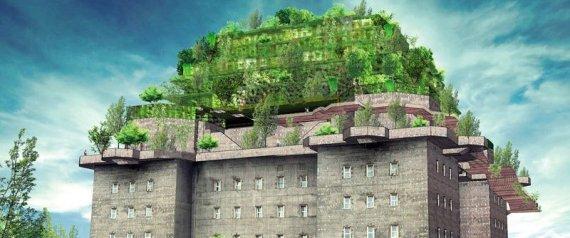
In 2014, local residents of the St. Pauli neighbourhood of Hamburg supported by architects decided to reshape the Hilldegarden bunker built during WW II. They managed to convince the owner of the bunker, who currently leases the rooms of the bunker to a nightclub, a music school, an instrument store and a photography studio, to re-create the bunker in a way that pays special attention to ecological and social aspects. (Reference 1-3). ”The new project would see the space continue its mixed-use atmosphere, but topped with a massive public rooftop garden with walking trails.” The 800 sqm garden will use sustainable techniques for its operation, including renewable energies and greywater collection for irrigation and will offer a public garden where residents can engage in urban food production. (Reference 2) In September 2020, the reconstruction of the bunker is still in its early phases. (Ref. 8)
Overview
Nature-based solution
- Nature on buildings (external)
- Green roofs
- Green walls or facades
- Parks and urban forests
- Large urban parks or forests
- Community gardens and allotments
- Allotments
Key challenges
- Climate action for adaptation, resilience and mitigation (SDG 13)
- Climate change adaptation
- Water management (SDG 6)
- Stormwater and rainfall management and storage
- Green space, habitats and biodiversity (SDG 15)
- Green space creation and/or management
- Environmental quality
- Air quality improvement
- Regeneration, land-use and urban development
- Promote natural styles of landscape design for urban development
- Inclusive and effective governance (SDG 16)
- Inclusive governance
- Social justice, cohesion and equity (SDG 10)
- Social interaction
- Environmental and climate justice
- Health and well-being (SDG 3)
- Creation of opportunities for recreation
- Cultural heritage and cultural diversity
- Protection of historic and cultural landscape/infrastructure
- Preservation of historic traditions
- Sustainable consumption and production (SDG 12)
- Sustainable production
Focus
Project objectives
Implementation activities
Climate-focused activities
Climate change adaptation:
- Increase or improve urban vegetation cover to help reduce outdoor temperature
- Create or improve outdoor spaces to help people escape from urban heat
Main beneficiaries
- Private sector/Corporate/Company
- Citizens or community groups
- Food producers and cultivators (i.e. farmers, gardeners)
Governance
Management set-up
- Led by non-government actors
Type of initiating organisation
- Citizens or community group
- Other
Participatory approaches/ community involvement
- Co-planning (e.g. stakeholder workshops, focus groups, participatory mapping)
- Consultation (e.g. workshop, surveys, community meetings, town halls)
- Joint implementation (e.g. tree planting)
- Citizen monitoring and review
Details on the roles of the organisations involved in the project
Project implemented in response to ...
Financing
Total cost
Source(s) of funding
- Corporate investment
Type of funding
- Direct funding (grants, subsidies, or self-financed projects by private entities)
Non-financial contribution
Impacts and Monitoring
Environmental impacts
- Climate change
- Reduced emissions
- Environmental quality
- Improved air quality
- Green space and habitat
- Increased conservation or restoration of ecosystems
- Increased number of species present
- Enhanced support of pollination
Economic impacts
- Unknown
Socio-cultural impacts
- Social justice and cohesion
- Increased involvement of locals in the management of green spaces
- Health and wellbeing
- Gain in activities for recreation and exercise
- Cultural heritage and sense of place
- Protection of historic and cultural landscape / infrastructure
- Increased sense of place identity, memory and belonging
- Increased appreciation for natural spaces
- Other
Type of reported impacts
Presence of formal monitoring system
Presence of indicators used in reporting
Presence of monitoring/ evaluation reports
Availability of a web-based monitoring tool
References
2. Jewell, N. (2017). German community bands together to convert old WWII bunker into a ‘green mountain’. Inhabitat. [online] Available at: Source link. [Accessed: 25.07.2017].
3. Syed, S. (2017). From War Relic to Mixed-Use: Plans to Build a “Green Mountain” Atop a Bunker in Hamburg. Archdaily. [online] Available at: Source link. [Accessed: 25.07.2017].
4. Source link. (2017). Alle Ideen. [online] Available at: Source link. [Accessed: 25.07.2017].
5. Source link. (2017). Was ist Hilldegarden? [online] Available at: Source link. [Accessed: 25.07.2017].
6. Source link. (2017). Fragen und Antworten. [online] Available at: Source link. [Accessed: 25.07.2017].
7. Planungsbüro Bunker (2017). From War Relic to Mixed-Use: Plans to Build a “Green Mountain” Atop a Bunker in Hamburg. Archdaily. [image] Available at: Source link. [Accessed: 25.07.2017].
8. Source link. (2020). St. Pauli Bunker: A Place 4,700 Plants Will Call Home. [online]. Available at: Source link [Accessed: 06 Sept. 2020].
9. Source link (2019).Bunker-Bau kann endlich starten – und die Zeit drängt. [online]. Available at: Source link [Accessed: 06 Sept. 2020].