

Last updated: October 2021
The Newton and Arkwright roof, buildings of the Nottingham Trent University campus, holds one of the region’s largest sedum roofs, which spans its way 2,500m² across the building, creating a home for 13 varieties of sedum, insects, songbirds and a new colony of honey bees, creating a trio of hives over all campuses (ref. 1). A 150m2 bank surrounding the building is unmown in order to promote biodiversity and attract pollinating insects in the summer months. Green-walled gates was also part of the implementation activities of this project. (ref. 5).
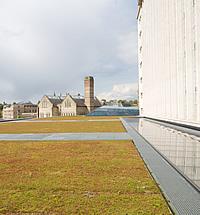
Nottingham Trent University green roof
https://www4.ntu.ac.uk/sustainability/biodiversity/Our_campuses/city_site/index.html
Overview
Nature-based solution
- Nature on buildings (external)
- Green roofs
- Green walls or facades
- Grey infrastructure featuring greens
- Institutional green space
- Other
Key challenges
- Climate action for adaptation, resilience and mitigation (SDG 13)
- Climate change mitigation
- Green space, habitats and biodiversity (SDG 15)
- Habitat and biodiversity conservation
- Green space creation and/or management
- Environmental quality
- Air quality improvement
- Regeneration, land-use and urban development
- Promote natural styles of landscape design for urban development
- Health and well-being (SDG 3)
- Creation of opportunities for recreation
Focus
Creation of new green areas
Project objectives
The project is part of the redevelopment of the 1877 Arkwright and 1950 Newton Buildings for the University (ref. 2) A total of 13 different varieties of sedum are being used in the roof, which extends over two separate wings of the university. The university aims to help improve air quality and absorb carbon dioxide with its green roof (ref. 4). "- increase access to green space - green courtyards, green walkways, green roofs for students, staff and visitors to have a pleasant environment (ref. 5)
Implementation activities
The Implementation activities were to install one of the region’s largest sedum roofs which spans its way 2,500m² across the building, creating a home for 13 varieties of sedum, insects, songbirds and a new colony of honey bees, complete with webcam, creating a trio of hives over all campuses. The roof is also home to a wild pair of Peregrine Falcons (since 2006). (Ref. 1) - 150m2 bank surrounding the building is unmown in order to promote biodiversity and will be sown with wildflower seeds to attract pollinating insects in the summer months (ref. 5) Green-walled gates (ref. 5) was also part of the implementation activities of this project.
NTU is investing significantly into its City campus site, but due to its center-city location, expansion of the site is limited. Investment has focused on the refurbishment of many of the buildings on-site, aiming to incorporate excellent sustainability features and outdoor spaces in each project. The largest projects have been the refurbishment of e.g. the Grade II* listed buildings Newton and Arkwright (ref. 5).
Climate-focused activities
Climate change mitigation:
- Install vertical or horizontal artificial surfaces that help with carbon storage and cooling
Biodiversity conservation or restoration-focused activities
Biodiversity conservation:
- Protect and enhance urban habitats
- Preserve and strengthen existing habitats and ecosystems
- Create new habitats
- Protect species
- Undertake specific measures to protect species
- Undertake specific measures to protect endangered species
- Undertake specific measures to protect valued species
- Means for conservation governance
- Create and use scientific knowledge for conservation
Main beneficiaries
- Public sector institution (e.g. school or hospital)
- Researchers/University
Governance
Management set-up
- Led by non-government actors
Type of initiating organisation
- Public sector institution
- Researchers/university
Participatory approaches/ community involvement
- Co-planning (e.g. stakeholder workshops, focus groups, participatory mapping)
- Taskforce groups
- Citizen monitoring and review
Details on the roles of the organisations involved in the project
As part of the redevelopment scheme of the 1877 Arkwright and 1950 Newton Buildings for Nottingham Trent University, a public university, Hopkins Architects and the university's environmental team worked on The Arkwright and Newton buildings retrofits (Ref. 1, 2)
Project implemented in response to ...
... an EU policy or strategy?
Unknown
... a national policy or strategy?
Unknown
... a local policy or strategy?
Unknown
Financing
Total cost
Unknown
Source(s) of funding
- Other
Type of funding
- Donations
- Other
Non-financial contribution
Unknown
Impacts and Monitoring
Environmental impacts
- Climate change
- Reduced emissions
- Enhanced carbon sequestration
- Environmental quality
- Improved air quality
- Green space and habitat
- Increased green space area
- Increased conservation or restoration of ecosystems
- Increased number of species present
- Enhanced support of pollination
- Increased spread of native/heirloom/open-pollinated seed
Economic impacts
- Unknown
Socio-cultural impacts
- Social justice and cohesion
- Improved access to urban green space
- Increased opportunities for social interaction
Type of reported impacts
Achieved impacts
Presence of formal monitoring system
Unknown
Presence of indicators used in reporting
No evidence in public records
Presence of monitoring/ evaluation reports
Yes
Availability of a web-based monitoring tool
Yes
References
1. EAUC. (n.d.) Nottingham Trent University. Member spotlight. Eauc. Available at: Source link (Accessed: 17 July 2020)
2. Hopkins Architects. (n.d.) Nottingham Trent University: Newton and Arkwright Buildings. Source link. Available at: Source link (Accessed: 17 July 2020)
3. BBC News Nottingham. (2011). Nottingham Trent University buildings win RIBA award. BBC. Available at: Source link (Accessed: 17 July 2020)
4. Horticulture Week. (2009). Sedum roof for Nottingham Trent University. Hortweek. Available at: Source link (Accessed: 17 July 2020)
5. Nottingham Trent University. (2014). Landscape Management Plan. City Site. Nottingham Trent University. Available at: Source link (Accessed: 17 July 2020)
6. Nottingham Trent University. (n.d.). Sustainability: Wildlife and Green Spaces. Nottingham Trent University. Available at: Source link (Accessed: 17 July 2020)
7. Nottingham Trent University. (n.d.). Sustainability: Our achievements. Nottingham Trent University. Available at: Source link (Accessed: 17 July 2020)
2. Hopkins Architects. (n.d.) Nottingham Trent University: Newton and Arkwright Buildings. Source link. Available at: Source link (Accessed: 17 July 2020)
3. BBC News Nottingham. (2011). Nottingham Trent University buildings win RIBA award. BBC. Available at: Source link (Accessed: 17 July 2020)
4. Horticulture Week. (2009). Sedum roof for Nottingham Trent University. Hortweek. Available at: Source link (Accessed: 17 July 2020)
5. Nottingham Trent University. (2014). Landscape Management Plan. City Site. Nottingham Trent University. Available at: Source link (Accessed: 17 July 2020)
6. Nottingham Trent University. (n.d.). Sustainability: Wildlife and Green Spaces. Nottingham Trent University. Available at: Source link (Accessed: 17 July 2020)
7. Nottingham Trent University. (n.d.). Sustainability: Our achievements. Nottingham Trent University. Available at: Source link (Accessed: 17 July 2020)