Last updated: October 2021
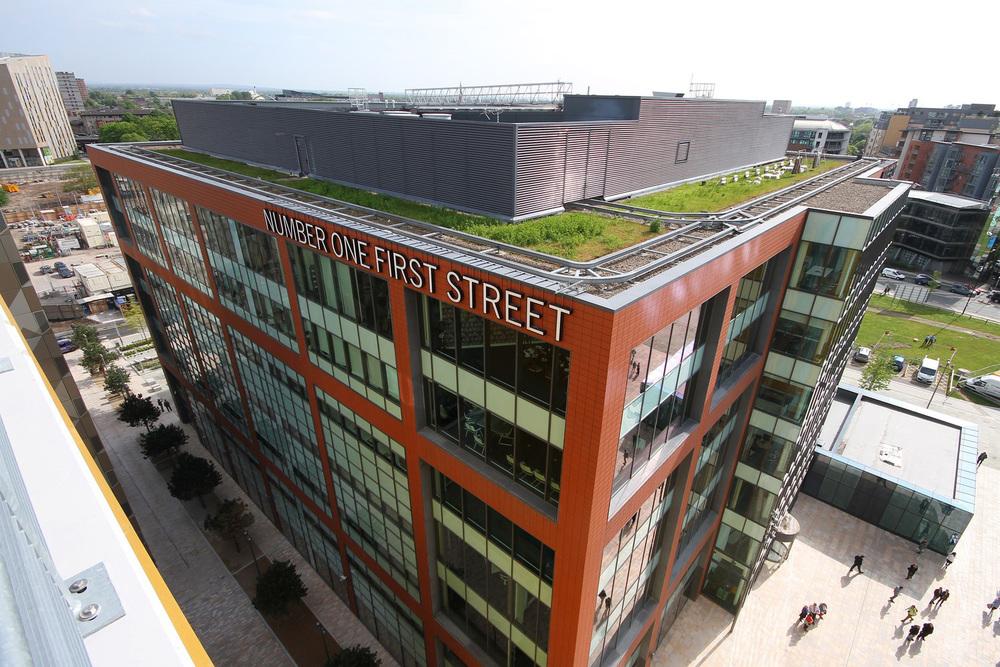
Number One First Street is at the corner of Medlock Street and Whitworth Street behind the train arches near Oxford Road Station in the city center of Manchester (ref. 6). During the redevelopment of the former BT building now called Number One First Street a green roof was installed (ref 2). Whilst the vegetation slowly established, it provided a habitat for invertebrates and insects. A green wall, accommodating 37,000 plants was planned to be installed by 2020 which would replace glass, plastic and metal cladding with greenery (ref 1).

Overview
Nature-based solution
- Nature on buildings (external)
- Green roofs
- Green walls or facades
Key challenges
- Climate action for adaptation, resilience and mitigation (SDG 13)
- Climate change adaptation
- Climate change mitigation
- Water management (SDG 6)
- Stormwater and rainfall management and storage
- Green space, habitats and biodiversity (SDG 15)
- Habitat and biodiversity conservation
- Green space creation and/or management
- Environmental quality
- Air quality improvement
- Regeneration, land-use and urban development
- Regulation of built environment
- Social justice, cohesion and equity (SDG 10)
- Social interaction
- Economic development and employment (SDG 8)
- Employment/job creation
Focus
Creation of new green areas
Project objectives
1. Provide habitat for invertebrates and insects on the green roof (ref 1)
2. Build a green wall to replace glass, plastic and metal cladding with greenery (ref 2) and to increase biodiversity (ref. 7)
3. Use rain/stormwater run-off to irrigate green roofs and walls (ref 1)
4. Reduce water consumption compared to other green wall systems (ref 2)
5. To change the microclimate in the surrounding square (ref 2)
6. To scrub the air in a way, catching pollution and converting carbon dioxide to oxygen (ref 2)
7. Quality employment and community enhancement also form part of the overall strategy (ref. 5)
8. Habitat creation to increase biodiversity in the city, with honeybees playing a major role as pollinators for plants in the city center, and actively engaging with issues of environmental sustainability and awareness (ref. 7)
Implementation activities
Green roof and Green wall installed (ref 2)
The green wall irrigation system was to deliver 1 to 3 applications per 24 hour period to 9 separate individually controlled zones. The system also used rain/stormwater run-off to irrigate green roofs and walls. Moreover, the First Street green wall planting system included a material called ‘Grodan’ which soaks up the water and vastly reduces the water consumption (ref 1)
Habitat creation to increase biodiversity with honeybees as an example was also completed as 'Bees on Roof' action (ref. 7). Activities included: Establishing garden in preparation for hive install Spring 2018, Maintaining and expanding garden growth, Regular hive checks-Social media/website news pieces to inform our audiences, Internal comms/Green Group to share with staff and continue support-Regular training updates, Budget and secure funds for upkeep and maintenance of garden and continued beekeeping materials, maintenance and training (ref. 7)
Always striving to make sustainable choices, old theater lights, stage props and exhibition materials are re-purposed, turning them into planters – old washing machine drums are utilized and brimmed with lavender (Ref. 8)
Climate-focused activities
Climate change adaptation:
- Create or improve outdoor spaces to help people escape from urban heat
Climate change mitigation:
- Increase green urban nature for carbon storage (wetlands, tree cover)
- Improve carbon sequestration through selection of more adaptable species
Biodiversity conservation or restoration-focused activities
Biodiversity conservation:
- Protect and enhance urban habitats
- Create new habitats
- Protect species
- Undertake specific measures to protect species
Main beneficiaries
- Local government/Municipality
- Private sector/Corporate/Company
Governance
Management set-up
- Led by non-government actors
Type of initiating organisation
- Private sector/corporate actor/company
Participatory approaches/ community involvement
- Unknown
Details on the roles of the organisations involved in the project
Client: ASK Real Estate
Architect: BDP Architects
(Ref 4)
Project implemented in response to ...
... an EU policy or strategy?
Unknown
... a national policy or strategy?
Unknown
... a local policy or strategy?
Unknown
Financing
Total cost
Unknown
Source(s) of funding
- Corporate investment
Type of funding
- Direct funding (grants, subsidies, or self-financed projects by private entities)
Non-financial contribution
Unknown
Impacts and Monitoring
Environmental impacts
- Climate change
- Lowered local temperature
- Enhanced carbon sequestration
- Environmental quality
- Improved air quality
- Improved waste management
- Water management and blue areas
- Improved stormwater management
- Green space and habitat
- Increased green space area
- Increased number of species present
- Enhanced support of pollination
Economic impacts
- Generation of income from NBS
- Other
Socio-cultural impacts
- Social justice and cohesion
- Improved social cohesion
- Increased opportunities for social interaction
- Increased access to healthy/affordable food
Type of reported impacts
Expected impacts, Achieved impacts
Presence of formal monitoring system
Unknown
Presence of indicators used in reporting
No evidence in public records
Presence of monitoring/ evaluation reports
No evidence in public records
Availability of a web-based monitoring tool
No evidence in public records
References
1. Green Infrastructure. (2009). Greater Manchester Green Roof Guidance. Available at: Source link (Accessed 17 August 2020)
2. Manchester Evening News. (2010). The green wonderwall. Available at: Source link (Accessed 17 August 2020)
3. Manchester Evening News. (2010). Green Scheme to be new First Street. Available at: Source link (Accessed 17 August 2020)
4. Hannan and Associates. (nd). Project: No1. First street Manchester. Available at: Source link (Accessed 17 August 2020)
5. NDY. (n.d.) First Street: Manchester, United Kingdom. Available at: Source link (Accessed 17 August 2020)
6. Home. (n.d.) Number 1 First St. Available at: Source link (Accessed 30 August 2020)
7. Home. (2019). Environmental and Sustainability Policy. Available at: Source link (Accessed 30 August 2020)
8. Home. (n.d.) Sustainability (Our Bees). Available at: Source link (Accessed 30 August 2020)
2. Manchester Evening News. (2010). The green wonderwall. Available at: Source link (Accessed 17 August 2020)
3. Manchester Evening News. (2010). Green Scheme to be new First Street. Available at: Source link (Accessed 17 August 2020)
4. Hannan and Associates. (nd). Project: No1. First street Manchester. Available at: Source link (Accessed 17 August 2020)
5. NDY. (n.d.) First Street: Manchester, United Kingdom. Available at: Source link (Accessed 17 August 2020)
6. Home. (n.d.) Number 1 First St. Available at: Source link (Accessed 30 August 2020)
7. Home. (2019). Environmental and Sustainability Policy. Available at: Source link (Accessed 30 August 2020)
8. Home. (n.d.) Sustainability (Our Bees). Available at: Source link (Accessed 30 August 2020)