

Since 2012, Gothenburg has worked with the Rivercity, an urban development project in the city centre, that uses different ways of working, with innovation at the core of its urban transformations projects. Frihamnen is one of the RiverCity Göteborg most vital projects which aims to unify the centre of Göteborg across the river and out towards Kvillebäcken, Lindholmen and Backaplan (districts). The environmental goal is to create climate adaptation by flood control & stormwater management. Additional benefits of the project are to make the area more attractive and create recreational areas. As part of the BEGIN project, the Frihamnen project aims to use 'blue-green' solutions (i.e. Blue Green Infrastructure through Social Innovation). (Ref. 1, 2)
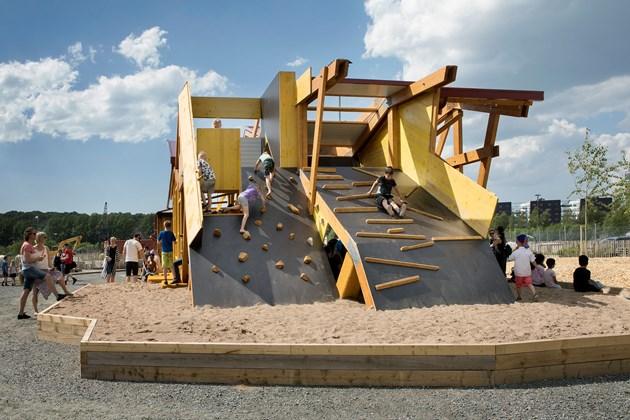
Overview
Nature-based solution
- Parks and urban forests
- Large urban parks or forests
- Pocket parks/neighbourhood green spaces
- Blue infrastructure
- Rivers/streams/canals/estuaries
Key challenges
- Climate action for adaptation, resilience and mitigation (SDG 13)
- Climate change adaptation
- Water management (SDG 6)
- Flood protection
- Stormwater and rainfall management and storage
- Green space, habitats and biodiversity (SDG 15)
- Green space creation and/or management
- Inclusive and effective governance (SDG 16)
- Effective management
Focus
Project objectives
Implementation activities
Climate-focused activities
Climate change adaptation:
- Implement sustainable urban drainage infrastructure (e.g. to make space for water)
- Renaturalization of rivers and other water bodies
Main beneficiaries
- National-level government
- Local government/Municipality
- Citizens or community groups
Governance
Management set-up
- Co-governance with government and non-government actors
Type of initiating organisation
- EU body
Participatory approaches/ community involvement
- Co-planning (e.g. stakeholder workshops, focus groups, participatory mapping)
- Taskforce groups
Details on the roles of the organisations involved in the project
Project implemented in response to ...
Financing
Total cost
Source(s) of funding
- EU funds
- Public local authority budget
Type of funding
- Earmarked public budget
- Direct funding (grants, subsidies, or self-financed projects by private entities)
Non-financial contribution
Impacts and Monitoring
Environmental impacts
- Climate change
- Strengthened capacity to address climate hazards/natural disasters
- Water management and blue areas
- Increased protection against flooding
- Improved stormwater management
- Green space and habitat
- Reduced biodiversity loss
Economic impacts
- Increase of green jobs (e.g. paid employment positions)
- Increase in agricultural production (for profit or not)
Socio-cultural impacts
- Social justice and cohesion
- Increased involvement of locals in the management of green spaces
- Education
- Increased support for education and scientific research
Type of reported impacts
Presence of formal monitoring system
Presence of indicators used in reporting
Presence of monitoring/ evaluation reports
Availability of a web-based monitoring tool
References
Ref. 2. The University of Sheffield (2017) BEGIN: European coorperation to fight climate change. Urban studies and Planning. Retrieved from Source link on 14th November, 2020.
Ref. 3. Göteborgs Stad (2016) Inventering av EU-projekt i Göteborgs Stad 2016. Byggnadsnämnden. Göteborgs Stad. Retrieved from Source link on 14th November, 2020.
Ref. 4. Göteborg & Co (2017) Anniversary plan 2017. Together for an even better city. Göteborg 2021. Göteborgs Stad. Retrieved from Source link on 14th November, 2020.
Ref. 5. BEGIN (n.d.) Blue Green Infrastructure through social innovation. Retrieved from Source link on 14th November, 2020.
Ref. 6. North Sea Region (n.d.) City of Gothenburg. Project vision. BEGIN. Retrieved from Source link on 14th November, 2020.
Ref. 7. City of Gothenburg (n.d.) Frihamnen. Rivercity. Gothenburg 2021. Retrieved from Source link on 14th November, 2020.
Ref. 8. North Sea Region (n.d.) About us. BEGIN. Retrieved from Source link on 14th November, 2020.
Ref. 9. North Sea Region (n.d.) Approach. BEGIN. Retrieved from Source link on 14th November, 2020.
Ref. 10. Kelder, E. (2020) BEYOND 2020: Gothenburg to present BEGIN's innovative approach. North Sea Region. Retrieved from Source link on 14th November, 2020.
