

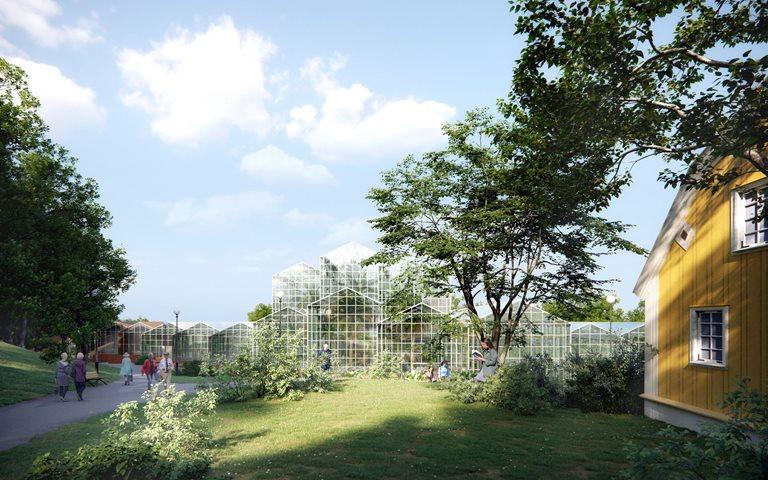
The Gothenburg Botanical Gardens are replacing and expanding their old greenhouses, which had serious flaws in terms of work environment, climate and accessibility [Ref. 1]. The new greenhouses will be divided into sections with a diverse set of climates and preserve over 4000 species, some of which are extinct in their natural environments [Ref. 1-2]. A new visitors centre is also being built and will have ameneties such as a café, a shop, toilets and places to sit, which will improve the Botanical Gardens' ability to invite the public and educate about biodiversity. The greenhouse project aims to strengthen the Gardens' national and international standing within research and education [Ref. 4]. A significant share of the visitors today are domestic and international tourists, and the new greenhouses aim to promote that further. The Botanical Gardens are owned by the regional government (Region Västra Götaland), which is funding these new project activities. The construction is ongoing and plans to finish in 2028, but the greenhouses will not be fully open to the public before the inauguration in 2030. The project has an investment budget of about 56 million EUR, and will, in total, occupy 6600 sqm [Ref. 1-3].
Overview
Nature-based solution
- Nature in buildings (indoor)
- Other
- Parks and urban forests
- Botanical gardens
Key challenges
- Green space, habitats and biodiversity (SDG 15)
- Green space creation and/or management
- Habitat and biodiversity conservation
- Health and well-being (SDG 3)
- Creation of opportunities for recreation
- Social justice, cohesion and equity (SDG 10)
- Environmental education
- Economic development and employment (SDG 8)
- Tourism support
Principal problems in Functional Urban Area (FUA)
- Environmental Degradation
- Biodiversity loss
Key priorities
Focus
Project objectives
Implementation activities
Biodiversity conservation or restoration-focused activities
Biodiversity conservation:
- Protect species
- Undertake specific measures to protect species
- Undertake specific measures to protect endangered species
- Undertake specific measures to protect valued species
- Take measures for ex situ conservation
- Means for conservation governance
- Raise public awareness
- Public engagement
- Create and use scientific knowledge for conservation
Main beneficiaries
- Researchers/University
- Citizens or community groups
- Young people and children
Governance
Management set-up
- Government-led
Type of initiating organisation
- Regional government
Participatory approaches/ community involvement
- The project didn't involve any form of stakeholder participatory activities
Details on the roles of the organisations involved in the project
Project implemented in response to ...
Type of enablers
Financing
Total cost
Source(s) of funding
- Public regional budget
Type of funding
- Earmarked public budget
Non-financial contribution
Impacts and Monitoring
Environmental impacts
- Climate change
- Energy efficiency improvements
- Expected energy efficiency improvements
- Green space and habitat
- Increased green space area
- Expected increased green space area
- Reduced biodiversity loss
- Expected reduced biodiversity loss
- Increased protection of threatened species
- Expected increased protection of threatened species
Economic impacts
- Unknown
Socio-cultural impacts
- Health and wellbeing
- Gain in activities for recreation and exercise
- Expected gain in activities for recreation and exercise
- Enhanced cognitive restoration, relaxation and stress relief
- Expected enhanced cognitive restoration, relaxation and stress relief
- Education
- Increased support for education and scientific research
- Expected increased support for education and scientific research
Type of reported impacts
Presence of formal monitoring system
Presence of indicators used in reporting
Presence of monitoring/ evaluation reports
Availability of a web-based monitoring tool
Potential risks of implementation and trade-offs
References
 Information about this nature-based solution was collected as part of the Naturescapes project funded by the European Union under Grant Agreement No 101084341.