

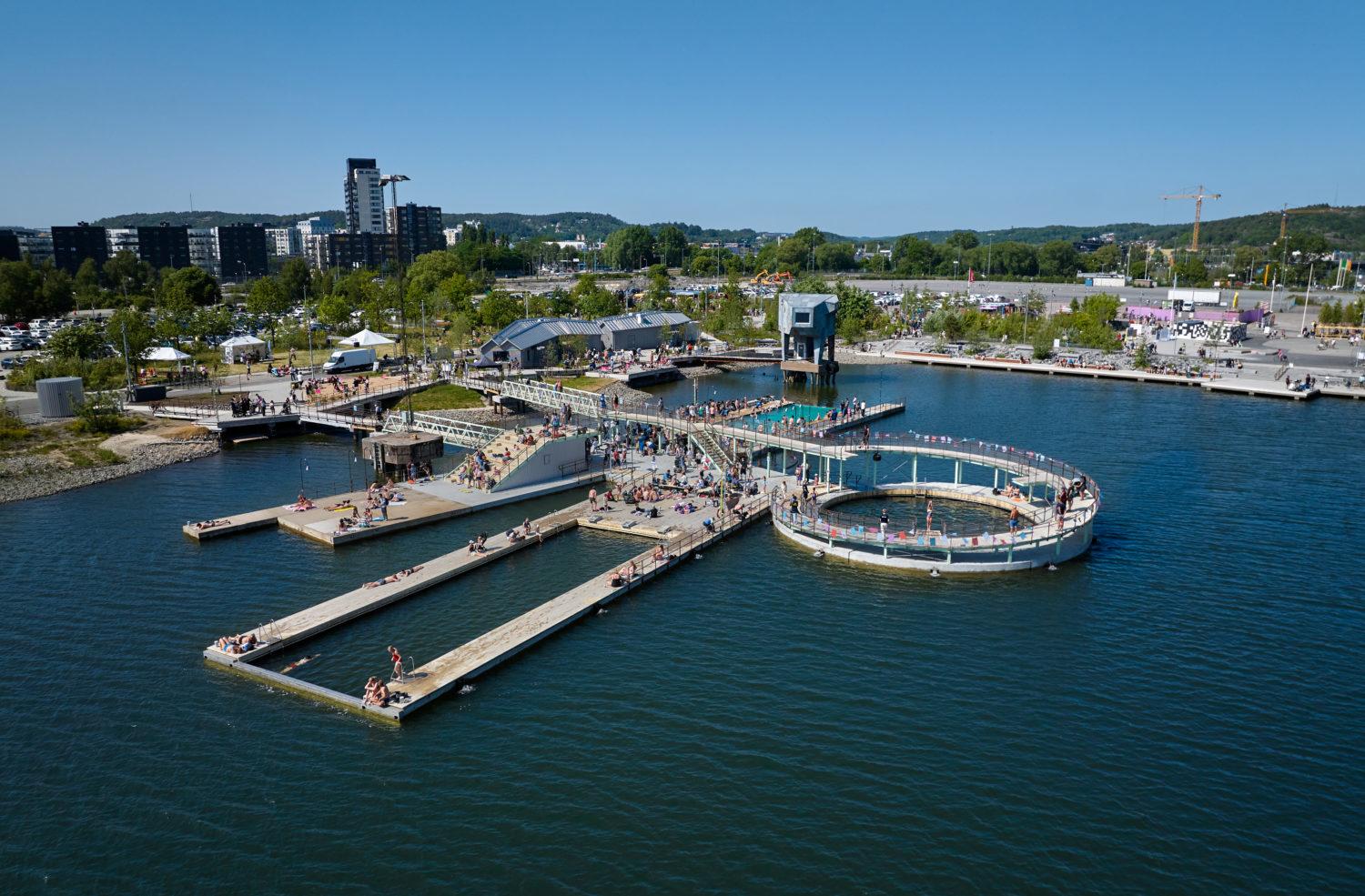
The "Jubilee Park" (Jubileumsparken) is a city park in the developing area of Frihamnen in central Gothenburg. The first part of the park finished construction in 2024, but the aim is that the park will continue to grow and develop until the year 2035 [Ref. 1-2, 5]. The park is said to be the result of the wishes of the people of Gothenburg to have better access to green areas and water before the city's 400-year jubilee in 2023 [Ref. 2]. To achieve this, the park has been constructed gradually in cooperation with residents, using a method called placemaking, where activities and amenities are tested in place to get feedback from residents before being made permanent [Ref. 2, 4]. Additionally, activities in the park are being run by a youth organisations, which also offers summer jobs to young people from across the city and aims to engage marginalised groups [Ref. 1, 6]. The park provides amenities a sculpture-based playground, an outdoor classroom, places to sit and a harbour bath at the edge of the park, with outdoor pools and a sauna. The park contains elements for biodiversity such as trees, meadows and an area for urban farming, increasing biodiversity and connectivity compared to the previous land use as a harbour [Ref. 1, 2, 9].
Overview
Nature-based solution
- Community gardens and allotments
- Community gardens
- Horticulture
- Parks and urban forests
- Large urban parks or forests
Key challenges
- Green space, habitats and biodiversity (SDG 15)
- Green space creation and/or management
- Regeneration, land-use and urban development
- Conversion of former industrial areas
- Health and well-being (SDG 3)
- Creation of opportunities for recreation
- Enabling opportunities for physical activity
- Inclusive and effective governance (SDG 16)
- Inclusive governance
- Social justice, cohesion and equity (SDG 10)
- Social interaction
- Sense of community and community engagement
Principal problems in Functional Urban Area (FUA)
- Environmental Degradation
- Biodiversity loss
- Health, Well-being and Social cohesion
- Inadequate access to recreational opportunities
- Disconnection from nature
- Poor community engagement
Key priorities
Focus
Project objectives
Implementation activities
Main beneficiaries
- Non-government organisation/Civil Society
- Citizens or community groups
- Food producers and cultivators (i.e. farmers, gardeners)
- Young people and children
- Marginalized groups: Children, young people or youth groups , People with functional diversities
Governance
Management set-up
- Government-led
Type of initiating organisation
- Local government/municipality
Participatory approaches/ community involvement
- Co-planning (e.g. stakeholder workshops, focus groups, participatory mapping)
- Consultation (e.g. workshop, surveys, community meetings, town halls)
Details on the roles of the organisations involved in the project
Project implemented in response to ...
Type of enablers
Financing
Total cost
Source(s) of funding
- Public local authority budget
Type of funding
- Earmarked public budget
Non-financial contribution
Impacts and Monitoring
Environmental impacts
- Green space and habitat
- Increased green space area
- Achieved increased green space area
- Increased ecological connectivity across regeneration sites and scales
- Expected increased ecological connectivity across regeneration sites and scales
- Increased number of species present
- Achieved increased number of species present
- Enhanced support of pollination
- Expected enhanced support of pollination
Economic impacts
- Increase of green jobs (e.g. paid employment positions)
- Achieved increase of green jobs (e.g. paid employment positions)
Socio-cultural impacts
- Social justice and cohesion
- Improved access to urban green space
- Achieved improved access to urban green space
- Increased visibility and opportunity for marginalised groups or indigenous peoples
- Achieved increased visibility and opportunity for marginalised groups or indigenous peoples
- Increased involvement of locals in the management of green spaces
- Achieved increased involvement of locals in the management of green spaces
- Health and wellbeing
- Gain in activities for recreation and exercise
- Achieved gain in activities for recreation and exercise
Type of reported impacts
Presence of formal monitoring system
Presence of indicators used in reporting
Presence of monitoring/ evaluation reports
Availability of a web-based monitoring tool
Potential risks of implementation and trade-offs
References

 Information about this nature-based solution was collected as part of the Naturescapes project funded by the European Union under Grant Agreement No 101084341.