

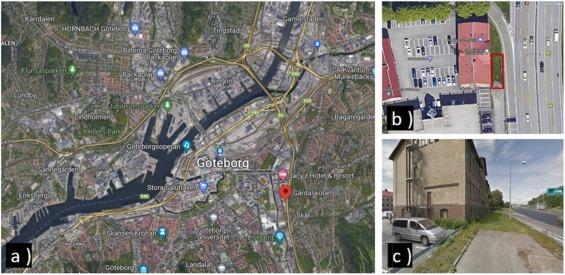
The Gårda pilot rain garden has been constructed as part of the research project Innovative Rain Gardens at Chalmers University of Technology in Gothenburg. In addition to causing flooding, runoff rain water in urban environments can be contaminated with microplastics, organic pollutants and metals which can spread into the natural environment. Yet, most of the storm water in urban environments is not treated. The purpose of the Innovative Rain Gardens project is to research the ability of a pilot rain garden to treat such pollution. The project acknowledges the function of a rain garden to prevent flooding, but in this study only the pollution treatment potential is investigated. The pilot rain garden was constructed next to the E6 highway in central Gothenburg [Ref. 1-4]. It includes several different bioretention filters where selected plants are grown in filters containing different materials such as biochar, ash and soil [Ref. 2, 3]. Results so far show that the use of rain gardens can significantly reduce pollution. However, further research is needed to determine the long term function of the bioretention filters and the potential of scaling up the NBS. The project is funded by the Swedish Research Council for Sustainable Development (Formas), IMMERSE - Implementing Measures for Sustainable Estuaries, an Interreg project supported by the North Sea Programme of the European Regional Development Fund of the European Union, and COWIfonden (private foundation) [Ref. 1-3].
Overview
Nature-based solution
- Green areas for water management
- Rain gardens
Key challenges
- Climate action for adaptation, resilience and mitigation (SDG 13)
- Climate change adaptation
- Water management (SDG 6)
- Flood protection
- Stormwater and rainfall management and storage
- Improvements to water quality
Principal problems in Functional Urban Area (FUA)
- Climate-Related Hazards
- Urban flooding (stormwater)
- Environmental Degradation
- Poor water quality
Key priorities
Focus
Project objectives
Implementation activities
Climate-focused activities
Climate change adaptation:
- Implement sustainable urban drainage schemes to manage stormwater
Main beneficiaries
- Private sector/Corporate/Company
- Researchers/University
Governance
Management set-up
- Led by non-government actors
Type of initiating organisation
- Researchers/university
- Private sector/corporate actor/company
Participatory approaches/ community involvement
- Unknown
Details on the roles of the organisations involved in the project
Project implemented in response to ...
Type of enablers
Financing
Total cost
Source(s) of funding
- Research organisation / University
- EU funds
- Private Foundation/Trust
Type of funding
- Direct funding (grants, subsidies, or self-financed projects by private entities)
Non-financial contribution
Impacts and Monitoring
Environmental impacts
- Water management and blue areas
- Improved water quality
- Achieved improved water quality
- Increased protection against flooding
- Expected increased protection against flooding
- Improved stormwater management
- Expected improved stormwater management
- Enhanced protection and restoration of coastal and marine ecosystems
- Expected enhanced protection and restoration of coastal and marine ecosystems
- Enhanced protection and restoration of freshwater ecosystems
- Expected enhanced protection and restoration of freshwater ecosystems
Economic impacts
- Unknown
Socio-cultural impacts
- Education
- Increased support for education and scientific research
- Achieved increased support for education and scientific research
- Increased awareness of NBS and their benefits
- Achieved increased awareness of NBS and their benefits
Type of reported impacts
Presence of formal monitoring system
Presence of indicators used in reporting
Presence of monitoring/ evaluation reports
Availability of a web-based monitoring tool
Potential risks of implementation and trade-offs
References

 Information about this nature-based solution was collected as part of the Naturescapes project funded by the European Union under Grant Agreement No 101084341.