

Last updated: October 2021
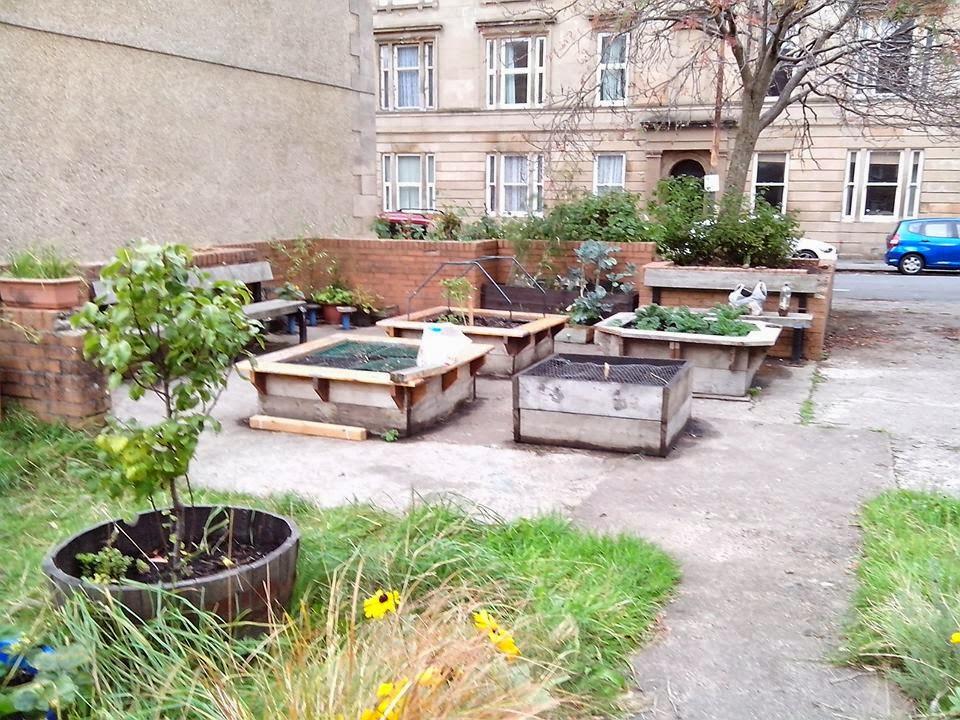
The Willowbank Community Garden is a council-maintained recreational area consisting of both turfed and concreted areas and waist raised beds, edged by some shrubs and trees. It is a small space (460 sqm.) but offers a variety of growing environments. The site is located within the residential community of Willowbank Crescent, easily accessible from Woodlands Road and a five-minute walk away from the Glasgow University main buildings. Local schools are also in close proximity. The place offers locally grown foods with aesthetics and contributes to urban green space. In 2012, it won "Keep Scotland Beautiful" Award (Ref 2).

The Willowbank Community Garden
Source: http://guwillowbankgarden.blogspot.ch/
Overview
Nature-based solution
- Community gardens and allotments
- Allotments
- Community gardens
Key challenges
- Green space, habitats and biodiversity (SDG 15)
- Green space creation and/or management
- Environmental quality
- Soil quality improvement
- Economic development and employment (SDG 8)
- Economic development: agriculture
- Sustainable consumption and production (SDG 12)
- Sustainable production
Focus
Creation of new green areas, Transformation of previously derelict areas
Project objectives
(a) The mission was to demonstrate sustainable practice by turning a recreational area into a portion of productive food growing space where people can gather to acquire and exchange knowledge (Ref 2).
(b) To produce own homegrown, heirloom, seasonal and fresh food.
(c) organic food growing education.
(d) to learn about harvest-compost-recycle. (e) promote industrialization.
(f) convert a derelict area to a food-producing area where people could engage (Ref 1, 2)
Implementation activities
Students at Glasgow University have taken guardianship of the recreational space on Willowbank Crescent in Woodlands by clearing the space of litter and unwanted items. This has been made possible by coordinating with ECAT officer Yusuf Faisal. In 2012 space won a Keep Scotland Beautiful Award through the People and Places Programme. The activities include arranging raised beds, filling them up with soil and compost, starting tatsoy, spring onion, red Russian kale, spinach beet, Chinese sprouting cabbage seedlings in seed trays; planting strawberries, sage, mint, lemongrass, goji berry, wild thyme, lovage, fennel, cowberry and rhubarb; turning drawers into planting boxes. Instead of the interest of the locals and the students from the Glasgow university, the project got stalled in 2015 (Ref 2, 5).
Main beneficiaries
- Researchers/University
- Citizens or community groups
Governance
Management set-up
- Co-governance with government and non-government actors
Type of initiating organisation
- Researchers/university
Participatory approaches/ community involvement
- Joint implementation (e.g. tree planting)
- Co-management/Joint management
Details on the roles of the organisations involved in the project
The Glasgow City Council is the owner of the space. The students of Glasgow University took the initiative to implement activities to make the area as a community garden. (Ref 2).
Project implemented in response to ...
... an EU policy or strategy?
Unknown
... a national policy or strategy?
Unknown
... a local policy or strategy?
Yes
(Glasgow Allotments Strategy 2009-2013: it is a Scottish strategy in the allotment of the community gardens (Ref 3). )
Financing
Total cost
Unknown
Source(s) of funding
- Crowdfunding
Type of funding
- Donations
Non-financial contribution
Type of non-financial contribution
- Provision of land
- Provision of goods
- Provision of labour
Who provided the non-financial contribution?
- Citizens (e.g. volunteering)
Impacts and Monitoring
Environmental impacts
- Environmental quality
- Improved waste management
- Green space and habitat
- Increased green space area
- Increased conversion of degraded land or soil
- Enhanced support of pollination
- Restoration of derelict areas
- Other
Economic impacts
- Increase in agricultural production (for profit or not)
- Attraction of business and investment
Socio-cultural impacts
- Social justice and cohesion
- Increased involvement of locals in the management of green spaces
- Increased access to healthy/affordable food
- Increased sustainability of agriculture practices
- Health and wellbeing
- Improved mental health
- Gain in activities for recreation and exercise
- Cultural heritage and sense of place
- Improvement in people’s connection to nature
- Education
- Increased support for education and scientific research
- Increased knowledge of locals about local nature
- Increased awareness of NBS and their benefits
Type of reported impacts
Achieved impacts
Presence of formal monitoring system
Unknown
Presence of indicators used in reporting
No evidence in public records
Presence of monitoring/ evaluation reports
No evidence in public records
Availability of a web-based monitoring tool
No evidence in public records
References
1. Cumbers Andrew, Shaw Deirdre, Crossan John, McMaster Robert (2017) The Work of Community Gardens: Reclaiming Place for Community in the City. Available at: Source link. Accessed on 28th July 2020.
2. Willowbank Community Garden. Available at: Source link. Accessed on 28th July, 2020.
3. Glasgow Community Growing Project. Central Scotland Green Network. Available at: Source link. Accessed on 28th July 2020.
4. Willowbank Community Garden. Yelp. Available at: Source link. Accessed on 28th July, 2020.
5. List of Stalled Spaces projects 2011-2016. Glasgow City Council. Available at: Source link. Accessed on 28th July, 2020.
2. Willowbank Community Garden. Available at: Source link. Accessed on 28th July, 2020.
3. Glasgow Community Growing Project. Central Scotland Green Network. Available at: Source link. Accessed on 28th July 2020.
4. Willowbank Community Garden. Yelp. Available at: Source link. Accessed on 28th July, 2020.
5. List of Stalled Spaces projects 2011-2016. Glasgow City Council. Available at: Source link. Accessed on 28th July, 2020.
The Willowbank Community Garden
Source: http://guwillowbankgarden.blogspot.ch/