

Last updated: October 2021
Malls Mire is an area of mixed woodland and wetland habitat situated between Toryglen and Rutherglen. People from the surrounding communities have been working with Urban Roots to manage the woodland since 2009, improving its value for wildlife and working on the paths so that more people can enjoy it(Ref 1). It was declared a Local Nature Reserve in March 2015(Ref 2). Surveys by entomologists showed that the site is valuable for a number of rare beetles and a spider, the latter, Southern Motherphage (Coelotes terrestris) having only been found at one other site in Scotland(Ref 2).
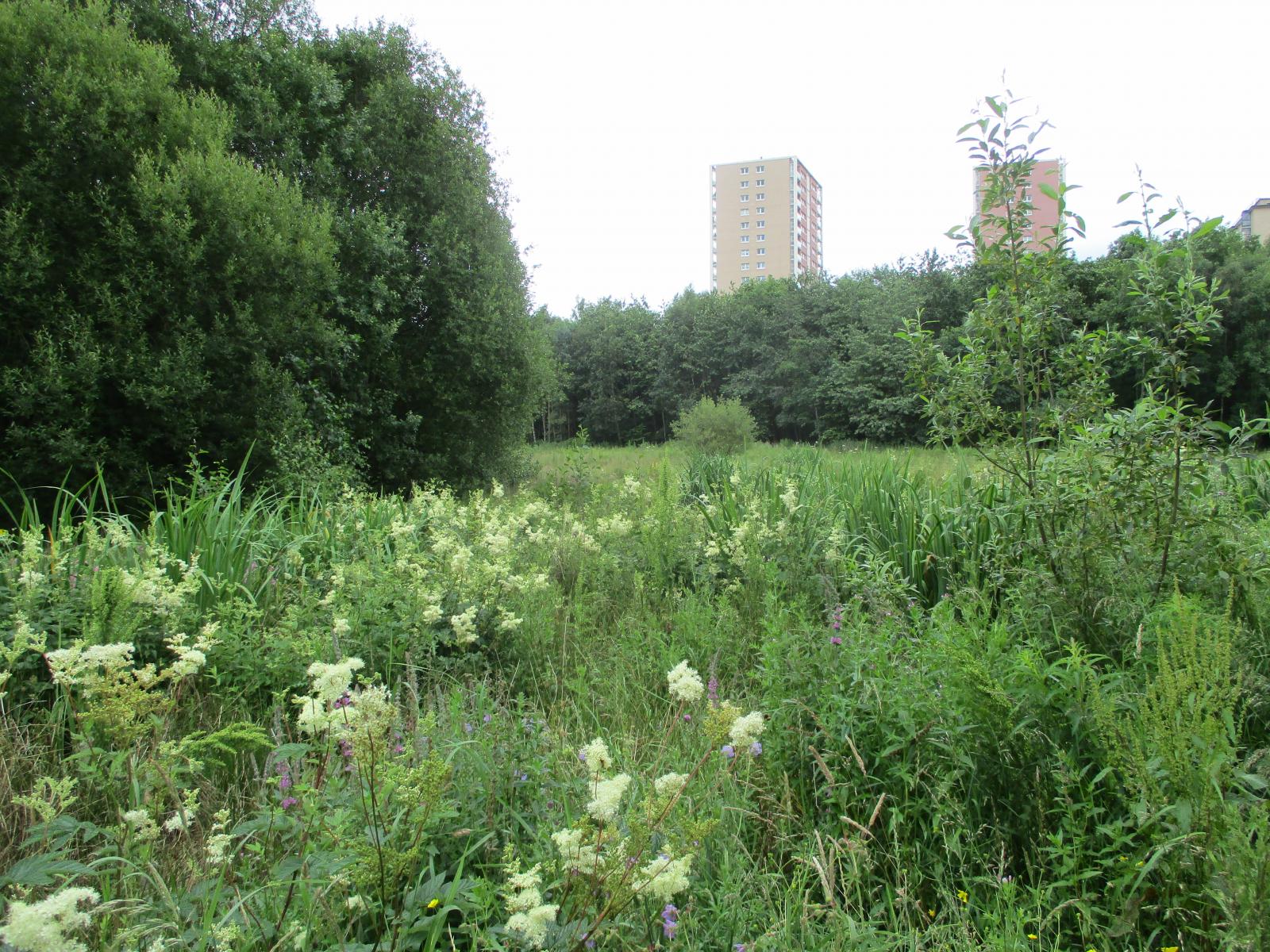
Mall's Mire Community Woodland & Local Nature Reserve (2017)
Lindsey Duncan, retrieved 08/18/2018
Overview
Nature-based solution
- Parks and urban forests
- Large urban parks or forests
Key challenges
- Climate action for adaptation, resilience and mitigation (SDG 13)
- Climate change mitigation
- Green space, habitats and biodiversity (SDG 15)
- Habitat and biodiversity restoration
- Habitat and biodiversity conservation
- Green space creation and/or management
- Environmental quality
- Air quality improvement
- Inclusive and effective governance (SDG 16)
- Effective management
- Social justice, cohesion and equity (SDG 10)
- Environmental education
- Social interaction
- Health and well-being (SDG 3)
- Enabling opportunities for physical activity
- Creation of opportunities for recreation
Focus
Maintenance and management of urban nature, Ecological restoration of ecosystems, Transformation of previously derelict areas, Monitoring and maintenance of habitats and/or biodiversity
Project objectives
The plan is (a) to make it a better place for wildlife and a better place for people, (b) to preserve the current tree species present and increase the diversity of native tree and plant species, (c) conserve the flora and fauna and improve wildlife habitats, (d) increase the number of tourists and visitors, (e) increase awareness among the locals by arranging workshops and campaign. (Ref 1)
Implementation activities
Small-scale woodland (and other non-woodland habitats) management, fund-raising, planning and administration of large scale is carried out by the woodland officer, with support from regular volunteers and an officer from Glasgow City Council’s natural environment team. Thinning out the trees to create more space for the best trees to spread out, removing some of the dangerous and damaged trees and improving the path network so that people can enjoy it more easily (Ref 5). Examples of some recent work include Path Maintenance, Habitat surveying, Litter Collection, Meadow management and Tree felling (Ref 1). Woodland management has mainly focused on conservation of the woodland and improving access through clearing windblown trees, halo thinning to favour veteran trees of conservation value, removing shade-tolerant non-native species, enrichment planting of woodland flower species and clearing rubbish. Furthermore, as part of the Prince of Wales Scheme for Disadvantaged Young People, work has been carried out by young delinquents on putting in a wooden path around a small pond on the site (Ref 5).
Climate-focused activities
Climate change mitigation:
- Increase green urban nature for carbon storage (wetlands, tree cover)
- Implement sustainable forest management measures to increase carbon sinks/ improve carbon storage
- Invest in public transport/bicycle infrastructure as a means to prevent car use
Biodiversity conservation or restoration-focused activities
Biodiversity conservation:
- Protect and enhance urban habitats
- Preserve and strengthen existing habitats and ecosystems
- Promote environmentally-sound development in and around protected areas
- Preserve and strengthen habitat connectivity
- Protect species
- Undertake specific measures to protect species
- Undertake specific measures to protect valued species
- Control and clean invasive alien species
- Means for conservation governance
- Manage biological resources for conservation and sustainable use
- Raise public awareness
- Public engagement
Biodiversity restoration:
- Restore species (native, endangered, or unspecified)
- Restore native species
- Restore valued species
- Clear and control invasive alien species
- Public engagement
Main beneficiaries
- Citizens or community groups
- Marginalized groups: Elderly people, People with functional diversities
Governance
Management set-up
- Led by non-government actors
Type of initiating organisation
- Non-government organisation/civil society
- Citizens or community group
Participatory approaches/ community involvement
- Co-management/Joint management
Details on the roles of the organisations involved in the project
Urban Roots currently undertake management work and assist with promotion of the site (and its biodiversity) amongst the local community in Toryglen (Ref 2). Urban Roots is a community led environmental and health improvement organisation working across the Southside of Glasgow (Ref 2). The woodland has a shared ownership between Glasgow City Council (c. 85%) and South Lanarkshire Council (c. 15%). Urban Roots has a single, rolling use agreement (without expiry date) with Glasgow City Council, and a letter from South Lanarkshire Council supporting the activities of the group. The agreement from Glasgow City Council has built-in assessment timescales but there is no obligation to carry out any review or assessment (Ref 5).
Project implemented in response to ...
... an EU policy or strategy?
Unknown
... a national policy or strategy?
Yes
(Land Reform Act: in the management and planning of the open space and landscape (Ref 5))
... a local policy or strategy?
Unknown
Financing
Total cost
€500,000 - €2,000,000
Source(s) of funding
- Public national budget
- Private Foundation/Trust
- Multilateral funds/international funding
Type of funding
- Earmarked public budget
- Direct funding (grants, subsidies, or self-financed projects by private entities)
- Donations
Non-financial contribution
Type of non-financial contribution
- Provision of land
- Provision of labour
Who provided the non-financial contribution?
- Citizens (e.g. volunteering)
Impacts and Monitoring
Environmental impacts
- Climate change
- Lowered local temperature
- Enhanced carbon sequestration
- Environmental quality
- Improved air quality
- Green space and habitat
- Promotion of naturalistic styles of landscape design for urban development
- Increased number of protection areas
- Increased conservation or restoration of ecosystems
- Increase in protected green space areas
- Reduced biodiversity loss
- Improved prevention or control of invasive alien species
- Restoration of derelict areas
Economic impacts
- Other
Socio-cultural impacts
- Social justice and cohesion
- Improved social cohesion
- Improved access to urban green space
- Increased involvement of locals in the management of green spaces
- Health and wellbeing
- Gain in activities for recreation and exercise
- Cultural heritage and sense of place
- Improvement in people’s connection to nature
- Increased awareness of flora and fauna as culturally and historically meaningful
- Increased appreciation for natural spaces
- Education
- Increased support for education and scientific research
- Increased knowledge of locals about local nature
- Increased awareness of NBS and their benefits
Type of reported impacts
Achieved impacts
Presence of formal monitoring system
Unknown
Presence of indicators used in reporting
No evidence in public records
Presence of monitoring/ evaluation reports
No evidence in public records
Availability of a web-based monitoring tool
No evidence in public records
References
1. Malls Mire Community Woodland. Community Woodland. Urban Roots. Available at: Source link. Accessed on 28th July 2020.
2. Urban Roots. Available at: Source link. Accessed on 29th July, 2020.
3. Malls Mire LNR. Friends of Glasgow’s Local Nature Reserve. Available at: Source link. Accessed on 29th July 2020.
4. Malls Mire Community Reserve. Woodland Trust. Available at: Source link. Accessed on 29th July, 2020.
5. Jagt. A. 2014. CWG Case study. CS 27 Urban Roots Initiative. Available at: Source link. Accessed on 29th July, 2020.
2. Urban Roots. Available at: Source link. Accessed on 29th July, 2020.
3. Malls Mire LNR. Friends of Glasgow’s Local Nature Reserve. Available at: Source link. Accessed on 29th July 2020.
4. Malls Mire Community Reserve. Woodland Trust. Available at: Source link. Accessed on 29th July, 2020.
5. Jagt. A. 2014. CWG Case study. CS 27 Urban Roots Initiative. Available at: Source link. Accessed on 29th July, 2020.