

Last updated: October 2021
A five-year project, would be the largest sustainable water drainage system project to be implemented in Glasgow. The investment follows years of study by the Metropolitan Glasgow Strategic Drainage Partnership, which includes Scottish Water, the Scottish Environment Protection Agency and Glasgow City Council. (Ref 1)
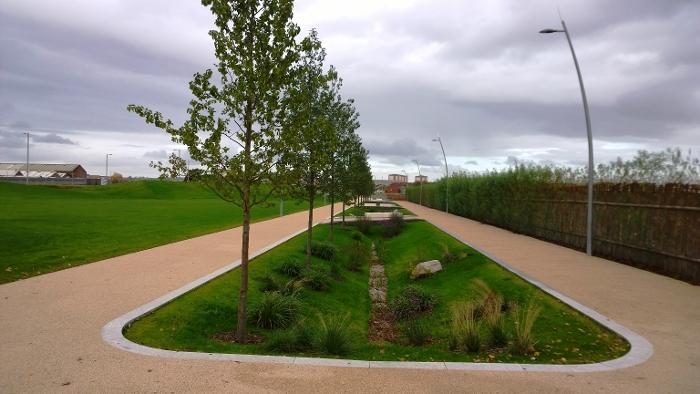
RainGarden
Source: The Metropolitan Glasgow Strategic Drainage Partnership. Available at: https://www.mgsdp.org/index.aspx?articleid=21096. Accessed on 31st July, 2020
Overview
Nature-based solution
- Green areas for water management
- Sustainable urban drainage systems
Key challenges
- Climate action for adaptation, resilience and mitigation (SDG 13)
- Climate change adaptation
- Water management (SDG 6)
- Flood protection
- Stormwater and rainfall management and storage
- Improvements to water quality
Focus
Creation of semi-natural blue areas, Improved governance of green or blue areas, Management and improved protection of rivers and other blue areas
Project objectives
The purpose of SuDS is (a) to provide water quality treatment and the attenuation of surface water prior to discharge to a receiving network. Also, (b) to implement, overlook, and monitor SuDS features such as ponds and basins. (c) To design the features to be accessible for maintenance purposes. In addition (d) a fully integrated system into the development’s open space and movement strategy requirements. (e) To promote the above-ground management and separation of surface water from foul sewerage (Ref 3).
Implementation activities
Any flows which exceed the design capacity of the SuDS or conveyance network designed to be routed in a controlled manner to an appropriate location. All developments having the potential is planned to discharged to a waterbody/watercourse or covered by a SWMP was provided the requisite levels of water quality treatment (Ref 3). In addition to meeting the basic water quality treatment requirements, the Council assessed the integration of the SuDS features into the overall development design. This was undertaken as part of a placemaking approach to the design of the new development and was considered in conjunction with the City Development Plan’s requirements for enhancing biodiversity, access to open space and the provision of sustainable travel routes as part of a multifunctional green network (Ref 3). Other implementation activities included, (1) Croftfoot Park: a new SuDS basin was constructed to attenuate surface runoff from Croftfoot Park (2) Shieldhall Strategic Tunnel: Scottish Water has built a 3.1 mile-long wastewater tunnel in the south of Glasgow (3) Ruchill SuDS Ponds: a series of linked SuDS ponds in Ruchill Park to manage surface water prior to discharge to the Forth & Clyde Canal at Firhill Basin (4) White Cart Water Flood Alleviation Scheme: 3no. upper catchment, on-line, flood storage reservoirs at Blackhouse (Earn Water), Kirkland Bridge (White Cart Water) and Kittoch Bridge (Kittoch Water), and urban flood defences along sections of the White Cart Water and Auldhouse Burn river corridors in the southside of the city. (5) Camlachie Burn Overflow: a 1300m long, 2.7m diameter flood by-pass tunnel, with a capacity of 11.8 cubic meters per second, from the Camlachie Burn at Camlachie Street to the River Clyde. (6) Toryglen Regional SuDS Pond: a regional SuDS pond designed to receive flows from the Toryglen area. (7) Wastewater treatment: the investment includes upgrades to Combined Sewer Overflows (CSO's) and improvements to the wastewater network across the MGSDP area. (8) South Dalmarnock Regional SuDS: a regional SuDS pond designed to receive flows. (9) Carstairs Street SuDS - Linear water feature/swale and highway rain gardens (10) North Renfrew Flood Prevention Scheme: a 3m high embankment and a new underground pumping station (11) Colquhoun Park Flood Alleviation Scheme: Flood storage area during strom (12) Springburn and Yoker and Clydebank Water Quality and Flooding Projects and (13) greenroofs. (Ref 4)
Climate-focused activities
Climate change adaptation:
- Implement sustainable urban drainage infrastructure (e.g. to make space for water)
Main beneficiaries
- National-level government
- Local government/Municipality
- Citizens or community groups
Governance
Management set-up
- Government-led
Type of initiating organisation
- National government
- Local government/municipality
Participatory approaches/ community involvement
- Consultation (e.g. workshop, surveys, community meetings, town halls)
Details on the roles of the organisations involved in the project
The innovation is led by the Glasgow City Council and Scottish Water. (Ref 1)
Project implemented in response to ...
... an EU policy or strategy?
Yes
(Flood Directive: to mitigate the effect of the flood (Ref 1,3))
... a national policy or strategy?
Yes
(o Flood Risk Management (Scotland) Act 2009: mitigate the effects of flood in the city (Ref 3)
o The Water Environment (Controlled Activities) (Scotland) Regs 2011 (CAR): in management of the city-wide drainage system (Ref 3)
)
... a local policy or strategy?
Yes
(o Surface Water Drainage Strategy (Ref 3)
o The Water Assessment and Drainage Assessment Guide (WADAG) (Ref 2)
)
Financing
Total cost
More than €4,000,000
Source(s) of funding
- EU funds
- Public national budget
Type of funding
- Earmarked public budget
- Direct funding (grants, subsidies, or self-financed projects by private entities)
Non-financial contribution
No
Impacts and Monitoring
Environmental impacts
- Environmental quality
- Improved air quality
- Water management and blue areas
- Improved water quality
- Increased protection against flooding
- Improved stormwater management
- Green space and habitat
- Increased green space area
Economic impacts
- Reduce financial cost for urban management
Socio-cultural impacts
- Health and wellbeing
- Gain in activities for recreation and exercise
- Education
- Increased support for education and scientific research
- Increased awareness of NBS and their benefits
Type of reported impacts
Expected impacts, Achieved impacts
Presence of formal monitoring system
Unknown
Presence of indicators used in reporting
No evidence in public records
Presence of monitoring/ evaluation reports
No evidence in public records
Availability of a web-based monitoring tool
No evidence in public records
References
1. Glasgow’s drainage system set for £250m revamp. 2013. Glasgow and West. Scotland. BBC News. URL: Source link. Accessed on 29th July 2020.
2. Diffuse pollution in the urban environment (SUDS). Scottish Environment Protection Agency (SEPA). Available at: Source link. Accessed on 29th July 2020.
3. Water Management. Water Environment. Supplementary Guidance. Proposed City Development Plan 2014. Available at: Source link. Accessed on 30th July 2020.
4. The Metropolitan Glasgow Strategic Drainage partnership. Available at: Source link. Accessed on 31st July, 2020.
2. Diffuse pollution in the urban environment (SUDS). Scottish Environment Protection Agency (SEPA). Available at: Source link. Accessed on 29th July 2020.
3. Water Management. Water Environment. Supplementary Guidance. Proposed City Development Plan 2014. Available at: Source link. Accessed on 30th July 2020.
4. The Metropolitan Glasgow Strategic Drainage partnership. Available at: Source link. Accessed on 31st July, 2020.