

Last updated: October 2021
In 2017, one of Gdynia’s squares was renovated to provide a friendly green public area with aesthetic and social functions. The terrain was regulated by restoring its slope and providing more soil to protect the protruding roots, alleys were reconstructed, lawns created and new vegetation planted [1,3].

Aestheticization of green areas at Gornoslaski Square
Photographer: Aleksander Trafas (2017), retrieved 08/10/2018 from Joanna Jaczewska (Department of Diagnoses and Participation)
Overview
Nature-based solution
- Parks and urban forests
- Pocket parks/neighbourhood green spaces
Key challenges
- Green space, habitats and biodiversity (SDG 15)
- Green space creation and/or management
- Regeneration, land-use and urban development
- Regulation of built environment
- Promote natural styles of landscape design for urban development
- Health and well-being (SDG 3)
- Creation of opportunities for recreation
Focus
Maintenance and management of urban nature
Project objectives
Better access to green public areas in Gdynia, increase the available green urban area and improvement of the aesthetic qualities of the area [1,3].
Implementation activities
1) Regulating the slope with a stone wall - 60-80 m long and 0,15-1,00 m high;
2) Removal of 6 concrete steps (about 1 m3);
3) Removing the turf from the area of 900m2;
4) Purchase and delivery of soil to shape the terrain and cover protruding tree roots (10 tons);
5) Construction of Hanse grand or gravel paths - about 700m2;
6) Building a concrete perimeter - about 100mb;
7) Planting lawn on the area of 900m2 [1].
Main beneficiaries
- Local government/Municipality
- Citizens or community groups
Governance
Management set-up
- Co-governance with government and non-government actors
Type of initiating organisation
- Citizens or community group
Participatory approaches/ community involvement
- Co-planning (e.g. stakeholder workshops, focus groups, participatory mapping)
- Crowd-sourcing/Crowd-funding/Participatory budget
- Consultation (e.g. workshop, surveys, community meetings, town halls)
Details on the roles of the organisations involved in the project
The local community developed a project proposal and applied for funds from the participatory budget of Gdynia. The municipality is responsible for the project's implementation.
Project implemented in response to ...
... an EU policy or strategy?
Unknown
... a national policy or strategy?
Unknown
... a local policy or strategy?
Unknown
Financing
Total cost
€10,000 - €50,000
Source(s) of funding
- Public local authority budget
Type of funding
- Earmarked public budget
Non-financial contribution
Unknown
Impacts and Monitoring
Environmental impacts
- Green space and habitat
- Promotion of naturalistic styles of landscape design for urban development
- Increased conservation or restoration of ecosystems
Economic impacts
- Unknown
Socio-cultural impacts
- Social justice and cohesion
- Improved liveability
- Improved access to urban green space
- Cultural heritage and sense of place
- Protection of historic and cultural landscape / infrastructure
Type of reported impacts
Achieved impacts
Presence of formal monitoring system
Yes
Presence of indicators used in reporting
No evidence in public records
Presence of monitoring/ evaluation reports
Yes
Availability of a web-based monitoring tool
No evidence in public records
References
1. Project's application website, Gdynia's participatory budget 2015, 'Estheticization of green areas at Gornoslaski Square - stage 1' ('Estetyzacja terenu zielonego przy Pl. Górnośląskim - etap 1'), Source link (Accessed: 26 September 2020).
2. Monitoring of program's implementation, Gdynia's participatory budget 2015, 'Estheticization of green areas at Gornoslaski Square - stage 1' ('Estetyzacja terenu zielonego przy Pl. Górnośląskim - etap 1'), Source link (Accessed: 26 September 2020).
3. Online article, (2017) 'Gornoslaski Square: the realization of the winning project begins' ('Plac Górnośląski: zaczyna się realizacja zwycięskiego projektu'), Source link (Accessed: 26 September 2020).
2. Monitoring of program's implementation, Gdynia's participatory budget 2015, 'Estheticization of green areas at Gornoslaski Square - stage 1' ('Estetyzacja terenu zielonego przy Pl. Górnośląskim - etap 1'), Source link (Accessed: 26 September 2020).
3. Online article, (2017) 'Gornoslaski Square: the realization of the winning project begins' ('Plac Górnośląski: zaczyna się realizacja zwycięskiego projektu'), Source link (Accessed: 26 September 2020).
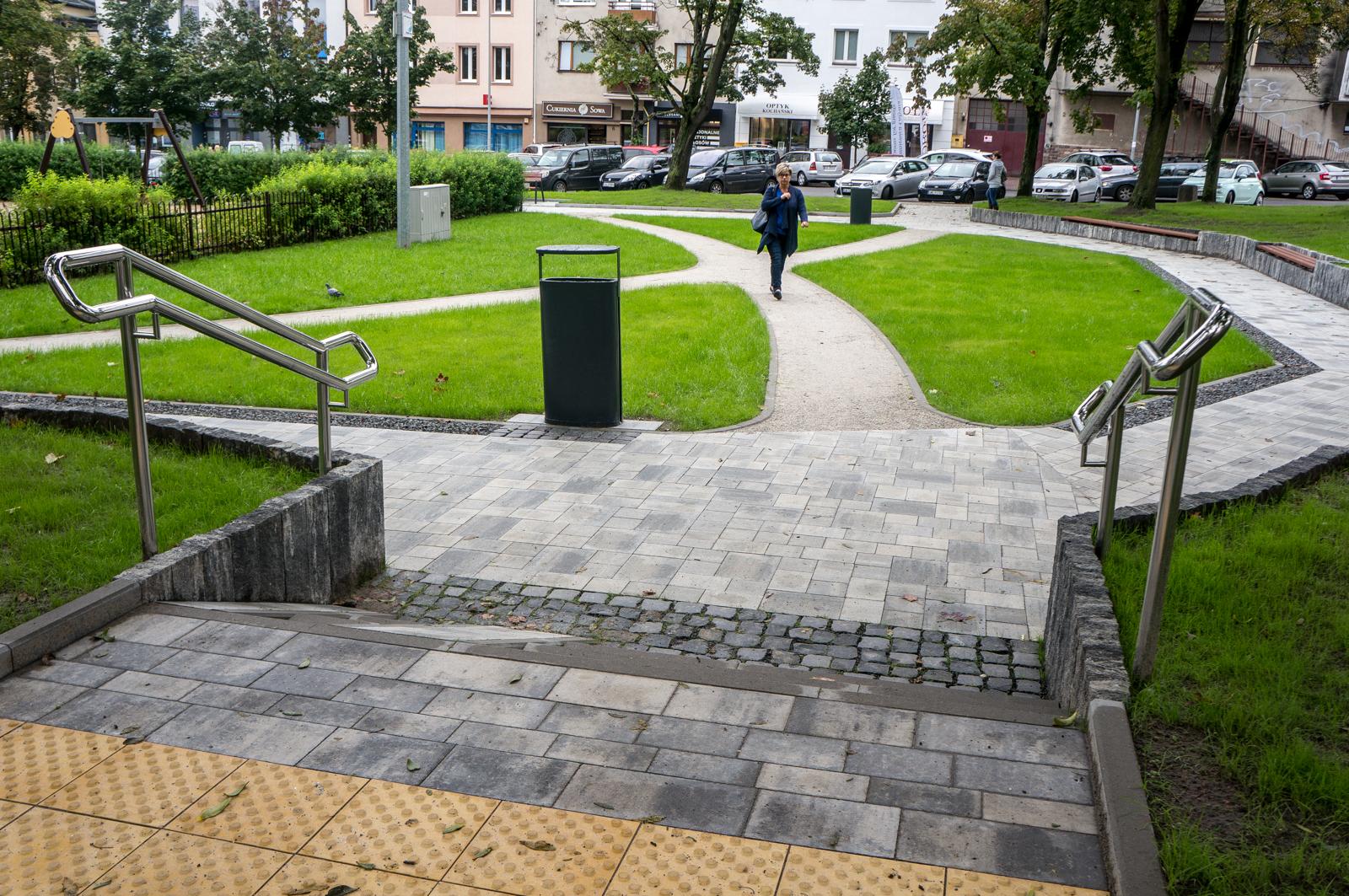
Aestheticization of green areas at Gornoslaski Square
Photographer: Aleksander Trafas (2017), retrieved 08/10/2018 from Joanna Jaczewska (Department of Diagnoses and Participation)