

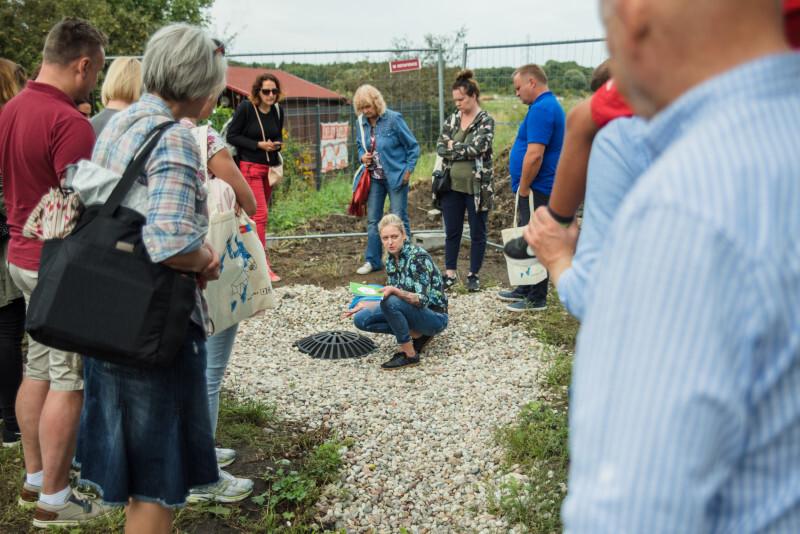
Rainwater management in Gdańsk presents significant challenges due to the city's hydromorphological conditions, including high groundwater levels and steep terrain. These factors, coupled with the periodic inefficiency of the storm sewer system and the intensification of extreme weather events such as heavy rainfall, have necessitated innovative solutions. Gdańsk has responded by implementing a climate change adaptation policy that promotes the use of open drainage systems, including small retention facilities like rain gardens. These gardens help mitigate the risks associated with excessive rainfall while enhancing urban sustainability. The first rain garden in Gdańsk was established in the Stogi district at the Flood Control Warehouse on Kaczeńce Street. This facility collects and utilizes rainwater from nearby paved surfaces, aiming to manage rainfall of at least 30 mm during intense, short-term downpours. Utilizing a variety of perennials such as marsh marigold, common loosestrife, comfrey, hemp agrimony, common calamus, and arrowhead, the garden retains and filters rainwater naturally, increasing efficiency and ecological benefits. Rain gardens absorb water up to 40% better than traditional lawns. They reduce rainwater runoff, mitigate flood risks, filter pollutants, improve biodiversity, and enhance urban air quality while lowering temperatures. The garden was created as part of a broader investment in the Flood Control Warehouse in Stogi, a facility opened in 2017 at a cost of over PLN 5 million. Strategically located near the Sucharski Route and the Martwa Wisła tunnel, the warehouse supports rapid response to flood emergencies, storing over 100 types of equipment, from shovels to large generators. This combination of infrastructure and green solutions demonstrates Gdańsk's commitment to urban resilience and environmental sustainability. (1-4)

Overview
Nature-based solution
- Green areas for water management
- Rain gardens
Key challenges
- Climate action for adaptation, resilience and mitigation (SDG 13)
- Climate change adaptation
- Environmental quality
- Air quality improvement
- Green space, habitats and biodiversity (SDG 15)
- Green space creation and/or management
- Habitat and biodiversity restoration
- Water management (SDG 6)
- Flood protection
- Stormwater and rainfall management and storage
- Improvements to water quality
- Inclusive and effective governance (SDG 16)
- Inclusive governance
- Social justice, cohesion and equity (SDG 10)
- Environmental education
- Sense of community and community engagement
Principal problems in Functional Urban Area (FUA)
- Climate-Related Hazards
- Urban flooding (stormwater)
- Environmental Degradation
- Biodiversity loss
- Air pollution
- Land use and Socio-economic change
- Rapid urbanization
Key priorities
Focus
Project objectives
Implementation activities
Climate-focused activities
Climate change adaptation:
- Increase urban vegetation cover to reduce urban heat island effect
- Implement sustainable urban drainage schemes to manage stormwater
Biodiversity conservation or restoration-focused activities
Biodiversity restoration:
- Restore native species
- Public engagement
Main beneficiaries
- Citizens or community groups
- Young people and children
Governance
Management set-up
- Co-governance with government and non-government actors
Type of initiating organisation
- Local government/municipality
Participatory approaches/ community involvement
- Co-planning (e.g. stakeholder workshops, focus groups, participatory mapping)
- Consultation (e.g. workshop, surveys, community meetings, town halls)
- Joint implementation (e.g. tree planting)
Details on the roles of the organisations involved in the project
Project implemented in response to ...
Type of enablers
Financing
Total cost
Source(s) of funding
- Public local authority budget
Type of funding
- Earmarked public budget
Non-financial contribution
- Provision of labour
- Provision of expertise
- Citizens (e.g. volunteering)
Impacts and Monitoring
Environmental impacts
- Climate change
- Lowered local temperature
- Expected lowered local temperature
- Environmental quality
- Improved air quality
- Expected improved air quality
- Water management and blue areas
- Improved water quality
- Expected improved water quality
- Increased protection against flooding
- Expected increased protection against flooding
- Improved stormwater management
- Expected improved stormwater management
- Green space and habitat
- Increased number of species present
- Expected increased number of species present
Economic impacts
- Unknown
Socio-cultural impacts
- Education
- Increased awareness of NBS and their benefits
- Expected increased awareness of NBS and their benefits
Type of reported impacts
Presence of formal monitoring system
Presence of indicators used in reporting
Presence of monitoring/ evaluation reports
Availability of a web-based monitoring tool
Potential risks of implementation and trade-offs
References


 Information about this nature-based solution was collected as part of the Naturescapes project funded by the European Union under Grant Agreement No 101084341.