

Last updated: October 2021
Weaver Park is was built on an area of 0.6 ha in the Liberties area in Dublin. It is one of the developments that form a part of the Liberties Greening Strategy. The park’s purpose was to address the lack of green space in the area, to provide a place for skateboarding and other recreational activities, and a place for relaxation and community events. (Ref. 1; Ref. 5)
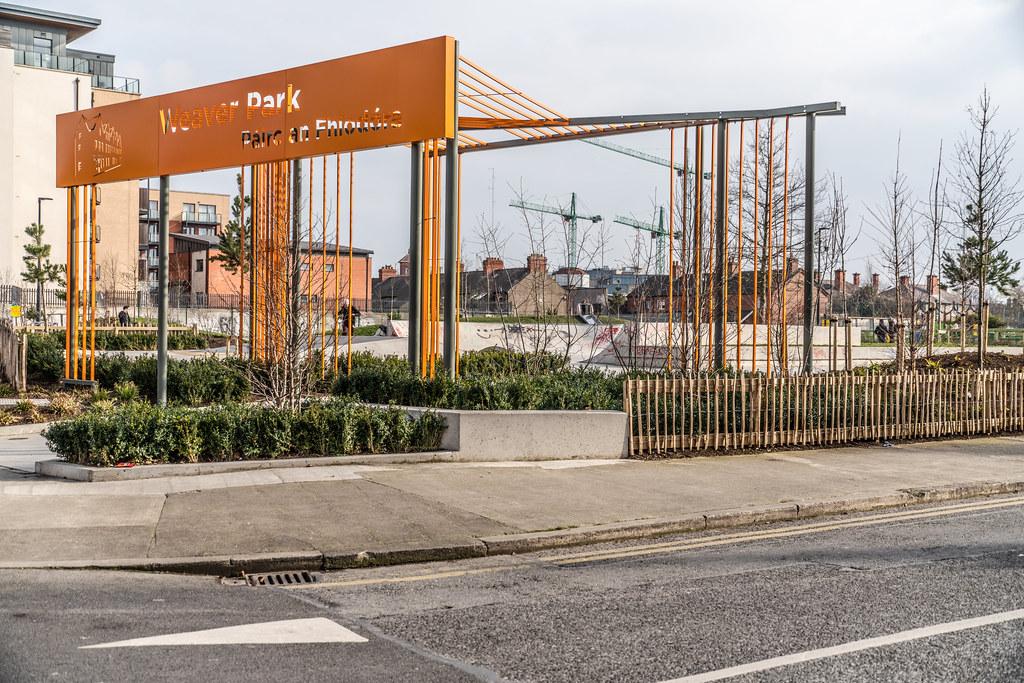
WEAVER PARK - CORK STREET DUBLIN
https://www.excellentstreetimages.com/dublin-street-photography/photo-diary-of-dublin-2018/public-parks-and-gardens/weaver-park-cork-street-dublin-8/
Overview
Nature-based solution
- Parks and urban forests
- Pocket parks/neighbourhood green spaces
Key challenges
- Green space, habitats and biodiversity (SDG 15)
- Green space creation and/or management
- Regeneration, land-use and urban development
- Promote natural styles of landscape design for urban development
- Health and well-being (SDG 3)
- Enabling opportunities for physical activity
- Improving mental health
- Creation of opportunities for recreation
- Cultural heritage and cultural diversity
- Protection of historic and cultural landscape/infrastructure
Focus
Creation of new green areas
Project objectives
1. Address the deficit of space and facilities suitable for skateboarding in the area.
2. Address the deficit of quality green space in the area.
3. Provide a place for community events, recreation, and relaxation.
4. Preserve the knowledge about the historical heritage of the area as being central to Dublin’s cloth working and leather tanning industry.
(Ref. 1; Ref. 4; Ref. 5)
Implementation activities
The plans include a pathway, benches, a playground, a terrace, skateboarding facilities, a large lawn for games and activities, a smaller raised lawn for sitting and reclining. On the edges of this central area will be a terrace onto Cork Street, an enclosed play area, a picnic space, and a small exercise space. Trees and hedges will also be planted. The play equipment is designed to make reference to the historical heritage of the area as being central to Dublin’s cloth working and leather tanning industry. This provides the opportunity to communicate this aspect of the local heritage to the children using the play area. (Ref. 1; Ref. 2; Ref. 3; Ref. 5)
Main beneficiaries
- Citizens or community groups
- Marginalized groups: Elderly people, People with functional diversities
- Young people and children
Governance
Management set-up
- Co-governance with government and non-government actors
Type of initiating organisation
- Local government/municipality
- Citizens or community group
Participatory approaches/ community involvement
- Co-planning (e.g. stakeholder workshops, focus groups, participatory mapping)
- Consultation (e.g. workshop, surveys, community meetings, town halls)
Details on the roles of the organisations involved in the project
The idea about building Weaver Park was suggested to the Dublin City Council in 2013 by the activist group Cork Street Park. The group campaigned for creating green space and skateboarding space in the area, which was insufficient. The Council finally approved the project and organised workshops with the local citizens to establish priorities for the park and design the project together.
(Ref. 1; Ref. 3; Ref. 4)
Project implemented in response to ...
... an EU policy or strategy?
Unknown
... a national policy or strategy?
Unknown
... a local policy or strategy?
Yes
(The Weaver Park project was the first major project to be developed as part of the Liberties Greening Strategy. The strategy builds on the policies and objectives of the Liberties Local Area Plan. (Ref. 1; Ref. 5))
Financing
Total cost
€500,000 - €2,000,000
Source(s) of funding
- Public local authority budget
Type of funding
- Earmarked public budget
Non-financial contribution
Type of non-financial contribution
- Provision of labour
Who provided the non-financial contribution?
- Public authorities (e.g. land, utility services)
Impacts and Monitoring
Environmental impacts
- Green space and habitat
- Promotion of naturalistic styles of landscape design for urban development
- Increased green space area
- Reduced biodiversity loss
- Increased number of species present
- Restoration of derelict areas
Economic impacts
- Unknown
Socio-cultural impacts
- Social justice and cohesion
- Improved access to urban green space
- Increased opportunities for social interaction
- Health and wellbeing
- Improved physical health
- Improved mental health
- Gain in activities for recreation and exercise
Type of reported impacts
Expected impacts, Achieved impacts
Presence of formal monitoring system
Yes
Presence of indicators used in reporting
No evidence in public records
Presence of monitoring/ evaluation reports
No evidence in public records
Availability of a web-based monitoring tool
No evidence in public records
References
Ref. 1. Ní Aodha, G. (2017). Work on The Liberties' new park will begin in the coming weeks. [online] available at: Source link (accessed 11th September, 2020).
Ref. 2. Seank (2016). Dublin City Is Getting This Beautiful New Park Next Year. [online] available at: Source link (accessed 11th September, 2020).
Ref. 3. Dublin City Council (2017). Weaver Park opens on Dublin’s Cork Street [online] available at: Source link. (accessed 11th September, 2020).
Ref. 4. Carr, D. (2015). “A People’s Park” The Cork Street Campaign. [online] available at: Source link (accessed 11th September, 2020).
Ref. 5. Dublin City Council (2015). The Liberties Greening Strategy. [online] available at: Source link (accessed 11th September, 2020).
Ref. 2. Seank (2016). Dublin City Is Getting This Beautiful New Park Next Year. [online] available at: Source link (accessed 11th September, 2020).
Ref. 3. Dublin City Council (2017). Weaver Park opens on Dublin’s Cork Street [online] available at: Source link. (accessed 11th September, 2020).
Ref. 4. Carr, D. (2015). “A People’s Park” The Cork Street Campaign. [online] available at: Source link (accessed 11th September, 2020).
Ref. 5. Dublin City Council (2015). The Liberties Greening Strategy. [online] available at: Source link (accessed 11th September, 2020).