

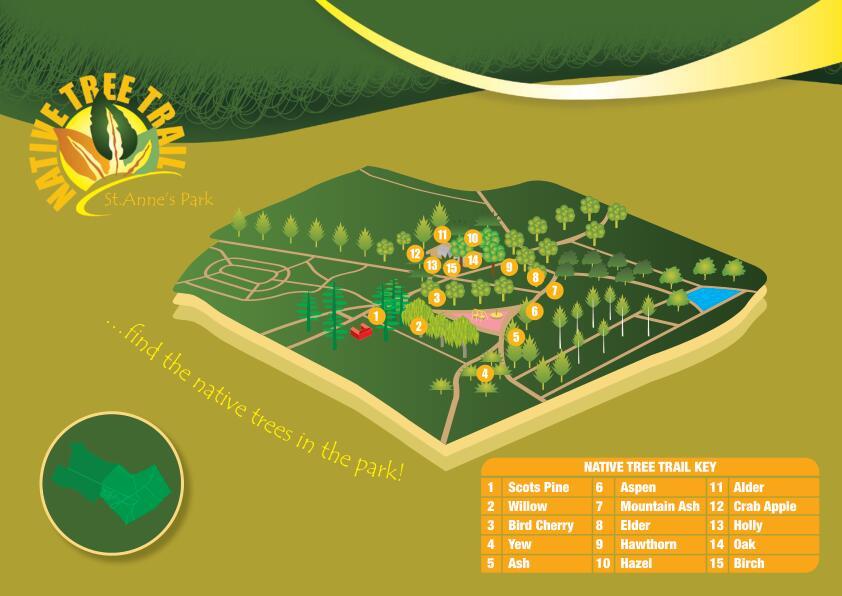
Ireland’s native trees have developed over thousands of years, forming a vibrant ecosystem alongside surrounding plants, animals, fungi, and microbes. These trees provide critical habitats for plants and wildlife, offering essential food and shelter while producing oxygen vital to animals and humans alike. Historically, native trees supplied early Irish communities with fuel, food, shelter, and building materials. Today, they play a modern role in filtering dust, reducing pollution, and enriching urban spaces. To highlight these benefits in Dublin, the Native Tree Trail in St. Anne's Park was created by DCC Parks and Landscape Services in 2008. This trail, featuring 15 different types of native trees, invites visitors to explore and appreciate the natural and cultural heritage of Ireland's native trees, underscoring the value of green spaces for both biodiversity and community well-being. Strategic tree placement contributes to Dublin’s sustainability by reducing soil erosion, sequestering carbon, and mitigating urban heat. A green city is a healthy city, and preserving open spaces enhances its appeal as a place to live, work, and visit. The trail also plays an essential role in environmental education and community engagement. Over the years, St. Anne's Park has hosted multiple tree-planting events, including a 2019 collaboration with local schools for National Tree Week and National Tree Day, in partnership with the Tree Council of Ireland. The NGO has also offered family-friendly guided walks along the trail, helping to instill an appreciation for nature in visitors of all ages (1, 2, 3, 4, 5, p.93).
Overview
Nature-based solution
- Parks and urban forests
- Large urban parks or forests
Key challenges
- Climate action for adaptation, resilience and mitigation (SDG 13)
- Climate change adaptation
- Climate change mitigation
- Environmental quality
- Air quality improvement
- Green space, habitats and biodiversity (SDG 15)
- Green space creation and/or management
- Habitat and biodiversity restoration
- Cultural heritage and cultural diversity
- Preservation of natural heritage
- Social justice, cohesion and equity (SDG 10)
- Environmental education
Principal problems in Functional Urban Area (FUA)
- Climate-Related Hazards
- Heat stress & Extreme temperatures
- Environmental Degradation
- Soil degradation and loss
Key priorities
Focus
Project objectives
Implementation activities
Climate-focused activities
Climate change adaptation:
- Implement measures that prevent/manage desertification, soil erosion and landslides
- Increase urban vegetation cover to reduce urban heat island effect
Climate change mitigation:
- Increase the availability of green urban space for carbon storage (street tree cover)
Biodiversity conservation or restoration-focused activities
Biodiversity restoration:
- Rehabilitate and restore damaged or destroyed ecosystems
- Restore species (native, endangered, or unspecified)
- Restore native species
- Public engagement
Main beneficiaries
- Local government/Municipality
- Non-government organisation/Civil Society
- Citizens or community groups
- Young people and children
Governance
Management set-up
- Co-governance with government and non-government actors
Type of initiating organisation
- Local government/municipality
Participatory approaches/ community involvement
- Dissemination of information and education
- Joint implementation (e.g. tree planting)
Details on the roles of the organisations involved in the project
Project implemented in response to ...
Type of enablers
Financing
Total cost
Source(s) of funding
- Public local authority budget
Type of funding
- Earmarked public budget
Non-financial contribution
Impacts and Monitoring
Environmental impacts
- Climate change
- Lowered local temperature
- Expected lowered local temperature
- Enhanced carbon sequestration
- Expected enhanced carbon sequestration
- Green space and habitat
- Increased conversion of degraded land or soil
- Expected increased conversion of degraded land or soil
- Increased number of species present
- Achieved increased number of species present
Economic impacts
- Unknown
Socio-cultural impacts
- Cultural heritage and sense of place
- Protection of natural heritage
- Expected protection of natural heritage
- Increased awareness of flora and fauna as culturally and historically meaningful
- Expected increased awareness of flora and fauna as culturally and historically meaningful
- Education
- Increased knowledge of locals about local nature
- Expected increased knowledge of locals about local nature
Type of reported impacts
Presence of formal monitoring system
Presence of indicators used in reporting
Presence of monitoring/ evaluation reports
Availability of a web-based monitoring tool
Potential risks of implementation and trade-offs
References
 Information about this nature-based solution was collected as part of the Naturescapes project funded by the European Union under Grant Agreement No 101084341.