

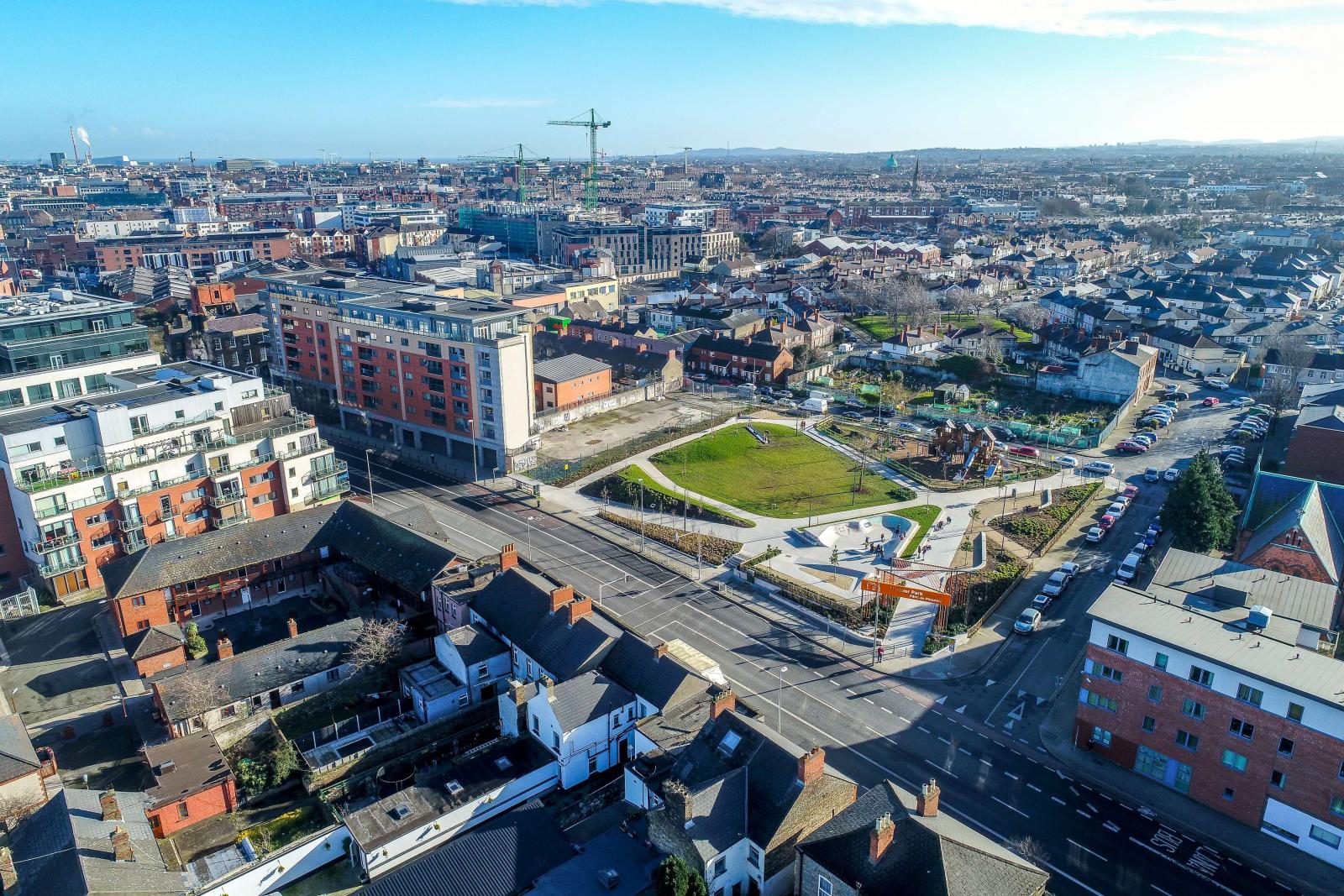
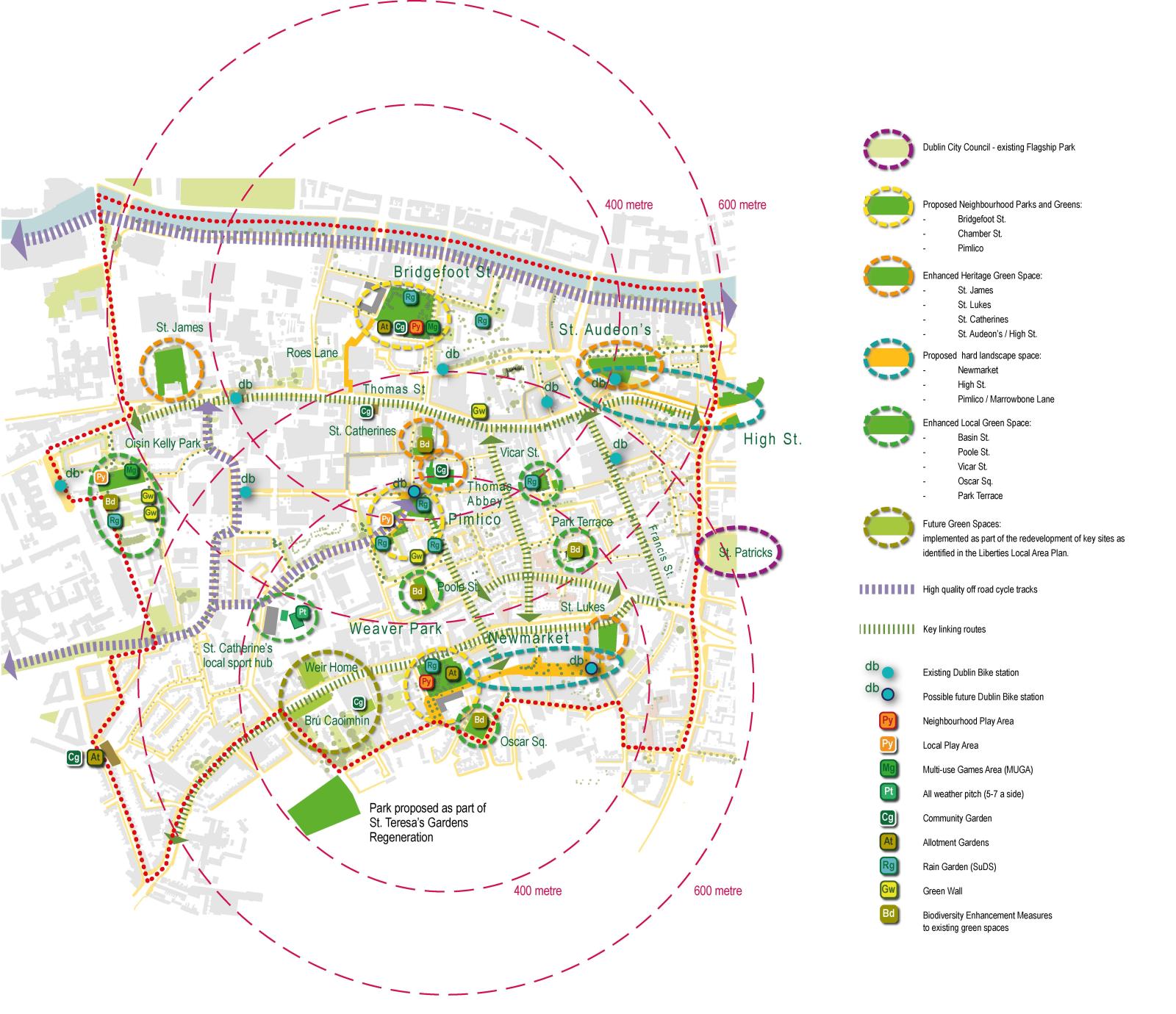
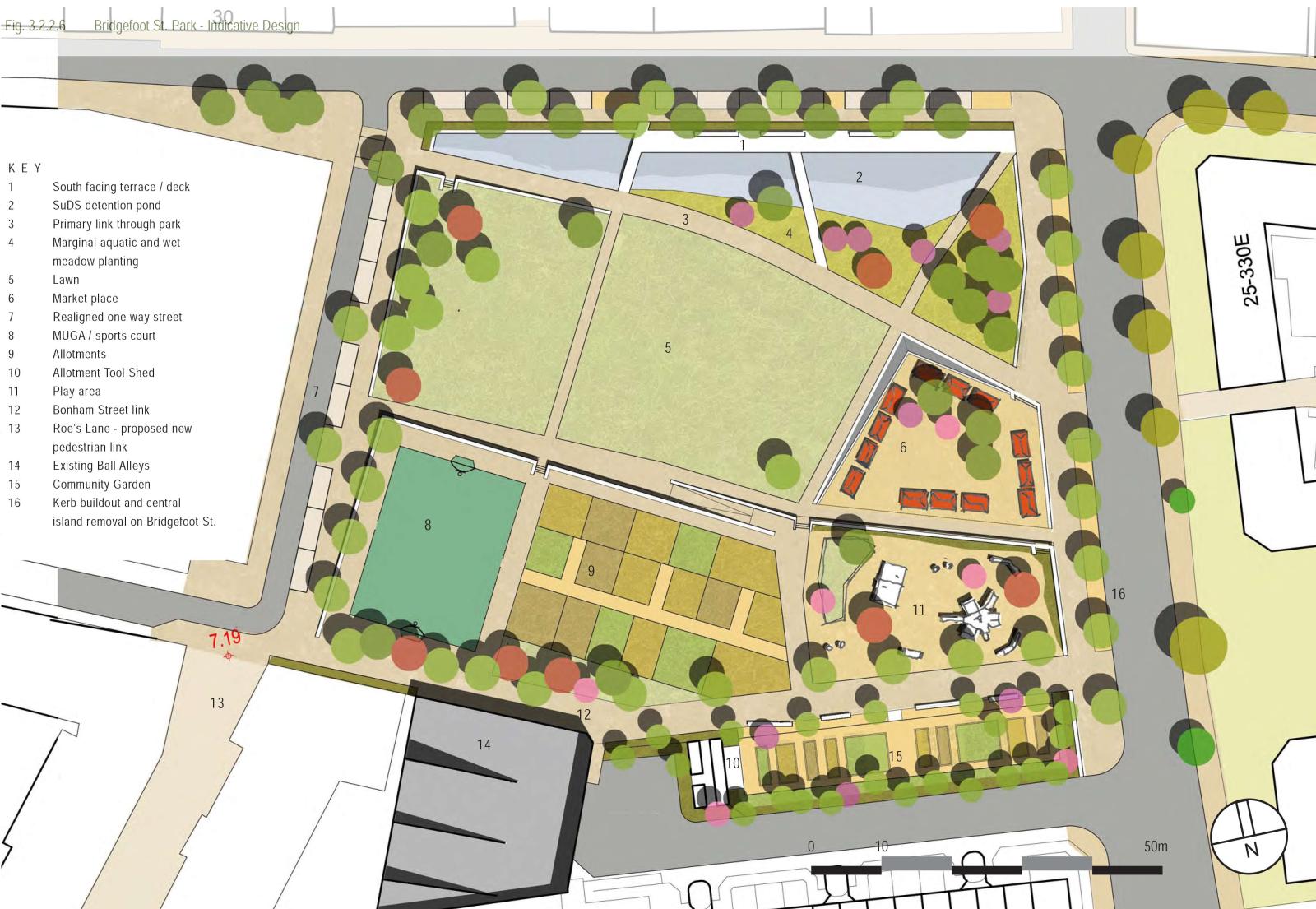
The Liberties is one of the most recognizable urban areas in Dublin and Ireland, strongly associated with old Dublin, working-class communities, and the brewing and distilling industries. While rich in history, cultural significance, and local stories, The Liberties faces numerous placemaking and quality-of-life challenges. The area continues to experience significant dereliction, a fragmented urban fabric, and a shortage of high-quality green spaces. For instance, tree coverage in The Liberties is sparse, with good-quality street trees only found in a few small areas, such as Gray St. and Reginald St., along the South Quays, Cornmarket, and near the fountain on James St. The area has approximately 1,200 trees, amounting to less than 5% canopy coverage. In response to these challenges, Dublin City Council enacted The Liberties Greening Strategy in 2015. Building on the Liberties' Local Area Plan, this strategy aims to develop a network of new urban parks, improve access to heritage green spaces, and refurbish existing parks and play areas. It addresses multiple goals, including ecological connectivity, water management, flood risk reduction, air quality improvement, social cohesion, environmental education, and public health. This strategy is an initiative of the Parks and Landscape Services Division of Dublin City Council, in collaboration with the South Central Area Office and with input from Áit Urbanism + Landscape and Mary Tubridy & Associates. Since its implementation in 2015, the strategy has resulted in the development of two new community parks, enhancements to several green spaces, and the greening of public spaces. It has also introduced measures to support food production in community gardens and allotments, revitalize ecosystems, strengthen water management, improve air quality, boost carbon sequestration through tree planting, divert water from the local sewer network, prevent flooding, and regulate heat. (1, 2, 3)
Overview
Nature-based solution
- Community gardens and allotments
- Community gardens
- Green areas for water management
- Rain gardens
- Grey infrastructure featuring greens
- Alley or street trees and other street vegetation
- Parks and urban forests
- Pocket parks/neighbourhood green spaces
Key challenges
- Climate action for adaptation, resilience and mitigation (SDG 13)
- Climate change adaptation
- Climate change mitigation
- Environmental quality
- Air quality improvement
- Green space, habitats and biodiversity (SDG 15)
- Green space creation and/or management
- Habitat and biodiversity restoration
- Water management (SDG 6)
- Flood protection
- Stormwater and rainfall management and storage
- Improvements to water quality
- Cultural heritage and cultural diversity
- Protection of historic and cultural landscape/infrastructure
- Health and well-being (SDG 3)
- Creation of opportunities for recreation
- Enabling opportunities for physical activity
- Improving physical health
- Inclusive and effective governance (SDG 16)
- Inclusive governance
- Social justice, cohesion and equity (SDG 10)
- Social justice and equity
- Social interaction
- Environmental education
- Sustainable consumption and production (SDG 12)
- Sustainable production
Principal problems in Functional Urban Area (FUA)
- Climate-Related Hazards
- Urban flooding (stormwater)
- Environmental Degradation
- Air pollution
- Land use and Socio-economic change
- Unequal availability and access to public green spaces
- Health, Well-being and Social cohesion
- Disconnection from nature
- Social fragmentation and isolation
- Poor community engagement
Key priorities
Focus
Project objectives
Implementation activities
Climate-focused activities
Climate change adaptation:
- Increase urban vegetation cover to reduce urban heat island effect
Climate change mitigation:
- Increase the availability of green urban space for carbon storage (street tree cover)
Biodiversity conservation or restoration-focused activities
Biodiversity restoration:
- Restore native species
Main beneficiaries
- Local government/Municipality
- Citizens or community groups
- Young people and children
Governance
Management set-up
- Government-led
Type of initiating organisation
- Local government/municipality
Participatory approaches/ community involvement
- Co-planning (e.g. stakeholder workshops, focus groups, participatory mapping)
- Deliberative decision-making processes (e.g., consensus building, deliberative polling)
- Dissemination of information and education
- Consultation (e.g. workshop, surveys, community meetings, town halls)
- Citizen oversight (e.g. boards, advisory)
Details on the roles of the organisations involved in the project
Project implemented in response to ...
Type of enablers
Financing
Total cost
Source(s) of funding
- Public local authority budget
Type of funding
- Earmarked public budget
Non-financial contribution
- Provision of expertise
- Citizens (e.g. volunteering)
Impacts and Monitoring
Environmental impacts
- Climate change
- Lowered local temperature
- Expected lowered local temperature
- Enhanced carbon sequestration
- Expected enhanced carbon sequestration
- Environmental quality
- Improved air quality
- Expected improved air quality
- Water management and blue areas
- Improved water quality
- Expected improved water quality
- Increased protection against flooding
- Expected increased protection against flooding
- Green space and habitat
- Increased green space area
- Expected increased green space area
- Reduced biodiversity loss
- Expected reduced biodiversity loss
Economic impacts
- Increase in agricultural production (for profit or not)
- Expected increase in agricultural production (for profit or not)
- Attraction of business and investment
- Expected attraction of business and investment
Socio-cultural impacts
- Social justice and cohesion
- Improved access to urban green space
- Expected improved access to urban green space
- Increased opportunities for social interaction
- Expected increased opportunities for social interaction
- Increased access to healthy/affordable food
- Expected increased access to healthy/affordable food
- Health and wellbeing
- Gain in activities for recreation and exercise
- Expected gain in activities for recreation and exercise
- Cultural heritage and sense of place
- Protection of historic and cultural landscape / infrastructure
- Expected protection of historic and cultural landscape / infrastructure
- Education
- Increased support for education and scientific research
- Expected increased support for education and scientific research
Type of reported impacts
Presence of formal monitoring system
Presence of indicators used in reporting
Presence of monitoring/ evaluation reports
Availability of a web-based monitoring tool
Potential risks of implementation and trade-offs
References




 Information about this nature-based solution was collected as part of the Naturescapes project funded by the European Union under Grant Agreement No 101084341.