

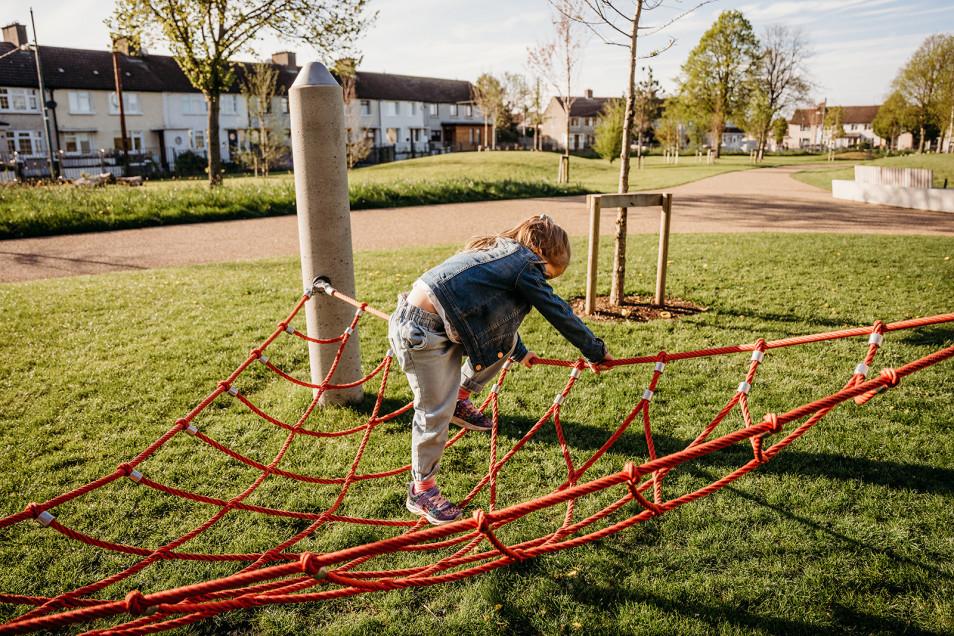
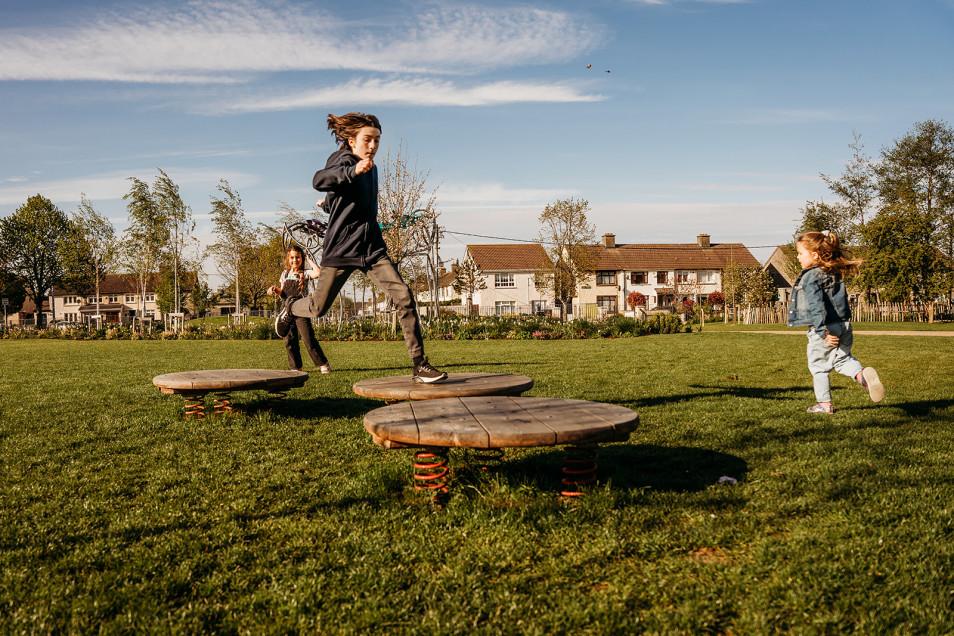
In 2021-2022, the fenced grassy area beside the Ballyfermot Community Civic Centre was transformed into a welcoming 'people’s park'—an open green space for the community (2). Designed by Dublin City Council’s Parks, Biodiversity, and Landscape Services, the park reflects ideas from local residents gathered over eight months of on-site conversations and two community consultation events. The new park features a winding perimeter path, earth mounds planted with a variety of trees and plants for seasonal color, and infrastructure to support small community gatherings. An open pergola and a designated market space for food, plant, and craft markets provide inviting spots for social events. Along the park’s edge, a movement trail with playable elements for exercise and play adds a dynamic feature to the space. Furthermore, a Jackstraws See-Saw is ideal for older children to play in groups and learn about movement whilst also being a tremendous informal seating area for them to gather and chat. Trees cover the See-Saw, offering shade and shelter from the weather, making it a great social space all year round. A Rope Course provides a physical challenge for older children to climb and balance at height while exploring the area. Informal play opportunities are found throughout the park to, with trees, fallen logs, benches and planting that create sensory, imaginative and physical play experiences. (5-7) Additionally, an edible garden is planned to be developed collaboratively with local residents over the next 2-3 years (4).

Overview
Nature-based solution
- Community gardens and allotments
- Community gardens
- Parks and urban forests
- Large urban parks or forests
Key challenges
- Green space, habitats and biodiversity (SDG 15)
- Green space creation and/or management
- Habitat and biodiversity restoration
- Health and well-being (SDG 3)
- Creation of opportunities for recreation
- Enabling opportunities for physical activity
- Inclusive and effective governance (SDG 16)
- Inclusive governance
- Social justice, cohesion and equity (SDG 10)
- Social cohesion
- Social interaction
- Sustainable consumption and production (SDG 12)
- Sustainable production
Principal problems in Functional Urban Area (FUA)
- Land use and Socio-economic change
- Agriculture/ crop production
- Limited economic opportunities and local livelihoods
- Rapid urbanization
- Health, Well-being and Social cohesion
- Physical health harm (from pollution, wildfire, extreme temperature)
- Mental health issues (stress, anxiety)
- Inadequate access to recreational opportunities
- Disconnection from nature
- Poor community engagement
Key priorities
Focus
Project objectives
Implementation activities
Biodiversity conservation or restoration-focused activities
Biodiversity restoration:
- Restore native species
- Restore ecological connectivity
- Public engagement
Main beneficiaries
- Local government/Municipality
- Non-government organisation/Civil Society
- Citizens or community groups
- Food producers and cultivators (i.e. farmers, gardeners)
- Young people and children
- Marginalized groups: Children, young people or youth groups , People with invisible disabilities, Socio-economically disadvantaged populations (e.g. low-income households, unemployed)
Governance
Management set-up
- Co-governance with government and non-government actors
Type of initiating organisation
- Local government/municipality
- Citizens or community group
Participatory approaches/ community involvement
- Co-planning (e.g. stakeholder workshops, focus groups, participatory mapping)
- Consultation (e.g. workshop, surveys, community meetings, town halls)
- Joint implementation (e.g. tree planting)
Details on the roles of the organisations involved in the project
Project implemented in response to ...
Type of enablers
Financing
Total cost
Source(s) of funding
- Public local authority budget
Type of funding
- Earmarked public budget
Non-financial contribution
- Provision of expertise
- Citizens (e.g. volunteering)
Impacts and Monitoring
Environmental impacts
- Green space and habitat
- Increased ecological connectivity across regeneration sites and scales
- Expected increased ecological connectivity across regeneration sites and scales
- Reduced biodiversity loss
- Expected reduced biodiversity loss
- Increased number of species present
- Expected increased number of species present
Economic impacts
- Increased market share for green economies
- Expected increased market share for green economies
Socio-cultural impacts
- Social justice and cohesion
- Improved social cohesion
- Expected improved social cohesion
- Improved access to urban green space
- Expected improved access to urban green space
- Increased opportunities for social interaction
- Expected increased opportunities for social interaction
- Health and wellbeing
- Gain in activities for recreation and exercise
- Expected gain in activities for recreation and exercise
- Improved physical health
- Expected improved physical health
- Cultural heritage and sense of place
- Improvement in people’s connection to nature
- Expected improvement in people’s connection to nature
- Education
- Increased support for education and scientific research
- Expected increased support for education and scientific research
Type of reported impacts
Presence of formal monitoring system
Presence of indicators used in reporting
Presence of monitoring/ evaluation reports
Availability of a web-based monitoring tool
Potential risks of implementation and trade-offs
References



 Information about this nature-based solution was collected as part of the Naturescapes project funded by the European Union under Grant Agreement No 101084341.