

Last updated: June 2024
The Humberhead Peatlands are the UK's largest lowland raised bog complex and are part of the Natura 2000 network. They are located East of Doncaster and include the Thorne Moors and the Hatfield Moors (both towns are part of the Doncaster Borough). Commercial peat extraction has changed the hydraulic balance of the area, which impacts the condition of the peatland. This project aims to restore the water balance and thereby the peatland that can help prevent flooding, which is a breeding ground for the European nightjar, while also creating local jobs. The Humberhead Peatlands LIFE+ project completed its delivery phase in June 2019. (Ref 2, 3)
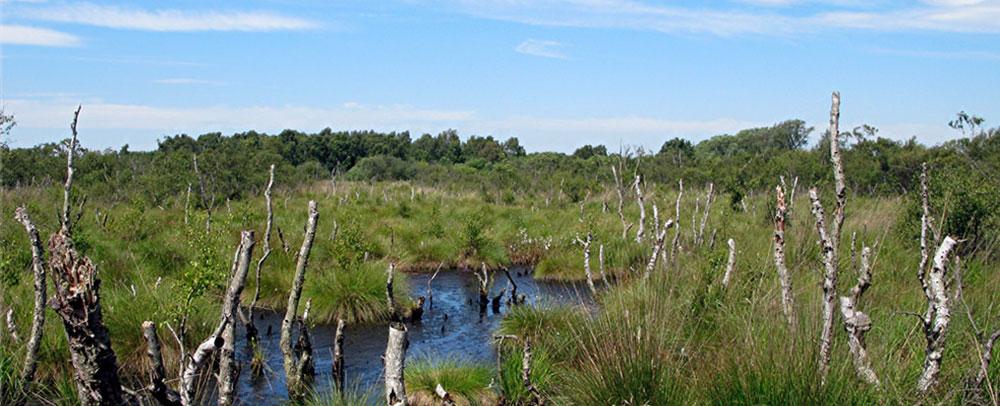
Humberhead Peatlands Project Website
http://www.humberheadpeatlands.org.uk/index.php?page=aboutUs
Overview
Nature-based solution
- Blue infrastructure
- In-land wetlands, peatlands, swamps, and moors
- Other
Key challenges
- Climate action for adaptation, resilience and mitigation (SDG 13)
- Climate change mitigation
- Green space, habitats and biodiversity (SDG 15)
- Habitat and biodiversity restoration
- Green space creation and/or management
- Water management (SDG 6)
- Flood protection
- Improvements to water quality
Focus
Creation of new green areas, Management and improved protection of rivers and other blue areas, Ecological restoration of ecosystems
Project objectives
1. Carry out conservation actions to restore lowland raised bog habitats and to establish a stable water table within +/- 20 cm of ground level across 3273 ha, thus enabling peat-forming vegetation to re-establish on degraded peat bog surfaces;
2. Link up areas of good quality habitat by increasing the general quality of the moors, allowing species to move between quality patches;
3. Create large areas of bog habitat in favourable condition, ensuring suitable conditions for key species despite increasingly varied climatic conditions;
4. Increase the European nightjar population by 15% from the current population of 80-88 territorial males; and Monitor bog recovery by water-level, data-logging and recording the re-establishment of peat-forming vegetation, and assess numbers of breeding European nightjar and key invertebrates. (Ref 1, 3, 4).
Implementation activities
The water balance of the Humberhead Peatlands was restored to better accommodate peat-forming vegetation. This was done by removing scrubs, installing weirs, peat dams and bunds and automatically operated pumping stations. In addition, this has created local jobs (Ref 2).
Climate-focused activities
Climate change mitigation:
- Increase green urban nature for carbon storage (wetlands, tree cover)
Biodiversity conservation or restoration-focused activities
Biodiversity restoration:
- Rehabilitate and restore damaged or destroyed ecosystems
- Restore species (native, endangered, or unspecified)
- Clear and control invasive alien species
Main beneficiaries
- Local government/Municipality
- Citizens or community groups
Governance
Management set-up
- Co-governance with government and non-government actors
Type of initiating organisation
- National government
- Local government/municipality
- Non-government organisation/civil society
- EU body
Participatory approaches/ community involvement
- Dissemination of information and education
- Joint implementation (e.g. tree planting)
Details on the roles of the organisations involved in the project
The project is a collaboration between The EU, Natural England, Doncaster East Internal Drainage Board, Thorne & Hatfield Moors Conservation Forum, Lincolnshire Wildlife Trust, North Lincolnshire Council, Doncaster Metropolitan Borough Council. The roles of the parties involved are not specified for this specific project, but a brief description of each is provided (Ref 1).
Project implemented in response to ...
... an EU policy or strategy?
Yes
(The LIFE programme (Ref. 2) project description refers to Nature Protection and Biodiversity, and Directive 92/43 - Conservation of natural habitats of wild fauna and flora - Habitats Directive. )
... a national policy or strategy?
Yes
(The Humberhead Levels are a Nature Improvement Area and are thereby part of a national scheme managed by Natural England (Ref 8) )
... a local policy or strategy?
Yes
(The Doncaster Green Infrastructure Strategy document of 2014 (Ref 5) refers to the Humberhad Level Peatland restoration.)
Financing
Total cost
More than €4,000,000
Source(s) of funding
- Public local authority budget
- Public national budget
- EU funds
Type of funding
- Earmarked public budget
- Direct funding (grants, subsidies, or self-financed projects by private entities)
- Unknown
Non-financial contribution
No
Impacts and Monitoring
Environmental impacts
- Climate change
- Enhanced carbon sequestration
- Environmental quality
- Improved waste management
- Improved soil quality
- Water management and blue areas
- Increased protection against flooding
- Enhanced protection and restoration of freshwater ecosystems
- Green space and habitat
- Increased green space area
- Increase in protected green space areas
- Increased number of protection areas
- Reduced biodiversity loss
Economic impacts
- Increase of green jobs (e.g. paid employment positions)
Socio-cultural impacts
- Education
- Increased support for education and scientific research
- Increased knowledge of locals about local nature
Type of reported impacts
Expected impacts, Achieved impacts
Presence of formal monitoring system
Yes
Presence of indicators used in reporting
Yes
Presence of monitoring/ evaluation reports
No evidence in public records
Availability of a web-based monitoring tool
No evidence in public records
References
Ref 1. Humberhead Peat Leaflet (attached)
Ref 2. Source link case studies. (no date) THATS-LIFE Restoring Humberhead Peatlands: LIFE+ Project. Available at: Source link. Accessed on 26th October, 2020.
Ref. 3. Source link (no date) Humberhread Peatlands restoration LIFE+ project. Available at: Source link. Accessed on 26th October, 2020.
Ref. 4. Hunberhead Peatland Project Website (no date) Humberhead Peatlands life+ project Hatfield, Thorne, Crowle & Goole Moors. Available at: Source link. Accessed on 26th October, 2020.
Ref 5. Doncaster Metropolitan Borough Council. (2014). The Doncaster Green Infrastructure Strategy 2014-2018: Creating a Greener, healthier and more attractive borough.
Ref 6. Natural England. (2015). Monitoring and evaluation of Nature Improvement Areas: Final report (2012-2015)
Ref 2. Source link case studies. (no date) THATS-LIFE Restoring Humberhead Peatlands: LIFE+ Project. Available at: Source link. Accessed on 26th October, 2020.
Ref. 3. Source link (no date) Humberhread Peatlands restoration LIFE+ project. Available at: Source link. Accessed on 26th October, 2020.
Ref. 4. Hunberhead Peatland Project Website (no date) Humberhead Peatlands life+ project Hatfield, Thorne, Crowle & Goole Moors. Available at: Source link. Accessed on 26th October, 2020.
Ref 5. Doncaster Metropolitan Borough Council. (2014). The Doncaster Green Infrastructure Strategy 2014-2018: Creating a Greener, healthier and more attractive borough.
Ref 6. Natural England. (2015). Monitoring and evaluation of Nature Improvement Areas: Final report (2012-2015)