

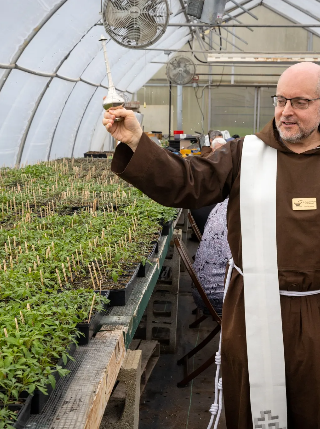
Earthworks Urban Farm, located on Detroit's east side, is a pioneering initiative of the Capuchin Soup Kitchen that integrates sustainable agriculture, social justice, and community development. The Capuchin Soup Kitchen is a religiously affiliated soup kitchen and non-profit organization located in Detroit, Michigan. It was founded by the Capuchin friars to provide food for the poor during the Great Depression and is sponsored by the Capuchin Franciscan Province of St. Joseph. The farm was founded in 1998 by Brother Rick Samyn, and began as a small garden focused on educating local youth about healthy food and its origins. Over time, this modest garden expanded into a 2.5-acre urban farm, including 1.5 certified organic acres—making it Detroit's only certified organic farm. The farm’s growth included adding a large plot behind its partner, Gleaners Community Food Bank, as well as establishing an apiary with up to 40 hives, a greenhouse for transplant production, a hoop house for year-round crops, and a community orchard. Earthworks' work has evolved along with its physical space, significantly extending its reach. A wide variety of vegetables are cultivated here without herbicides or pesticides, with harvests distributed to local residents and included in meals at the Capuchin Soup Kitchen, ensuring fresh, nutritious food for those in need. Beyond agriculture, Earthworks serves as a community hub, engaging volunteers, offering educational tours, and supporting thousands of community gardens across Detroit with transplants and expertise. Committed to evolving its programs, Earthworks has experimented with mobile markets, community-supported agriculture (CSA), and local market stands, demonstrating its dedication to meeting community needs through sustainable practices. (Ref.1,2)
Overview
Nature-based solution
- Community gardens and allotments
- Community gardens
- Horticulture
Key challenges
- Green space, habitats and biodiversity (SDG 15)
- Green space creation and/or management
- Social justice, cohesion and equity (SDG 10)
- Social justice and equity
- Environmental education
- Sense of community and community engagement
- Sustainable consumption and production (SDG 12)
- Sustainable consumption
- Sustainable production
- Food scarcity / security
Principal problems in Functional Urban Area (FUA)
- Land use and Socio-economic change
- Unequal availability and access to public green spaces
- Health, Well-being and Social cohesion
- Disconnection from nature
- Poor community engagement
- Resource Scarcity and Competition
- Food insecurity due to disruptions in food production and distribution
Key priorities
Focus
Project objectives
Implementation activities
Main beneficiaries
- Citizens or community groups
- Young people and children
- Marginalized groups: Children, young people or youth groups , Socio-economically disadvantaged populations (e.g. low-income households, unemployed), Homeless people & people living in informal settlements
Governance
Management set-up
- Led by non-government actors
Type of initiating organisation
- Non-government organisation/civil society
- Other
Participatory approaches/ community involvement
- Co-planning (e.g. stakeholder workshops, focus groups, participatory mapping)
- Crowd-sourcing/Crowd-funding/Participatory budget
- Dissemination of information and education
- Joint implementation (e.g. tree planting)
Details on the roles of the organisations involved in the project
Project implemented in response to ...
Type of enablers
Financing
Total cost
Source(s) of funding
- Corporate investment
- Funds provided by non-governmental organization (NGO)
- Crowdfunding
- Private Foundation/Trust
Type of funding
- Direct funding (grants, subsidies, or self-financed projects by private entities)
- Donations
Non-financial contribution
- Provision of goods
- Provision of labour
- Citizens (e.g. volunteering)
- Private sector (businesses, financial institution)
Impacts and Monitoring
Environmental impacts
- Green space and habitat
- Increased green space area
- Achieved increased green space area
- Increased number of species present
- Achieved increased number of species present
- Enhanced support of pollination
- Achieved enhanced support of pollination
- Restoration of derelict areas
- Achieved restoration of derelict areas
Economic impacts
- Increase of green jobs (e.g. paid employment positions)
- Achieved increase of green jobs (e.g. paid employment positions)
- Generation of other type of work opportunities (e.g. voluntary, work for rehabilitation)
- Achieved generation of other type of work opportunities (e.g. voluntary, work for rehabilitation)
- More sustainable tourism
- Achieved more sustainable tourism
- Increase in agricultural production (for profit or not)
- Achieved increase in agricultural production (for profit or not)
- Generation of income from NBS
- Achieved generation of income from NBS
Socio-cultural impacts
- Social justice and cohesion
- Improved access to urban green space
- Achieved improved access to urban green space
- Increased visibility and opportunity for marginalised groups or indigenous peoples
- Achieved increased visibility and opportunity for marginalised groups or indigenous peoples
- Increased opportunities for social interaction
- Achieved increased opportunities for social interaction
- Increased involvement of locals in the management of green spaces
- Achieved increased involvement of locals in the management of green spaces
- Increased access to healthy/affordable food
- Achieved increased access to healthy/affordable food
- Education
- Increased knowledge of locals about local nature
- Expected increased knowledge of locals about local nature
Type of reported impacts
Presence of formal monitoring system
Presence of indicators used in reporting
Presence of monitoring/ evaluation reports
Availability of a web-based monitoring tool
Potential risks of implementation and trade-offs
References


 Information about this nature-based solution was collected as part of the Naturescapes project funded by the European Union under Grant Agreement No 101084341.