

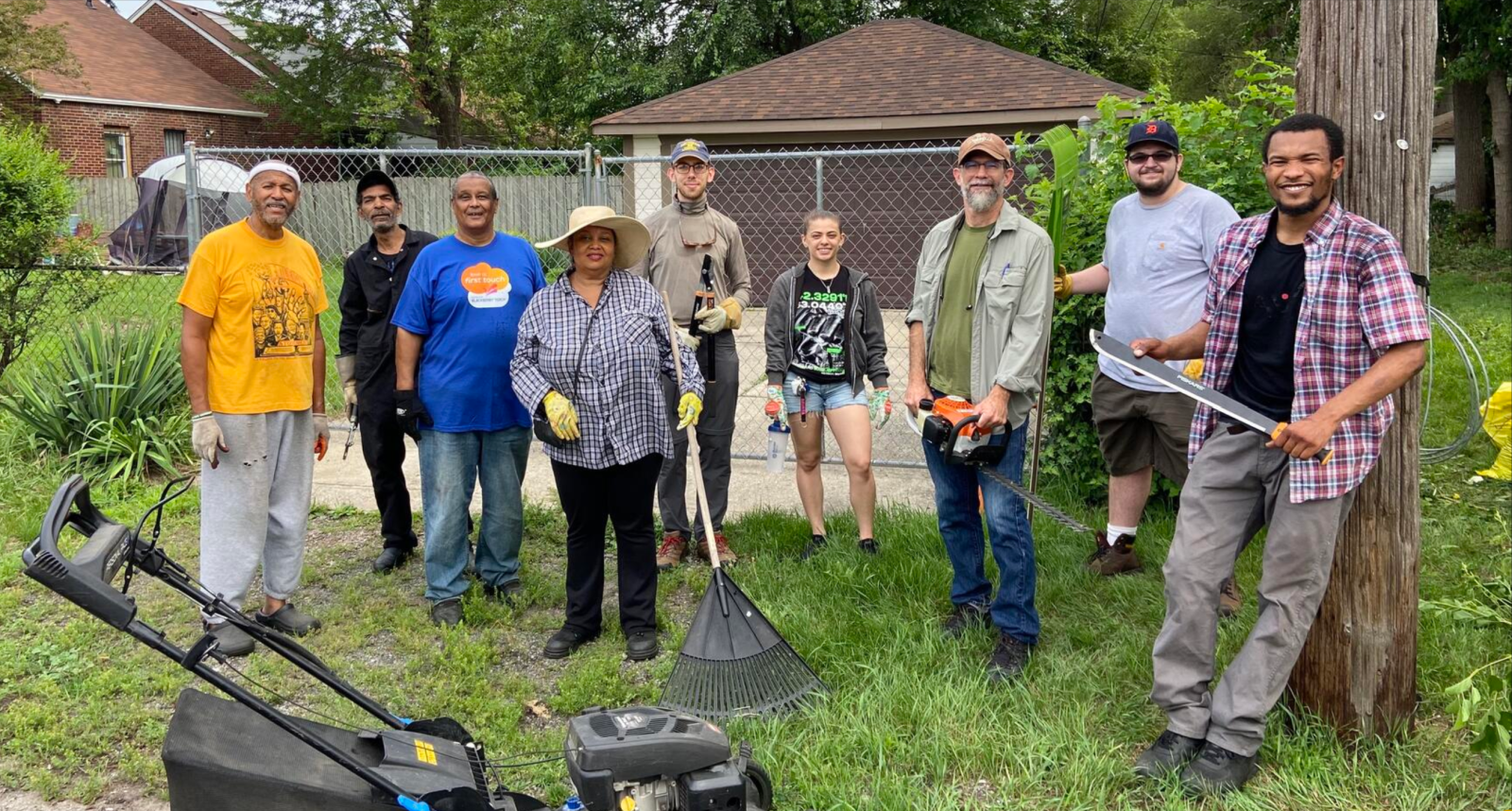
Detroit’s neighborhoods grapple with a dual challenge: neglect and flooding. When the city stopped maintaining alleys in the late 1980s, responsibility shifted to residents. However, with limited resources and a declining population, many of these alleys fell into disrepair, becoming symbols of urban decay. This neglect is further compounded by the increasing frequency and intensity of severe storms, which have exposed the city's vulnerabilities in stormwater management, leading to regular flooding. To address these challenges, the "Alley Activation" project, launched in 2020 by a team of researchers at the UM-Dearborn in partnership with local residents and organizations, seeks to transform neglected alleys into vibrant greenways, rain gardens, and pollinator habitats. The project focuses on cleaning and greening alleys located in 2 neighborhoods namely Littlefield and McNichols. The activated alleys are bounded by Littlefield, Hartwell, McNichols and Outer Drive roads. These roads enclose an area of 141,436 square meters, located in the Bethune community and the Hubbell Puritan neighborhoods. Alley Activation involves clearing blocked alleyways and turning them into inviting, productive spaces that support sustainability goals. These revitalized alleys serve as a "green capillary system," contributing to the city's environmental, cultural, and social well-being. As these spaces are cleared, they offer a fresh opportunity to re-imagine their role and potential within the community. (1,2,3,4,5)
Overview
Nature-based solution
- Green areas for water management
- Rain gardens
- Sustainable urban drainage systems
- Grey infrastructure featuring greens
- Alley or street trees and other street vegetation
Key challenges
- Climate action for adaptation, resilience and mitigation (SDG 13)
- Climate change adaptation
- Green space, habitats and biodiversity (SDG 15)
- Green space creation and/or management
- Regeneration, land-use and urban development
- Promote natural styles of landscape design for urban development
- Water management (SDG 6)
- Stormwater and rainfall management and storage
- Inclusive and effective governance (SDG 16)
- Inclusive governance
- Combatting crime and corruption
- Social justice, cohesion and equity (SDG 10)
- Social justice and equity
- Environmental education
- Sense of community and community engagement
Principal problems in Functional Urban Area (FUA)
- Climate-Related Hazards
- Urban flooding (stormwater)
- Extreme weather events (e.g. storms, hurricanes)
- Land use and Socio-economic change
- Unequal availability and access to public green spaces
- Health, Well-being and Social cohesion
- Poor community engagement
- Insecurity in public spaces
Key priorities
Focus
Project objectives
Implementation activities
Climate-focused activities
Climate change adaptation:
- Implement sustainable urban drainage schemes to manage stormwater
Main beneficiaries
- Citizens or community groups
- Marginalized groups: Disadvantaged ethnic or racial groups
Governance
Management set-up
- Led by non-government actors
Type of initiating organisation
- Researchers/university
Participatory approaches/ community involvement
- Co-planning (e.g. stakeholder workshops, focus groups, participatory mapping)
- Dissemination of information and education
- Consultation (e.g. workshop, surveys, community meetings, town halls)
- Joint implementation (e.g. tree planting)
- Citizen monitoring and review
Details on the roles of the organisations involved in the project
Project implemented in response to ...
Type of enablers
Financing
Total cost
Source(s) of funding
- Research organisation / University
Type of funding
- Direct funding (grants, subsidies, or self-financed projects by private entities)
Non-financial contribution
- Provision of land
- Provision of goods
- Provision of labour
- Provision of expertise
- Citizens (e.g. volunteering)
Impacts and Monitoring
Environmental impacts
- Water management and blue areas
- Improved stormwater management
- Expected improved stormwater management
- Green space and habitat
- Increased green space area
- Achieved increased green space area
- Enhanced support of pollination
- Expected enhanced support of pollination
- Restoration of derelict areas
- Achieved restoration of derelict areas
Economic impacts
- Generation of other type of work opportunities (e.g. voluntary, work for rehabilitation)
- Achieved generation of other type of work opportunities (e.g. voluntary, work for rehabilitation)
- Increased property prices
- Expected increased property prices
- Reduce financial cost for urban management
- Expected reduce financial cost for urban management
- Attraction of business and investment
- Expected attraction of business and investment
Socio-cultural impacts
- Social justice and cohesion
- Increased visibility and opportunity for marginalised groups or indigenous peoples
- Expected increased visibility and opportunity for marginalised groups or indigenous peoples
- Education
- Increased support for education and scientific research
- Achieved increased support for education and scientific research
- Increased knowledge of locals about local nature
- Expected increased knowledge of locals about local nature
- Increased awareness of NBS and their benefits
- Expected increased awareness of NBS and their benefits
- Safety
- Increased perception of safety
- Expected increased perception of safety
- Decreased crime rates
- Expected decreased crime rates
Type of reported impacts
Presence of formal monitoring system
Presence of indicators used in reporting
Presence of monitoring/ evaluation reports
Availability of a web-based monitoring tool
Potential risks of implementation and trade-offs
References


 Information about this nature-based solution was collected as part of the Naturescapes project funded by the European Union under Grant Agreement No 101084341.