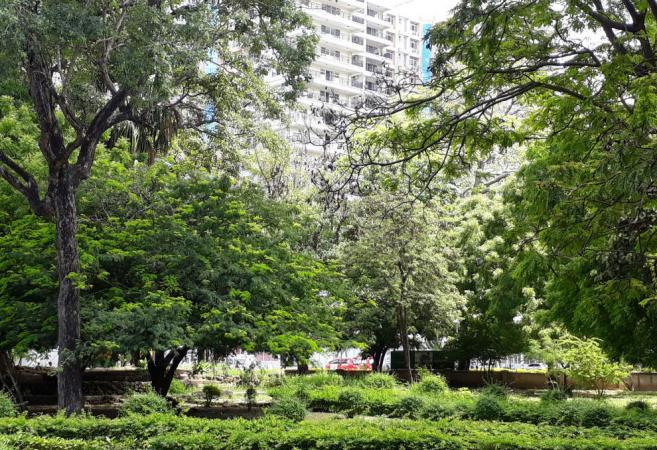
Located in the Eastern part of Tanzania's mainland, the city of Dar es Salaam has been a fast urbanising centre in Sub Saharan Africa. A steady population increase represents implications related to increased human activities, such as encroachment of hazardous land, poor urban planning, as well as lack of infrastructure, placing considerable pressure on the good functioning of the city and causing a rapid loss of green areas and of trees. In counterbalancing these aspects, peri-urban agriculture, artisanal fishing, and nature-based tourism contribute substantially to the well being and livelihoods of the inhabitants of Dar es Salaam. Understanding that nature plays a significant role in the sustainable development of the city and to address the issues above, the municipality of Dar es Salaam, alongside several stakeholders, elaborated a so-called "Thematic Atlas of Nature’s Benefits to Dar es Salaam", tailored specifically for the city. One of the aims of the atlas is to tackle climate change effects that are threatening Dar es Salaam by keeping urban and peri-urban ecosystems intact while implementing nature-based solutions. It is a balancing act coupled with the fact that Dar es Salaam is located in a globally important biodiversity hotspot, the ‘East African Coastal Forest’. (1,2,3)

Overview
Nature-based solution
- Blue infrastructure
- Rivers/streams/canals/estuaries
- Coastlines
- Community gardens and allotments
- Community gardens
- Horticulture
- Green areas for water management
- Sustainable urban drainage systems
- Grey infrastructure featuring greens
- Alley or street trees and other street vegetation
- Parks and urban forests
- Pocket parks/neighbourhood green spaces
Key challenges
- Climate action for adaptation, resilience and mitigation (SDG 13)
- Climate change adaptation
- Environmental quality
- Air quality improvement
- Green space, habitats and biodiversity (SDG 15)
- Habitat and biodiversity conservation
- Green space creation and/or management
- Water management (SDG 6)
- Flood protection
- Stormwater and rainfall management and storage
- Improvements to water quality
- Inclusive and effective governance (SDG 16)
- Effective management
- Social justice, cohesion and equity (SDG 10)
- Environmental education
Focus
Project objectives
Implementation activities
Climate-focused activities
Climate change adaptation:
- Increase or improve urban vegetation cover to help reduce outdoor temperature
Biodiversity conservation or restoration-focused activities
Biodiversity conservation:
- Protect and enhance urban habitats
- Preserve and strengthen existing habitats and ecosystems
- Protect species
- Undertake specific measures to protect species
- Undertake specific measures to protect native species
- Means for conservation governance
- Biodiversity offsets
- Raise public awareness
- Capacity building
- Other
Main beneficiaries
- Local government/Municipality
- Citizens or community groups
- Food producers and cultivators (i.e. farmers, gardeners)
Governance
Management set-up
- Co-governance with government and non-government actors
Type of initiating organisation
- Local government/municipality
- Multilateral organisation
Participatory approaches/ community involvement
- Consultation (e.g. workshop, surveys, community meetings, town halls)
Details on the roles of the organisations involved in the project
Project implemented in response to ...
Financing
Total cost
Source(s) of funding
- Other
Type of funding
- Unknown
Non-financial contribution
Impacts and Monitoring
Environmental impacts
- Unknown
Economic impacts
- Other
Socio-cultural impacts
- Education
- Increased support for education and scientific research
- Increased knowledge of locals about local nature
- Increased awareness of NBS and their benefits
Type of reported impacts
Presence of formal monitoring system
Presence of indicators used in reporting
Presence of monitoring/ evaluation reports
Availability of a web-based monitoring tool
References
2. Karutz R., Berghöfer A., Moore L.R., and van Wyk, E. (2019). A Thematic Atlas of Nature’s Benefits to Dar es Source link and Cape Town: Helmholtz Centre for Environmental Research and ICLEI Africa Secretariat. 78 pages. Available at Source link (accessed 7 Apr. 2022)
3. CASE STUDY A thematic atlas of urban ecosystem services for enhanced greenspace management in Dar es Salaam, Tanzania In a nutshell. (n.d.). [online] Available at: Source link [Accessed 7 Apr. 2022].
4. ICLEI. (2019). A thematic atlas of urban ecosystem services for enhanced greenspace management in Dar es Salaam, Tanzania. [online] Available at: Source link [Accessed 7 Apr. 2022].
5. LUGONGO, B. (2019). New era due as Dar City Council gets novel atlas. [online] Source link. Available at: Source link [Accessed 7 Apr. 2022].