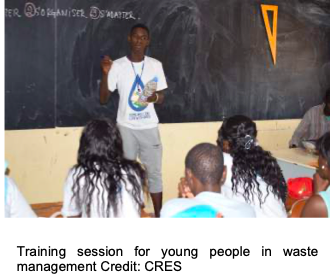
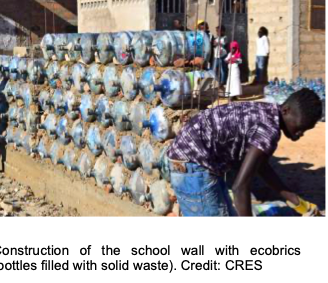
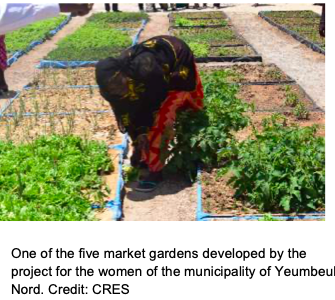
In Senegal, urban flooding in the rainy season causes major damage to public and private infrastructure, and poses considerable social, economic and health-related risks to the human population, in particular the poorest. Poor drainage systems mean that rainwater floods the whole neighbourhood, paralysing transport, and economic activities and posing health and safety risks due to stagnation and contamination (e.g. increase in water-borne diseases). To respond to such emergencies, in 2015 several stakeholders (Senegalese government, local authorities in Dakar and the local community) initiated a project that aimed to build resilience to flooding in informal settlements of Dakar. The project consisted of building resilience to floods by focusing on 3 fields: 1) infrastructure (floodwater evacuation, solid waste management, urban gardening and greening); 2) policy (district flood contingency plans and national policy advice); and 3) capacity building (training and awareness building for beneficiaries and key stakeholders, with a special focus on empowering women). The project was concluded in 2017 however its benefits are still felt today by the inhabitants of Greater Dakar. (1,2,3)

Overview
Nature-based solution
- Community gardens and allotments
- Community gardens
Key challenges
- Climate action for adaptation, resilience and mitigation (SDG 13)
- Climate change adaptation
- Green space, habitats and biodiversity (SDG 15)
- Habitat and biodiversity restoration
- Water management (SDG 6)
- Flood protection
- Economic development and employment (SDG 8)
- Economic development: agriculture
- Sustainable consumption and production (SDG 12)
- Sustainable consumption
- Sustainable production
Focus
Project objectives
Implementation activities
Climate-focused activities
Climate change adaptation:
- Implement sustainable urban drainage infrastructure (e.g. to make space for water)
Biodiversity conservation or restoration-focused activities
Biodiversity restoration:
- Rehabilitate and restore damaged or destroyed ecosystems
- Restore species (native, endangered, or unspecified)
- Public engagement
Main beneficiaries
- Citizens or community groups
- Marginalized groups: Socio-economically disadvantaged populations (e.g. low-income households, unemployed)
Governance
Management set-up
- Co-governance with government and non-government actors
Type of initiating organisation
- Non-government organisation/civil society
- Multilateral organisation
Participatory approaches/ community involvement
- Co-planning (e.g. stakeholder workshops, focus groups, participatory mapping)
- Dissemination of information and education
- Consultation (e.g. workshop, surveys, community meetings, town halls)
- Joint implementation (e.g. tree planting)
- Co-management/Joint management
Details on the roles of the organisations involved in the project
Project implemented in response to ...
Financing
Total cost
Source(s) of funding
- Funds provided by non-governmental organization (NGO)
Type of funding
- Direct funding (grants, subsidies, or self-financed projects by private entities)
Non-financial contribution
- Provision of land
- Provision of labour
- Provision of expertise
- Public authorities (e.g. land, utility services)
- Citizens (e.g. volunteering)
Impacts and Monitoring
Environmental impacts
- Water management and blue areas
- Increased protection against flooding
- Green space and habitat
- Increased green space area
Economic impacts
- Generation of income from NBS
Socio-cultural impacts
- Safety
- Improved community safety to climate-related hazards
- Social justice and cohesion
- Increased involvement of locals in the management of green spaces
- Increased sustainability of agriculture practices
- Education
- Increased knowledge of locals about local nature
Type of reported impacts
Presence of formal monitoring system
Presence of indicators used in reporting
Presence of monitoring/ evaluation reports
Availability of a web-based monitoring tool
References
2. Butterfield, R.E., Coll Besa, M., Burmeister, H., Blair, K., Kavonic, J., Bharwani, S., Cullis, J.,
Spires, M. and Mwalukanga, B. (2017). Inspiring Climate Action in African Cities: Practical Options for
Resilient Pathways. FRACTAL Working Paper 4. Stockholm Environment Institute Oxford Centre,
Oxford, UK., available at Source link (accessed 27-05-2022)
3. Braced (no dates), Vivre avec l'eau | Live with water: Capturing urban floodwaters for water stock and micro-gardening, available at Source link, (accessed 27-05-2022)
4. UNFCCC (no date), Vivre Avec L'eau, available at Source link (accessed 27-05-2022)
5. BARBE Audrey, COLBERT Elise, DIALLO Aminata, RABOUILLE Fabien, Une analyse de la gestion
des eaux pluviales au Sénégal (2017), available at Source link (accessed 27-05-2022)