

Last updated: October 2021
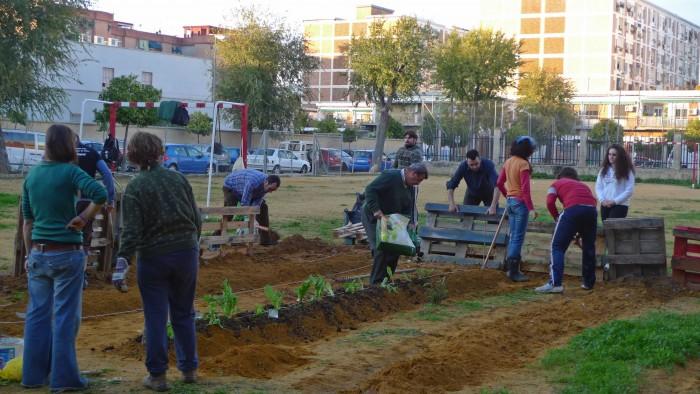
The neighbours of the Fuensanta in Cordoba recovered an abandoned public plot of the old Fuensanta’s cinema transforming it into a social and ecological vegetable garden (Ref 1), occasionally used to play soccer and used as a dog park previously (Ref. 3). "All the activities were free of charge, coordinated by volunteers and consisted of: a walk around the neighbourhood, a building recycled furniture workshop, an urban vegetable gardens workshop and urbanism for children workshop. All of them took place in the plot and the creation of a vegetable garden was the most popular activity." (Ref 1)

Urban vegetable garden workshop
Source: Ref. 1
Overview
Nature-based solution
- Community gardens and allotments
- Community gardens
Key challenges
- Green space, habitats and biodiversity (SDG 15)
- Green space creation and/or management
- Inclusive and effective governance (SDG 16)
- Inclusive governance
- Social justice, cohesion and equity (SDG 10)
- Environmental education
- Social cohesion
- Social interaction
- Health and well-being (SDG 3)
- Improving physical health
- Creation of opportunities for recreation
- Cultural heritage and cultural diversity
- Preservation of historic traditions
- Sustainable consumption and production (SDG 12)
- Sustainable consumption
- Sustainable production
Focus
Creation of new green areas, Transformation of previously derelict areas, Knowledge creation and awareness raising
Project objectives
The Fuensanta Garden aims to promote:
-Healthy eating & lifestyle (Ref. 3)
-Collective work (Ref. 3,4)
-Sustainable models of consumption and production (Ref. 3)
-Knowledge exchange with other local communities (Ref. 3,4)
Implementation activities
"All the activities were free of charge, coordinated by volunteers and consisted of: a walk around the neighbourhood, a building recycled furniture workshop, an urban vegetable gardens workshop and a urbanism for children workshop. All of them took place in the plot and the creation of a vegetable garden was the most popular activity." (Ref 1)
School gardens; orchard visits; comprehensive recycling; DIY workshops; gastronomic workshops; food education workshops; agrarian education workshops; workshops for artisanal creations of tools (Ref. 4)
Collaboration with other organizations: ARBA (Association for the reforestation of native forests) (Rural reforestation); Civic centers; Educational centers; Dionisio Ortiz School of Art; Organization of activities in the Congress of Wisdom and Knowledge; Literary workshops with Aprosub-Montilla; ONCE (Sensory activities with disabled people); IPEP; ABB Córdoba (Recycling of solid wood waste for use in educational centers (Ref. 4)
Main beneficiaries
- Public sector institution (e.g. school or hospital)
- Non-government organisation/Civil Society
- Citizens or community groups
- Marginalized groups: People with functional diversities
- Food producers and cultivators (i.e. farmers, gardeners)
- Other
Governance
Management set-up
- Led by non-government actors
Type of initiating organisation
- Non-government organisation/civil society
- Citizens or community group
- District/neighbourhood association
- Social enterprise
Participatory approaches/ community involvement
- Co-planning (e.g. stakeholder workshops, focus groups, participatory mapping)
- Crowd-sourcing/Crowd-funding/Participatory budget
- Taskforce groups
- Dissemination of information and education
- Consultation (e.g. workshop, surveys, community meetings, town halls)
- Joint implementation (e.g. tree planting)
- Co-management/Joint management
- Citizen oversight (e.g. boards, advisory)
- Citizen science
- Other
Details on the roles of the organisations involved in the project
"UrbanismoDeBarrio” is a project by Colaborativa.eu and Tercera Piel Arquitectura –in collaboration with numerous architects, individuals, collectives and social agents– to recover abandoned public plots by the neighbours taking firsthand action."(Ref 1)
Roles:
• Gardeners: neighbours. (Ref. 1)
• Motivators, gardeners and campaign managers: Colaborativa.eu. (Ref. 1)
• Activities’ organizers: many neighbourhood’s collectives. (Ref. 1)
• Collaborators: schools and colleges of the district. (Ref. 1)
• Co-financiers: more than 60 people (via Crowdfunding on Goteo). (Ref. 1,3)
"The neighbors of the Fuensanta in Cordoba are recovering an abandoned public lot to transform it into a social and ecological garden."(Ref 3)
“Since September 2012 a group of about 20 residents of Fuensanta have met every Monday to build the garden." (Ref 3)
Project implemented in response to ...
... an EU policy or strategy?
Unknown
... a national policy or strategy?
Unknown
... a local policy or strategy?
Unknown
Financing
Total cost
Less than €10,000
Source(s) of funding
- Crowdfunding
Type of funding
- Donations
Non-financial contribution
Type of non-financial contribution
- Provision of land
- Provision of goods
- Provision of labour
- Provision of expertise
Who provided the non-financial contribution?
- Public authorities (e.g. land, utility services)
- Citizens (e.g. volunteering)
Impacts and Monitoring
Environmental impacts
- Environmental quality
- Improved waste management
- Green space and habitat
- Increased green space area
- Restoration of derelict areas
- Other
Economic impacts
- Unknown
Socio-cultural impacts
- Social justice and cohesion
- Improved social cohesion
- Improved access to urban green space
- Increased visibility and opportunity for marginalised groups or indigenous peoples
- Increased opportunities for social interaction
- Increased involvement of locals in the management of green spaces
- Increased access to healthy/affordable food
- Health and wellbeing
- Improved physical health
- Gain in activities for recreation and exercise
- Cultural heritage and sense of place
- Improvement in people’s connection to nature
- Protection of natural heritage
- Protection of historic and cultural landscape / infrastructure
- Increased sense of place identity, memory and belonging
- Increased awareness of flora and fauna as culturally and historically meaningful
- Education
- Increased awareness of NBS and their benefits
Type of reported impacts
Achieved impacts
Presence of formal monitoring system
Unknown
Presence of indicators used in reporting
No evidence in public records
Presence of monitoring/ evaluation reports
No evidence in public records
Availability of a web-based monitoring tool
No evidence in public records
References
1. Source link. (n.d). #UrbanismoDeBarrio. Source link. Available at: Source link [Accessed: 12 September 2020].
2. Anon. (2015). Huerto Fuensanta. Wikipedia. Available at: Source link [Accessed: 12 September 2020].
3. Equipo del Huerto Fuensanta (2013). Un huerto social y ecológico en el barrio de la Fuensanta. Goteo. Available at: Source link [Accessed: 12 September 2020].
4. Anon. (n.d). Huerto Solidario Fuensanta. [Document provided].
5. Huerto Solidario Fuensanta. (n.d.). Huerto Solidario Fuensanta. Facebook page. Available at: Source link [Accessed: 12 September 2020].
2. Anon. (2015). Huerto Fuensanta. Wikipedia. Available at: Source link [Accessed: 12 September 2020].
3. Equipo del Huerto Fuensanta (2013). Un huerto social y ecológico en el barrio de la Fuensanta. Goteo. Available at: Source link [Accessed: 12 September 2020].
4. Anon. (n.d). Huerto Solidario Fuensanta. [Document provided].
5. Huerto Solidario Fuensanta. (n.d.). Huerto Solidario Fuensanta. Facebook page. Available at: Source link [Accessed: 12 September 2020].

Abandoned public plot of the old Fuensanta's cinema
Source: Ref. 1

Preparing for Fuensanta's festivity
Source: Ref. 1

Sign for Fuensanta's Vegetable Garden
Source: Ref. 1
Source: Ref. 3

Source: Ref. 3