

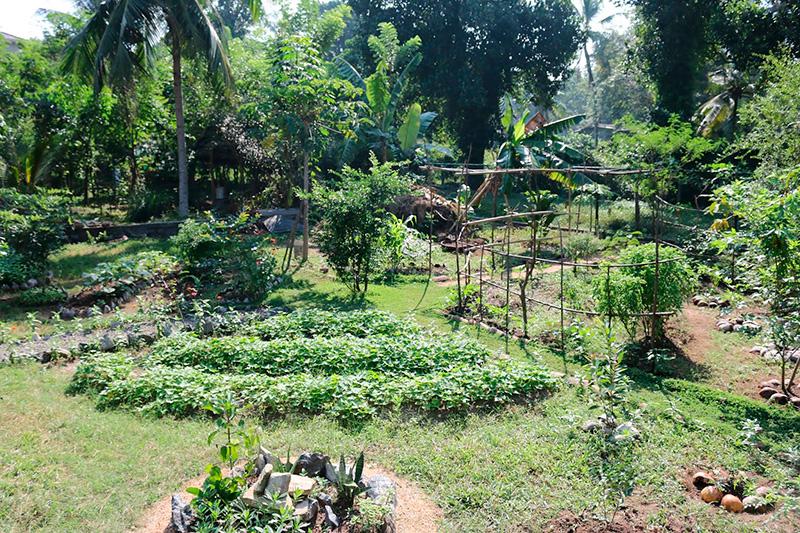
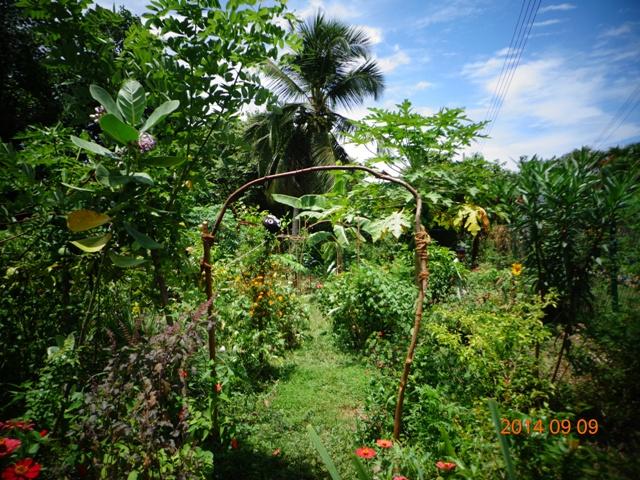
Public spaces in Colombo are disappearing due to rising land prices, causing infrastructure issues that harm citizens' health, especially in low-income areas (3). One proposed solution to address the problems caused by rapid urbanization is the creation of community gardens, which can at least improve low-income residents' diets and immune systems and address malnutrition (3). Considering the limited urban space for both citizens and other living beings, the organization Eco-friendly Volunteers decided to create a community garden. The Metta Garden in Colombo (1, 2) aims to bring back urban biodiversity through organic home gardening, generating healthy food for people and creating living space for many other animals and plants (2). Following the Buddhist concept of Metta (loving-kindness to all beings), it promotes walking meditation paths and facilities to experience nature using all five sensory organs (1), in addition to being a place for experiencing loving-kindness for both human and non-human living beings, seen and unseen (4, 5). It has become a training institute for many stakeholders seeking to grow organic food and earn a better income through the high demand for organic products (2). At the same time, it serves as a biodiversity spot, attracting butterflies, bees, and other forms of wildlife to an urban environment (2). The area is located in the middle of a semi-urbanized area, on the outskirts of Boralesgamuwa (2, 3). Maintained by a group of volunteers, it features a greenhouse and a plot of land of around 5,000 sq feet, populated with vegetable patches, a butterfly garden, flowers and rare medicinal plants (3, 4). The garden was divided into four sections representing the Buddhist elements: water, heat, air, and solid. Each section features specific plants and designs, like a pond for water, a compost pit for heat, tall plants for air, and a rock garden for solid. The layout follows a mandala design based on permaculture principles (4).
Overview
Nature-based solution
- Community gardens and allotments
- Community gardens
Key challenges
- Environmental quality
- Soil quality improvement
- Green space, habitats and biodiversity (SDG 15)
- Green space creation and/or management
- Habitat and biodiversity restoration
- Regeneration, land-use and urban development
- Rewilding
- Health and well-being (SDG 3)
- Creation of opportunities for recreation
- Improving mental health
- Social justice, cohesion and equity (SDG 10)
- Sense of community and community engagement
- Economic development and employment (SDG 8)
- Economic development: agriculture
- Sustainable consumption and production (SDG 12)
- Sustainable production
- Food scarcity / security
Principal problems in Functional Urban Area (FUA)
- Environmental Degradation
- Biodiversity loss
- Soil degradation and loss
- Land use and Socio-economic change
- Limited economic opportunities and local livelihoods
- Rapid urbanization
- Health, Well-being and Social cohesion
- Disconnection from nature
- Resource Scarcity and Competition
- Food insecurity due to disruptions in food production and distribution
Key priorities
Focus
Project objectives
Implementation activities
Biodiversity conservation or restoration-focused activities
Biodiversity restoration:
- Rehabilitate and restore damaged or destroyed ecosystems
- Restore species (native, endangered, or unspecified)
- Restore native species
- Public engagement
Main beneficiaries
- Public sector institution (e.g. school or hospital)
- Private sector/Corporate/Company
- Citizens or community groups
- Food producers and cultivators (i.e. farmers, gardeners)
- Young people and children
- Marginalized groups: Children, young people or youth groups , Women
- Other
Governance
Management set-up
- Led by non-government actors
Type of initiating organisation
- Non-government organisation/civil society
Participatory approaches/ community involvement
- Dissemination of information and education
- Joint implementation (e.g. tree planting)
Details on the roles of the organisations involved in the project
Project implemented in response to ...
Type of enablers
Financing
Total cost
Source(s) of funding
- Funds provided by non-governmental organization (NGO)
Type of funding
- Direct funding (grants, subsidies, or self-financed projects by private entities)
Non-financial contribution
- Provision of labour
- Citizens (e.g. volunteering)
Impacts and Monitoring
Environmental impacts
- Green space and habitat
- Increased green space area
- Achieved increased green space area
- Increased conservation or restoration of ecosystems
- Achieved increased conservation or restoration of ecosystems
- Increased conversion of degraded land or soil
- Achieved increased conversion of degraded land or soil
- Reduced biodiversity loss
- Achieved reduced biodiversity loss
- Increased number of species present
- Achieved increased number of species present
- Increased presence and recovery of wild species
- Achieved increased presence and recovery of wild species
- Enhanced support of pollination
- Achieved enhanced support of pollination
Economic impacts
- Generation of other type of work opportunities (e.g. voluntary, work for rehabilitation)
- Achieved generation of other type of work opportunities (e.g. voluntary, work for rehabilitation)
- Increase in agricultural production (for profit or not)
- Achieved increase in agricultural production (for profit or not)
- Generation of income from NBS
- Achieved generation of income from NBS
Socio-cultural impacts
- Social justice and cohesion
- Increased involvement of locals in the management of green spaces
- Achieved increased involvement of locals in the management of green spaces
- Increased access to healthy/affordable food
- Achieved increased access to healthy/affordable food
- Increased sustainability of agriculture practices
- Achieved increased sustainability of agriculture practices
- Health and wellbeing
- Enhanced cognitive restoration, relaxation and stress relief
- Expected enhanced cognitive restoration, relaxation and stress relief
- Cultural heritage and sense of place
- Improvement in people’s connection to nature
- Achieved improvement in people’s connection to nature
- Preserved spiritual and religious values
- Achieved preserved spiritual and religious values
- Increased appreciation for natural spaces
- Achieved increased appreciation for natural spaces
- Education
- Increased awareness of NBS and their benefits
- Achieved increased awareness of NBS and their benefits
Type of reported impacts
Presence of formal monitoring system
Presence of indicators used in reporting
Presence of monitoring/ evaluation reports
Availability of a web-based monitoring tool
Potential risks of implementation and trade-offs
References

 Information about this nature-based solution was collected as part of the Naturescapes project funded by the European Union under Grant Agreement No 101084341.