

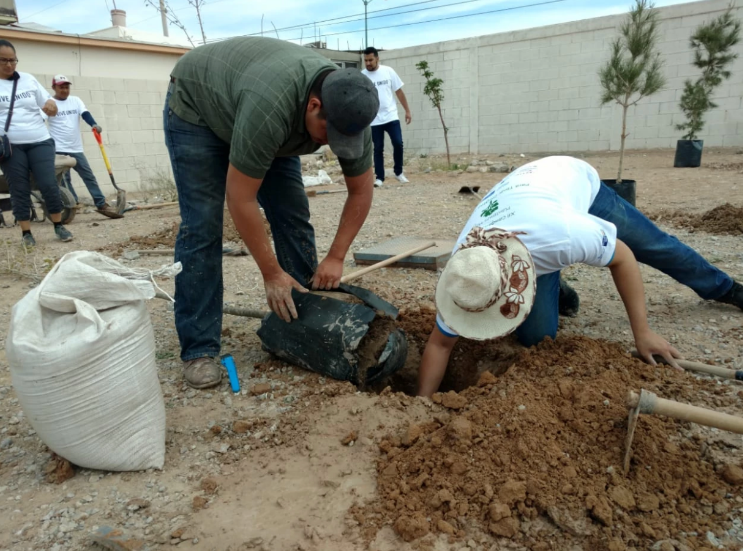
Fondo Unido Chihuahua, in collaboration with its corporate partners, is committed to raising awareness about environmental care and reforestation. One of its flagship initiatives is the annual tree-planting campaign, "Planting Today to Have Oxygen Tomorrow," organized by United Way Chihuahua in Ciudad Juárez. This environmental initiative focuses on improving the quality of different urban green spaces (parks, school grounds, streets) while fostering ecological awareness in vulnerable communities across the city. The primary objective is to plant a significant number of trees throughout Ciudad Juárez, using native species that are water-efficient and well-adapted to the local climate and soil. In 2022 the initiative aimed to reforest 18 parks located mainly in the south-eastern part of this border city with 1,000 trees. In 2023 and 2024 the intervention focused on planting 850 trees scatted all over the city. The campaign brings together donations and volunteers through partnerships with various stakeholders, including local and regional governments, private companies, community organizations, and the general public. United Way Chihuahua oversees the planning, coordination, and logistical efforts for the campaign. On planting days, volunteers gather at designated sites, guided by the organization to ensure successful planting efforts and community engagement (Ref 1-4).
Overview
Nature-based solution
- Grey infrastructure featuring greens
- Alley or street trees and other street vegetation
- Green playgrounds and school grounds
- Parks and urban forests
- Pocket parks/neighbourhood green spaces
Key challenges
- Climate action for adaptation, resilience and mitigation (SDG 13)
- Climate change adaptation
- Environmental quality
- Air quality improvement
- Soil quality improvement
- Green space, habitats and biodiversity (SDG 15)
- Green space creation and/or management
- Health and well-being (SDG 3)
- Creation of opportunities for recreation
- Social justice, cohesion and equity (SDG 10)
- Social justice and equity
- Environmental education
- Sense of community and community engagement
Principal problems in Functional Urban Area (FUA)
- Climate-Related Hazards
- Heat stress & Extreme temperatures
- Environmental Degradation
- Deforestation and forest degradation
- Soil degradation and loss
- Air pollution
- Desertification
- Land use and Socio-economic change
- Unequal availability and access to public green spaces
Key priorities
Focus
Project objectives
Implementation activities
Climate-focused activities
Climate change adaptation:
- Implement measures that prevent/manage desertification, soil erosion and landslides
- Increase urban vegetation cover to reduce urban heat island effect
Specification of climate or environmentally vulnerable communities
Main beneficiaries
- Citizens or community groups
- Young people and children
- Marginalized groups: Children, young people or youth groups , Socio-economically disadvantaged populations (e.g. low-income households, unemployed), Homeless people & people living in informal settlements
Governance
Management set-up
- Led by non-government actors
Type of initiating organisation
- Non-government organisation/civil society
Participatory approaches/ community involvement
- Crowd-sourcing/Crowd-funding/Participatory budget
- Dissemination of information and education
- Joint implementation (e.g. tree planting)
Details on the roles of the organisations involved in the project
Project implemented in response to ...
Type of enablers
Financing
Total cost
Source(s) of funding
- Public regional budget
- Funds provided by non-governmental organization (NGO)
- Crowdfunding
Type of funding
- Direct funding (grants, subsidies, or self-financed projects by private entities)
- Donations
Non-financial contribution
- Provision of labour
- Citizens (e.g. volunteering)
- Private sector (businesses, financial institution)
Impacts and Monitoring
Environmental impacts
- Water management and blue areas
- Reduced risk of damages by drought
- Achieved reduced risk of damages by drought
- Green space and habitat
- Increased number of species present
- Achieved increased number of species present
Economic impacts
- Unknown
Socio-cultural impacts
- Social justice and cohesion
- Increased involvement of locals in the management of green spaces
- Expected increased involvement of locals in the management of green spaces
- Cultural heritage and sense of place
- Increased sense of place identity, memory and belonging
- Expected increased sense of place identity, memory and belonging
- Education
- Increased awareness of NBS and their benefits
- Expected increased awareness of NBS and their benefits
- Safety
- Increased perception of safety
- Expected increased perception of safety
Type of reported impacts
Presence of formal monitoring system
Presence of indicators used in reporting
Presence of monitoring/ evaluation reports
Availability of a web-based monitoring tool
Potential risks of implementation and trade-offs
References
 Information about this nature-based solution was collected as part of the Naturescapes project funded by the European Union under Grant Agreement No 101084341.