

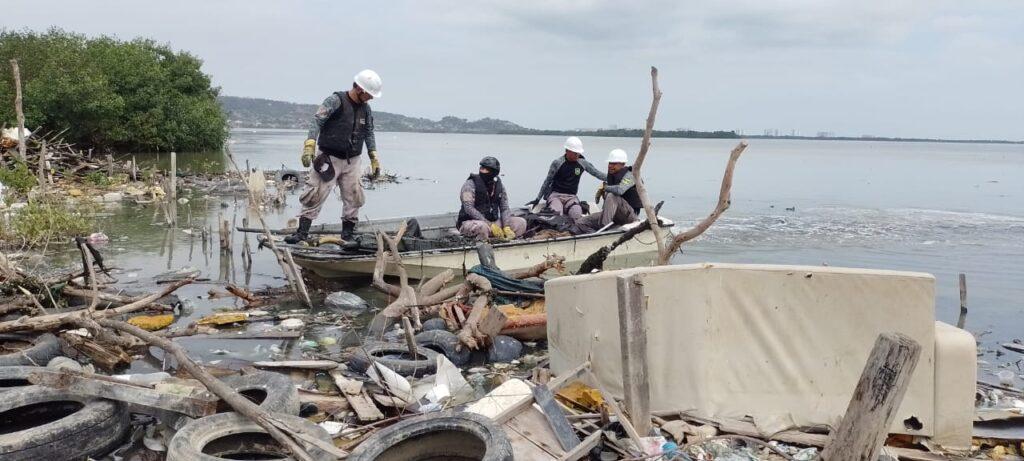
The Ciénaga de la Virgen is a coastal wetland (cienaga) located on the north side of the border of the city of Cartagena, separated from the sea by La Boquilla's sandy beach. It has a maximum width of 4.5 km, a length of approximately 7 km, a water body area of about 22.5 km², and depths of up to 1.6 m. It is connected to the city's canal system (ref 1). The recovery project of la Cienaga de la Virgen, led by EPA Cartagena, is proposed as a strategy to address the issues affecting the water body, local communities, the economic activities that depend on it, and the ecosystems that regulate the water cycle and provide multiple services, many of them essential, with an integrated and global management approach based on the basin as the unit for planning and resource management (ref 14). Some of the main problems of the wetland are related to illegal settlements on its shore, as well as illicit dumping of waste, pollution by wastewater from the illegal settlements and deforestation of mangroves (ref 4). Key activities include stopping illegal occupation by relocating established families, improving roads, promoting reforestation, encouraging social participation, managing wastewater, and enhancing tidal systems (ref. 1 and 15). Alonside the EPA, other stakeholders involved include the regional authority "Regional Autonomous Corporation of the Canal del Dique" (Cardique), with jurisdiction in the rural area, and Cartagena Mayor's Office, and the local community, involved in all the stages of the plan thanks to the “mesas de governance” or "governance tables", discussion spaces where different actors participate in the decision-making (ref 2).
Overview
Nature-based solution
- Blue infrastructure
- Coastal wetland, mangroves and salt marshes
- Mangroves
Key challenges
- Environmental quality
- Waste management
- Green space, habitats and biodiversity (SDG 15)
- Habitat and biodiversity restoration
- Regeneration, land-use and urban development
- Regulation of built environment
- Water management (SDG 6)
- Improvements to water quality
- Social justice, cohesion and equity (SDG 10)
- Social cohesion
- Environmental education
Principal problems in Functional Urban Area (FUA)
- Environmental Degradation
- Deforestation and forest degradation
- Poor water quality
- Resource Scarcity and Competition
- Land rights conflicts
Key priorities
Focus
Project objectives
Implementation activities
Specification of climate or environmentally vulnerable communities
Biodiversity conservation or restoration-focused activities
Biodiversity restoration:
- Rehabilitate and restore damaged or destroyed ecosystems
- Restore ecological connectivity
- Public engagement
Main beneficiaries
- Local government/Municipality
- Private sector/Corporate/Company
- Citizens or community groups
- Marginalized groups: Socio-economically disadvantaged populations (e.g. low-income households, unemployed), Homeless people & people living in informal settlements, Disadvantaged ethnic or racial groups, Vulnerable populations in disaster-prone areas
Governance
Management set-up
- Government-led
Type of initiating organisation
- Local government/municipality
Participatory approaches/ community involvement
- Co-planning (e.g. stakeholder workshops, focus groups, participatory mapping)
- Consultation (e.g. workshop, surveys, community meetings, town halls)
- Joint implementation (e.g. tree planting)
- Co-management/Joint management
Details on the roles of the organisations involved in the project
Project implemented in response to ...
Type of enablers
Financing
Total cost
Source(s) of funding
- Public local authority budget
- Public regional budget
Type of funding
- Earmarked public budget
- Direct funding (grants, subsidies, or self-financed projects by private entities)
Non-financial contribution
- Provision of goods
- Provision of labour
- Public authorities (e.g. land, utility services)
- Citizens (e.g. volunteering)
Impacts and Monitoring
Environmental impacts
- Environmental quality
- Improved waste management
- Expected improved waste management
- Water management and blue areas
- Improved water quality
- Expected improved water quality
- Increased protection against flooding
- Expected increased protection against flooding
- Green space and habitat
- Increased green space area
- Expected increased green space area
- Increased number of protection areas
- Expected increased number of protection areas
- Increased conservation or restoration of ecosystems
- Expected increased conservation or restoration of ecosystems
Economic impacts
- More sustainable tourism
- Expected more sustainable tourism
Socio-cultural impacts
- Social justice and cohesion
- Increased visibility and opportunity for marginalised groups or indigenous peoples
- Achieved increased visibility and opportunity for marginalised groups or indigenous peoples
- Education
- Increased knowledge of locals about local nature
- Expected increased knowledge of locals about local nature
- Safety
- Improved community safety to climate-related hazards
- Expected improved community safety to climate-related hazards
Type of reported impacts
Presence of formal monitoring system
Presence of indicators used in reporting
Presence of monitoring/ evaluation reports
Availability of a web-based monitoring tool
Potential risks of implementation and trade-offs
References


 Information about this nature-based solution was collected as part of the Naturescapes project funded by the European Union under Grant Agreement No 101084341.