

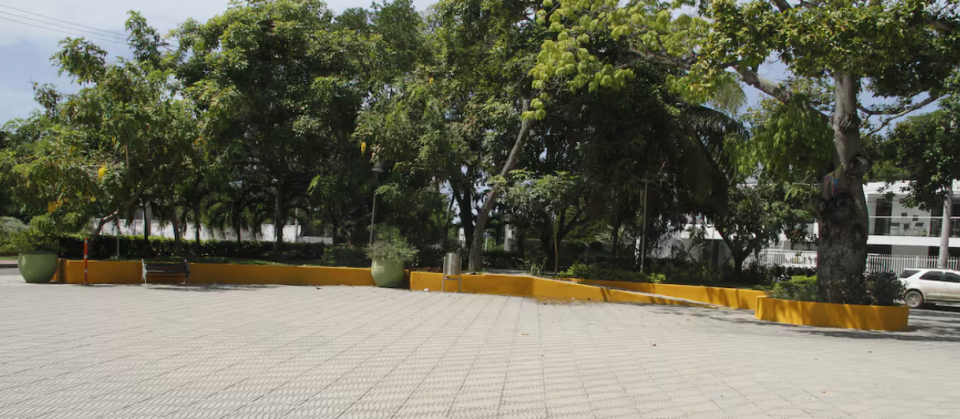
Parque Lácides Segovia is an urban park located on Isla de Manga in Cartagena, Colombia. The park was inaugurated and revitalizated in June 2014 to serve as a multifunctional green space promoting cultural, social, and environmental activities. Named after General Lácides Segovia, a notable figure in Cartagena's history, the park aimed to provide a family-friendly and culturally enriching environment (ref 1). The primary goal was to transform a neglected urban area into a dynamic public space that fosters community interaction and enhances local culture. The park aimed to create a safe, inclusive, and accessible environment for residents of all ages, promoting social integration and cultural activities. Additionally, the project sought to establish a green area contributing to the ecological health of the city through urban greenery (ref 1, 2). The first revitalization in 2014 involved facilities, planting native trees, and setting up public amenities such as Wi-Fi, seating, and cultural spaces(1, 2, 3). This new revitalization in 2024, led by the local government of Cartagena, will focus on enhancing the infrastructure of both the park and the surrounding sports area in Manga to improve sustainability. The project has an estimated budget of approximately USD 675,000. The improvement works to provide better facilities and infrastructure to support recreational and sports activities, benefiting the community and promoting a healthier urban environment (ref 6). The park is essential for the community; it was recently the subject of several citizen science projects led by the Montessori School, including research identifying the park's ecosystem services (ref 3).

Overview
Nature-based solution
- Parks and urban forests
- Large urban parks or forests
Key challenges
- Green space, habitats and biodiversity (SDG 15)
- Green space creation and/or management
- Habitat and biodiversity restoration
- Regeneration, land-use and urban development
- Regulation of built environment
- Health and well-being (SDG 3)
- Creation of opportunities for recreation
- Enabling opportunities for physical activity
- Social justice, cohesion and equity (SDG 10)
- Social interaction
- Environmental education
Principal problems in Functional Urban Area (FUA)
- Land use and Socio-economic change
- Unequal availability and access to public green spaces
- Health, Well-being and Social cohesion
- Inadequate access to recreational opportunities
Key priorities
Focus
Project objectives
Implementation activities
Biodiversity conservation or restoration-focused activities
Biodiversity restoration:
- Restore species (native, endangered, or unspecified)
- Restore native species
- Public engagement
Main beneficiaries
- Citizens or community groups
Governance
Management set-up
- Government-led
Type of initiating organisation
- National government
- Regional government
- Local government/municipality
Participatory approaches/ community involvement
- Consultation (e.g. workshop, surveys, community meetings, town halls)
- Citizen science
Details on the roles of the organisations involved in the project
Project implemented in response to ...
Type of enablers
Financing
Total cost
Source(s) of funding
- Public local authority budget
- Public national budget
Type of funding
- Earmarked public budget
Non-financial contribution
Impacts and Monitoring
Environmental impacts
- Climate change
- Enhanced carbon sequestration
- Achieved enhanced carbon sequestration
- Environmental quality
- Improved air quality
- Achieved improved air quality
- Water management and blue areas
- Improved stormwater management
- Achieved improved stormwater management
- Green space and habitat
- Increased green space area
- Achieved increased green space area
Economic impacts
- Unknown
Socio-cultural impacts
- Social justice and cohesion
- Improved access to urban green space
- Achieved improved access to urban green space
- Health and wellbeing
- Gain in activities for recreation and exercise
- Expected gain in activities for recreation and exercise
- Cultural heritage and sense of place
- Promotion of cultural diversity
- Expected promotion of cultural diversity
- Education
- Increased support for education and scientific research
- Achieved increased support for education and scientific research
Type of reported impacts
Presence of formal monitoring system
Presence of indicators used in reporting
Presence of monitoring/ evaluation reports
Availability of a web-based monitoring tool
Potential risks of implementation and trade-offs
References

 Information about this nature-based solution was collected as part of the Naturescapes project funded by the European Union under Grant Agreement No 101084341.