

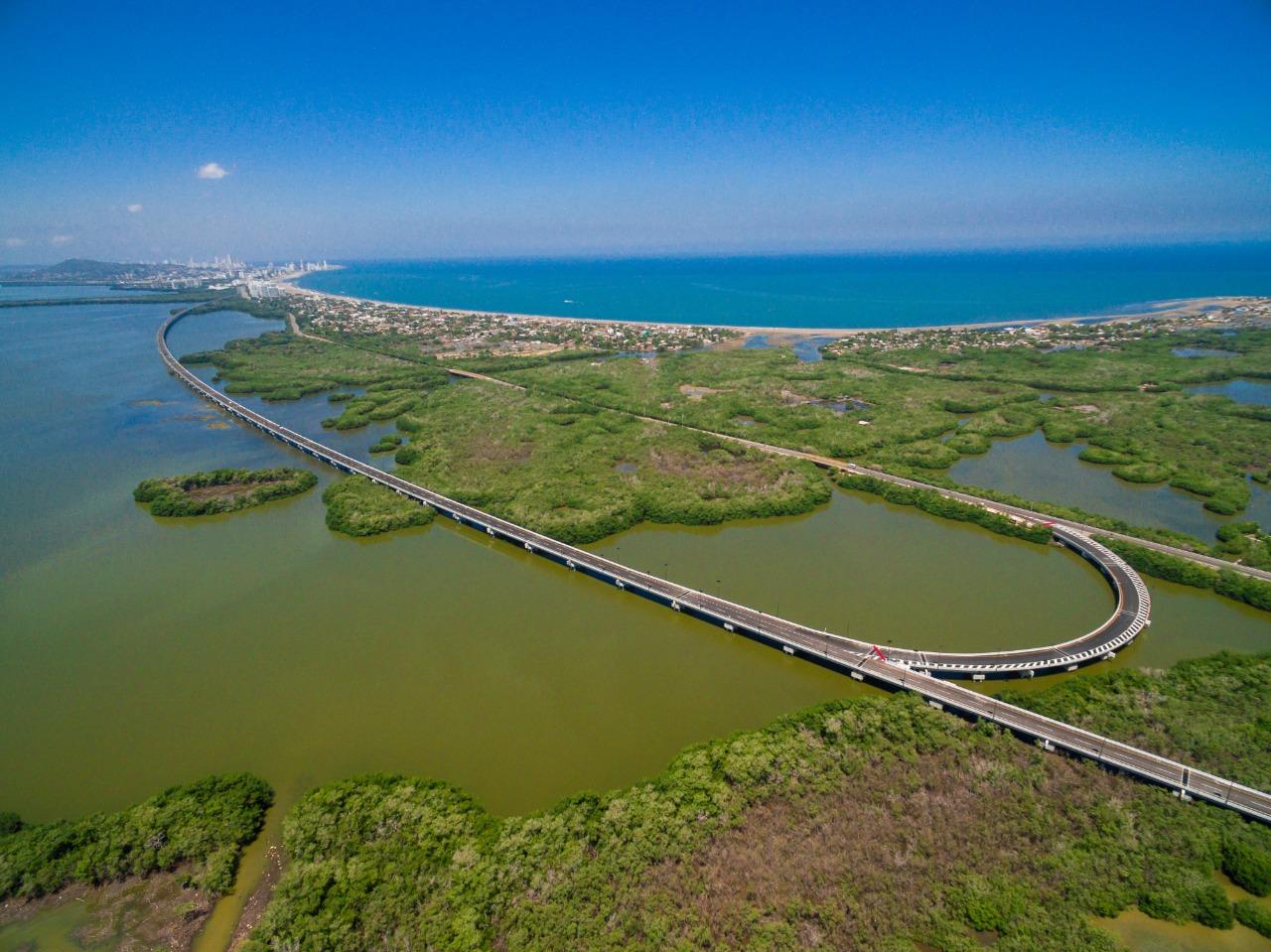
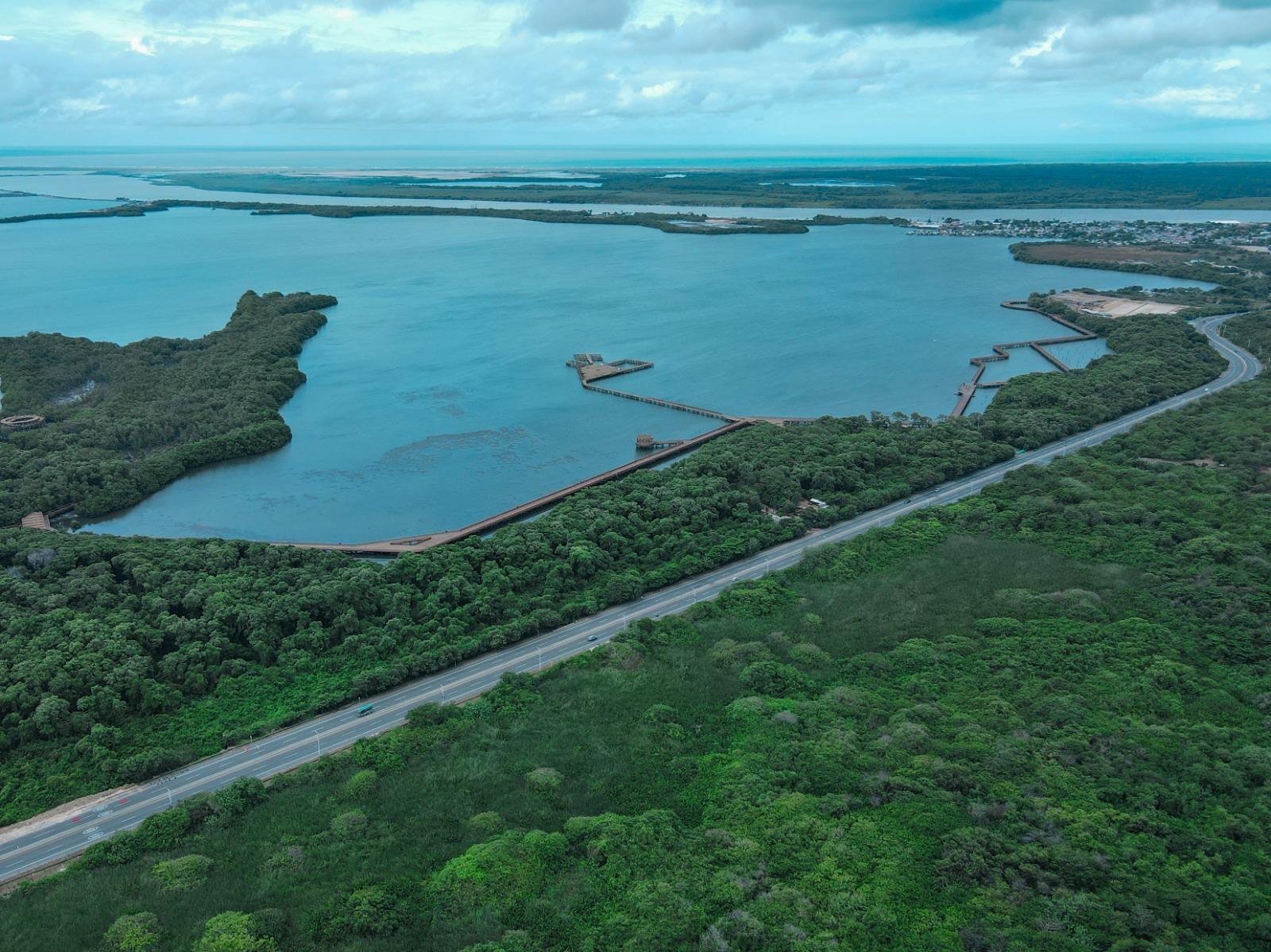
The Cartagena-Barranquilla Road Corridor project, led by the National Infrastructure Agency (Agencia Nacional de Infraestructura (ANI)), covers 146.7 km to enhance connectivity between Cartagena and Barranquilla (ref 2). While primarily a transportation initiative, the project stands out for its focus on environmental conservation and community development. A major goal is the restoration of ecosystems and biodiversity protection. To this end, over 40,000 mangrove seedlings have been planted in the 34.13-hectare Ciénaga de la Virgen, a vital coastal wetland in Cartagena. These mangroves play a crucial role in restoring habitats, capturing carbon, and acting as natural flood barriers, thereby safeguarding nearby communities (ref 1,4,6). The project also tackles hazards like wildlife-vehicle collisions and habitat fragmentation. Seven wildlife crossings have been built to facilitate the safe movement of species, including the endangered Blue Crab (Cardisoma guanhumi) in the Ciénaga de Mallorquín. These crossings are essential for preserving local wildlife (ref 1,7). In terms of socio-economic impact, the project has created over 9,000 jobs and established six bioclimatic nurseries, which provide sustainable livelihoods for communities in La Boquilla, Villa Gloria, Tierra Baja, and Puerto Rey. These nurseries support mangrove restoration and offer local people opportunities to participate in planting, monitoring, and maintenance activities. This approach fosters a circular economy, empowering community members, both men and women, to engage in sustainable economic practices (ref 1,2,6). Overall, the Cartagena-Barranquilla Road Corridor is more than a transport project; it acts as a green corridor with a comprehensive approach that combines environmental conservation, hazard mitigation, and socio-economic development.
Overview
Nature-based solution
- Blue infrastructure
- Coastal wetland, mangroves and salt marshes
- Mangroves
- Parks and urban forests
- Green corridors and green belts
Key challenges
- Climate action for adaptation, resilience and mitigation (SDG 13)
- Climate change adaptation
- Climate change mitigation
- Coastal resilience and marine protection (SDG 14)
- Coastal protection / hazard mitigation
- Green space, habitats and biodiversity (SDG 15)
- Green space creation and/or management
- Habitat and biodiversity restoration
- Habitat and biodiversity conservation
- Economic development and employment (SDG 8)
- Employment/job creation
Principal problems in Functional Urban Area (FUA)
- Climate-Related Hazards
- Coastal hazards (e.g. erosion, flooding)
- Environmental Degradation
- Biodiversity loss
- Land use and Socio-economic change
- Limited economic opportunities and local livelihoods
Key priorities
Focus
Project objectives
Implementation activities
Climate-focused activities
Climate change adaptation:
- Restore mangroves, marshes, reefs and wetlands to dissipate the effects of storms and floodwaters
Climate change mitigation:
- Protect and restore coastal wetlands, mangroves and salt marshes, aiming at sequestering carbon dioxide and storing it in their soils
Specification of climate or environmentally vulnerable communities
Biodiversity conservation or restoration-focused activities
Biodiversity conservation:
- Protect and enhance urban habitats
- Preserve and strengthen existing habitats and ecosystems
- Reduce negative impacts and avoid the alteration/damage of ecosystem
- Protect species
- Undertake specific measures to protect species
- Undertake specific measures to protect native species
- Undertake specific measures to protect valued species
Biodiversity restoration:
- Rehabilitate and restore damaged or destroyed ecosystems
- Restore species (native, endangered, or unspecified)
- Restore native species
- Restore valued species
- Restore ecological connectivity
Main beneficiaries
- Citizens or community groups
Governance
Management set-up
- Government-led
Type of initiating organisation
- National government
Participatory approaches/ community involvement
- Co-planning (e.g. stakeholder workshops, focus groups, participatory mapping)
- Consultation (e.g. workshop, surveys, community meetings, town halls)
Details on the roles of the organisations involved in the project
Project implemented in response to ...
Type of enablers
Financing
Total cost
Source(s) of funding
- Public national budget
- Public regional budget
Type of funding
- Earmarked public budget
Non-financial contribution
Impacts and Monitoring
Environmental impacts
- Climate change
- Enhanced carbon sequestration
- Expected enhanced carbon sequestration
- Enhanced protection against extreme weather events (e.g. storms, cyclones, tidal surges, coastal erosion)
- Expected enhanced protection against extreme weather events (e.g. storms, cyclones, tidal surges, coastal erosion)
- Green space and habitat
- Increased green space area
- Achieved increased green space area
- Increased conservation or restoration of ecosystems
- Achieved increased conservation or restoration of ecosystems
- Increased ecological connectivity across regeneration sites and scales
- Expected increased ecological connectivity across regeneration sites and scales
- Reduced biodiversity loss
- Expected reduced biodiversity loss
- Enhanced support of pollination
- Expected enhanced support of pollination
Economic impacts
- Increase of green jobs (e.g. paid employment positions)
- Achieved increase of green jobs (e.g. paid employment positions)
- Generation of income from NBS
- Achieved generation of income from NBS
Socio-cultural impacts
- Social justice and cohesion
- Increased involvement of locals in the management of green spaces
- Achieved increased involvement of locals in the management of green spaces
- Safety
- Improved community safety to climate-related hazards
- Expected improved community safety to climate-related hazards
Type of reported impacts
Presence of formal monitoring system
Presence of indicators used in reporting
Presence of monitoring/ evaluation reports
Availability of a web-based monitoring tool
Potential risks of implementation and trade-offs
References

 Information about this nature-based solution was collected as part of the Naturescapes project funded by the European Union under Grant Agreement No 101084341.