

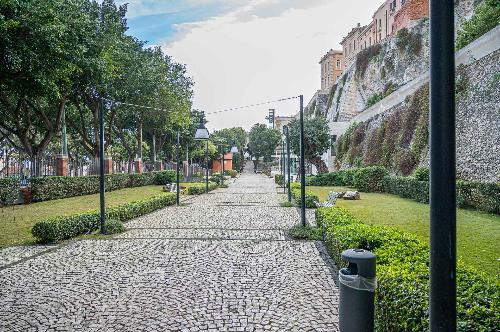
The Garden Under the Walls, also known as the Garden of the Brothers Giuseppe and Vittorino Fiori, is a green space located in the historic Villanova district of Cagliari, along Viale Regina Elena. Inaugurated on 28 March 2014, the project transformed a long-neglected area beneath the Castello walls into a garden promenade. Closed to the public for many years due to ongoing construction, this green space has been reopened and returned to the city. The garden spans 500 meters in length and covers an area of 6,500 square meters. The total renovation cost was 1.8 million euros. The project focused on preserving the historical significance of the area while ensuring the safety of the Castello walls. The accessible pathway, designed to accommodate people with disabilities, features seven sculptures by renowned Sardinian artist Pinuccio Sciola, adding an artistic dimension to the space. This project successfully blends green spaces, accessibility, and culture (Refs. 1, 2, 3 & 4).
Overview
Nature-based solution
- Parks and urban forests
- Pocket parks/neighbourhood green spaces
Key challenges
- Green space, habitats and biodiversity (SDG 15)
- Green space creation and/or management
- Habitat and biodiversity restoration
- Regeneration, land-use and urban development
- Promote natural styles of landscape design for urban development
- Cultural heritage and cultural diversity
- Protection of historic and cultural landscape/infrastructure
- Health and well-being (SDG 3)
- Creation of opportunities for recreation
- Social justice, cohesion and equity (SDG 10)
- Social justice and equity
Principal problems in Functional Urban Area (FUA)
- Land use and Socio-economic change
- Limited economic opportunities and local livelihoods
- Health, Well-being and Social cohesion
- Inadequate access to recreational opportunities
- Loss of sense of place and identity
Key priorities
Focus
Project objectives
Implementation activities
Biodiversity conservation or restoration-focused activities
Biodiversity restoration:
- Restore species (native, endangered, or unspecified)
Main beneficiaries
- Citizens or community groups
Governance
Management set-up
- Government-led
Type of initiating organisation
- Local government/municipality
Participatory approaches/ community involvement
- Co-planning (e.g. stakeholder workshops, focus groups, participatory mapping)
- Consultation (e.g. workshop, surveys, community meetings, town halls)
Details on the roles of the organisations involved in the project
Project implemented in response to ...
Type of enablers
Financing
Total cost
Source(s) of funding
- Public local authority budget
Type of funding
- Earmarked public budget
Non-financial contribution
Impacts and Monitoring
Environmental impacts
- Green space and habitat
- Increased green space area
- Achieved increased green space area
- Increased conversion of degraded land or soil
- Achieved increased conversion of degraded land or soil
- Increased number of species present
- Achieved increased number of species present
Economic impacts
- Attraction of business and investment
- Achieved attraction of business and investment
Socio-cultural impacts
- Social justice and cohesion
- Improved access to urban green space
- Achieved improved access to urban green space
- Increased visibility and opportunity for marginalised groups or indigenous peoples
- Achieved increased visibility and opportunity for marginalised groups or indigenous peoples
- Cultural heritage and sense of place
- Protection of historic and cultural landscape / infrastructure
- Achieved protection of historic and cultural landscape / infrastructure
Type of reported impacts
Presence of formal monitoring system
Presence of indicators used in reporting
Presence of monitoring/ evaluation reports
Availability of a web-based monitoring tool
Potential risks of implementation and trade-offs
References
 Information about this nature-based solution was collected as part of the Naturescapes project funded by the European Union under Grant Agreement No 101084341.