
Wachtberg, Germany
City population: 305257
Duration: 2001 – 2002
Implementation status: Completed
Scale: Micro-scale: District/neighbourhood level
Project area: 400 m2
Type of area: Residential, Public Greenspace Area
Last updated: October 2021

The Agenda working group called "Natural gardens in Wachtberg" aims at the development and promotion of nature-based construction solutions and increased use of local wild plants since 1998. In this pursuit, it managed to acquire land (400 sqm) from the municipality of Berkum and, transform the lawn area into a near-natural garden showcasing nature-based gardening elements with the help of other environmental associations and sponsors (1,2,7). Apart from securing and enhancing local biodiversity, the garden serves as a display of possible elements and solutions of a nature-based garden for interested parties. Moreover, through information boards, workshops and a detailed brochure on implementation guidelines, the project can spark interest and empower local residents to implement such nature-based elements in their own garden (1, 3, 4,7).
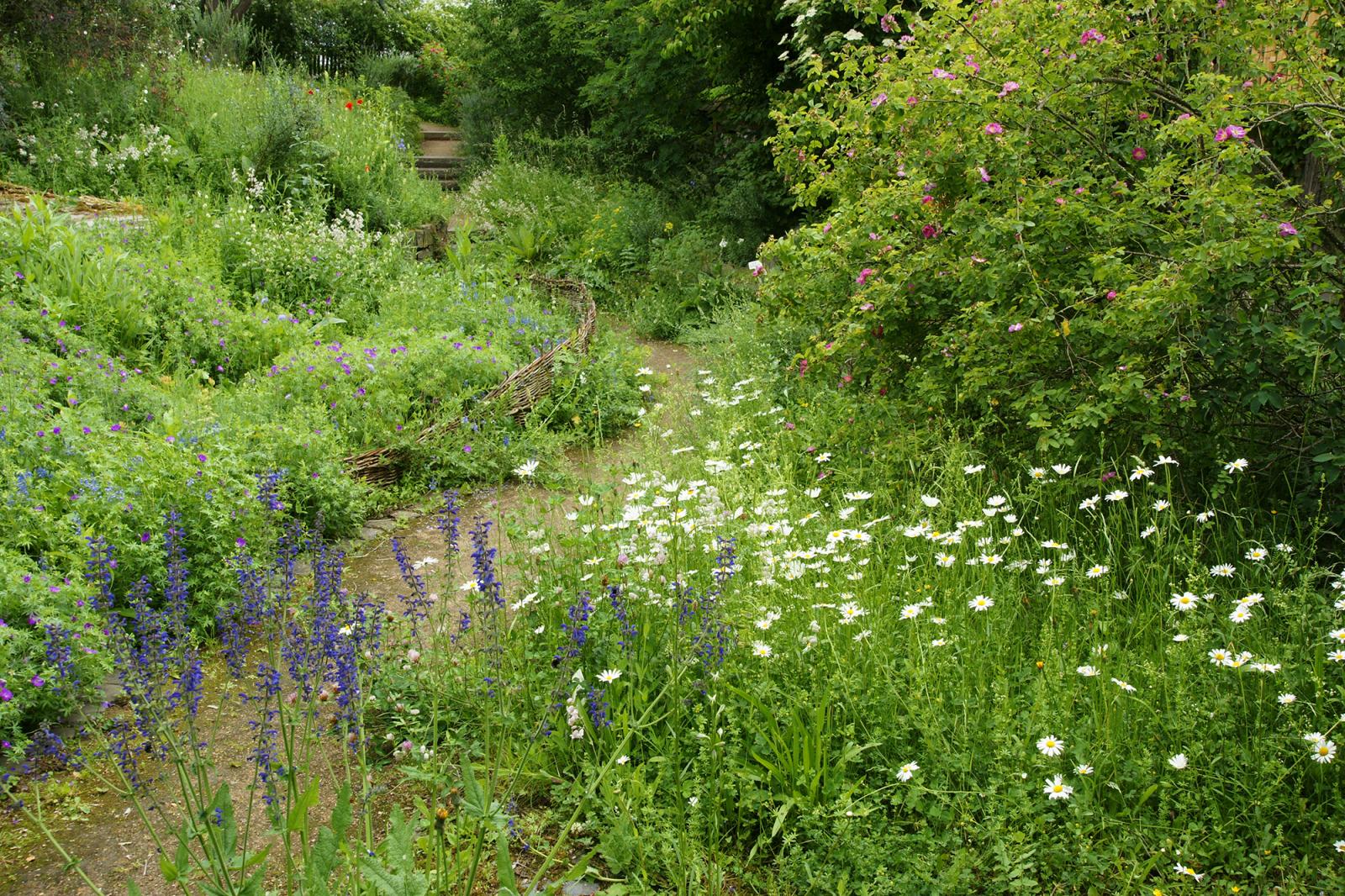
Nature Show Garden in Wachtberg (2014)
Photographer: Hans-Georg Levin, retrieved 08/18/2018 from Ulrike Aufderheide

Overview

Nature-based solution

  • Parks and urban forests
  • Pocket parks/neighbourhood green spaces
  • Green areas for water management
  • Swales and filter strips

Key challenges

  • Climate action for adaptation, resilience and mitigation (SDG 13)
  • Climate change adaptation
  • Water management (SDG 6)
  • Stormwater and rainfall management and storage
  • Green space, habitats and biodiversity (SDG 15)
  • Habitat and biodiversity restoration
  • Green space creation and/or management
  • Environmental quality
  • Cultural heritage and cultural diversity
  • Preservation of natural heritage

Focus

Creation of new green areas, Maintenance and management of urban nature, Knowledge creation and awareness raising

Project objectives

1. Securing space for protecting and enhancing local biodiversity, providing a space where nature can grow and thrive safely and its in original state. (6) 2. Regeneration and reintroduction of widely unknown or forgotten local, indigenous plants and plant species on which local animal species used to rely on (Coevolution). These have disappeared from the natural realm and have been widely replaced by foreign plants and flowers (1,4). 3. Development and displaying replicable natural solutions that tackle climate adaptation (especially cooling, flood prevention and water efficiency) (6). 4. Promotion of nature-based garden elements with building guidelines and know-how to encourage the application of local nature-friendly gardening practices (1).

Implementation activities

- Plantation of more than 50 wild wood and 100 wild perennial species (1) - Creation and building of flower meadow and flower lawns, free-growing natural hedges, planted and sown hedge borders, perennial beds, a sand hill and a flower gravel lawn all using solely native plant species rarely appearing in the urban environment (1) - Building of paths with water-bound path cover and small pavement (1) - Building of dry stone walls, as a seat, a herb spiral and retaining wall (1) - Publication of a brochure on the nature-based garden elements in the Natural Show Garden and their importance in the local biodiversity. The booklet describes each nature-based element and their functions with detailed construction plans, seeding plants with information on where to purchase these elements and how to take care of them (1, 4). - Organisation of social and environmental education themed events in the garden, such as the open house day, where members of the working group were present to answer gardening related questions and organized a guided tour (5)

Climate-focused activities

Climate change adaptation:

  • Increase or improve urban vegetation cover to help reduce outdoor temperature
  • Create or improve outdoor spaces to help people escape from urban heat
  • Implement sustainable urban drainage infrastructure (e.g. to make space for water)

Biodiversity conservation or restoration-focused activities

Biodiversity restoration:

  • Restore species (native, endangered, or unspecified)
  • Restore native species
  • Public engagement

Main beneficiaries

  • Local government/Municipality
  • Citizens or community groups

Governance

Management set-up

  • Led by non-government actors

Type of initiating organisation

  • Non-government organisation/civil society
  • Citizens or community group

Participatory approaches/ community involvement

  • Dissemination of information and education
  • Consultation (e.g. workshop, surveys, community meetings, town halls)

Details on the roles of the organisations involved in the project

The Agenda working group called "Naturnahe Gärten in Wachtberg" (Natural Gardens in Wachtberg) intitiated the creation of a Nature Show Garden project. As part of the implementation, first the working group received a piece of land for free from the municipality of Wachtberg. The garden construction works were carried out by the volunteer members of the working group with support from numerous companies providing the building materials, machines, plants and their labor at a low price or free of charge (7). The Bonn district group of the Federation for Environment and Nature Conservation Germany (Bund für Umwelt und Naturschutz Deutschland, Kreisgruppe Bonn) also supported the working group in their natural show garden implementation efforts (7). Financially the working group received support from the Sparkassenstiftung des Rhein-Sieg district. The cost of the information board in the show garden and the printing of the first edition of the Brochure (2003) was taken over by the Nordrhein-Westfälische Foundation for Environment and Development. The new edition (2020) was financed by the state of North Rhine-Westphalia (Heimat-Scheck) (7). As of 2020, the working group is responsible for maintenance of the garden, providing information to interested parties who want to replicate the natural elements in their own gardens. Local residents interested in gardening also contribute to the day-to-day maintenance of the Natural show garden (1, 4, 5).

Project implemented in response to ...

... an EU policy or strategy? Yes (International directive. In 1998, the council of the Wachtberg municipality passed the resolution to harmonise the future development of the municipality design to the to the principle of sustainability in order to achieve the demands of the Conference on Environment and Development in Rio de Janeiro 1992. The "Agenda 21" outlined in the Rio declaration granted the municipalities an important one role in the implementation of sustainable and environmentally friendly development in the fields of economy, urban society and ecology too. The Agenda working group was formed and worked in line with the Rio Declaration and contributed to the Local Agenda 21 realisation (7).)
... a national policy or strategy? Unknown
... a local policy or strategy? Unknown

Financing

Total cost

€10,000 - €50,000

Source(s) of funding

  • Other

Type of funding

  • Donations

Non-financial contribution

Type of non-financial contribution
  • Provision of land
  • Provision of goods
  • Provision of labour
Who provided the non-financial contribution?
  • Citizens (e.g. volunteering)
  • Private sector (businesses, financial institution)

Impacts and Monitoring

Environmental impacts

  • Water management and blue areas
  • Improved stormwater management
  • Green space and habitat
  • Increased number of species present
  • Increased protection of threatened species
  • Improved prevention or control of invasive alien species
  • Enhanced support of pollination
  • Increased spread of native/heirloom/open-pollinated seed

Economic impacts

  • Unknown

Socio-cultural impacts

  • Health and wellbeing
  • Gain in activities for recreation and exercise
  • Cultural heritage and sense of place
  • Protection of natural heritage
  • Education
  • Increased knowledge of locals about local nature
  • Increased awareness of NBS and their benefits

Type of reported impacts

Expected impacts, Achieved impacts

Presence of formal monitoring system

No

Presence of indicators used in reporting

No

Presence of monitoring/ evaluation reports

No

Availability of a web-based monitoring tool

No

References

Source: http://www.bonn.bund.net/themen_und_projekte/naturnaher_schaugarten_wachtberg_berkum/
Source: http://www.wachtberg.de/cms127/s/a/mg/a/2017-06-08_schaugarten_off_gartenpforte_neuer_flyer.shtml