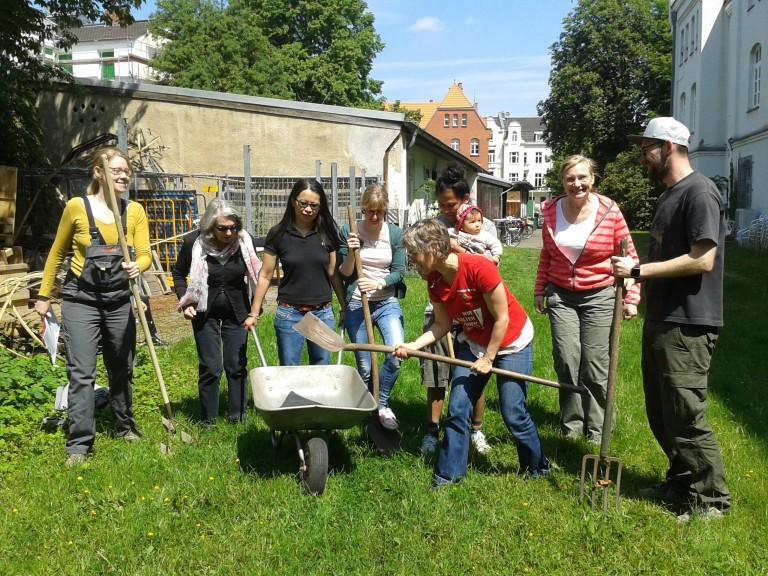
Since it's founding in 2005, the association "Ermekeilinitiative e. V." has been aiming at the transformation of the Ermekeil quarter, a former military base to a communal, generation-wide and intercultural space with diverse ecological and sustainable use. Since the Federal Office for Defense Administration moved out in 2013, the territory was released for interim use. Together with residents and communities, the association turned the territory into a lively, green and mixed neighbourhood with several initiatives taking place in parallel. The community garden project was one of them (1). The interim use of the area ended in 2016, some of the buildings of the former military base have been sold on the real estate market. This resulted in the termination of most of the Association's initiatives in the area including the removal of the 100 raised beds of the community garden. Parts of the community garden was relocated to a different part of the quarter, however, since 2018 there is no information on the current working and management of the community garden (2,6).

Overview
Nature-based solution
- Nature on buildings (external)
- Balcony greens
- Grey infrastructure featuring greens
- House gardens
- Community gardens and allotments
- Community gardens
- Horticulture
Key challenges
- Water management (SDG 6)
- Stormwater and rainfall management and storage
- Green space, habitats and biodiversity (SDG 15)
- Green space creation and/or management
- Regeneration, land-use and urban development
- Promote natural styles of landscape design for urban development
- Social justice, cohesion and equity (SDG 10)
- Environmental education
- Social cohesion
- Social interaction
- Sustainable consumption and production (SDG 12)
- Sustainable production
Focus
Project objectives
Implementation activities
Main beneficiaries
- Non-government organisation/Civil Society
- Citizens or community groups
- Marginalized groups: Refugees, asylum seekers, and migrants
Governance
Management set-up
- Led by non-government actors
Type of initiating organisation
- Non-government organisation/civil society
Participatory approaches/ community involvement
- Co-planning (e.g. stakeholder workshops, focus groups, participatory mapping)
- Dissemination of information and education
- Consultation (e.g. workshop, surveys, community meetings, town halls)
- Joint implementation (e.g. tree planting)
- Co-management/Joint management
Details on the roles of the organisations involved in the project
Project implemented in response to ...
Financing
Total cost
Source(s) of funding
- Funds provided by non-governmental organization (NGO)
Type of funding
- Unknown
Non-financial contribution
- Provision of land
- Provision of labour
- Citizens (e.g. volunteering)
Impacts and Monitoring
Environmental impacts
- Climate change
- Lowered local temperature
- Green space and habitat
- Promotion of naturalistic styles of landscape design for urban development
- Increased green space area
Economic impacts
- Unknown
Socio-cultural impacts
- Social justice and cohesion
- Increased visibility and opportunity for marginalised groups or indigenous peoples
- Increased opportunities for social interaction
- Increased access to healthy/affordable food
- Cultural heritage and sense of place
- Promotion of cultural diversity
- Education
- Increased knowledge of locals about local nature
Type of reported impacts
Presence of formal monitoring system
Presence of indicators used in reporting
Presence of monitoring/ evaluation reports
Availability of a web-based monitoring tool
References
2. Ermekeilinitiative e.V. (2016). Der Ermekeilgarten - Ein Gemeinschaftsprojekt auf dem Ermekeilgelände in der Bonner Südstadt. Accessed on September 13, 2020. Source link
3. Ermekeilinitiative e.V. (2015). Das Ermekeilkarree - Ort der Vielfalt - Wichtiges in Kürze. Bonn. Accessed on September 13, 2020. Source link
4. Ermekeilinitiative e.V. (2015). Ermekeilinitiative e.V. Das Quartier mit dem integrativen Nutzungskonzept – entwickelt von und für BürgerInnen. Bonn. Accessed on September 13, 2020. Source link
5. Initiative zur zivilen Nutzung der Ermekeilkaserne e.V. (2013). Das Ermekeil-Karree Quartier der Vielfalt: Integratives Nutzungskonzept. Bonn. Accessed on September 13, 2020. Source link
6. Ermekeilgarten. (n/a). Zwischennutzung. Accessed on September 13, 2020. Source link