

Last updated: October 2021
In 2010 a very special orchard was inaugurated in the Park of Villa Ghigi in Bologna, the first of its kind in the region and probably in Italy, to preserve the germplasm of some of the oldest varieties of fruit plants in the Emilia-Romagna region. The Orchard contains about thirty fruit trees, organized into homogeneous groups: olives, pears, apples, rowan and smaller fruits. Each plant is accompanied by a panel describing the characteristics of the plant, the agronomic and the cultural aspects, including the tree and fruit picture (1).
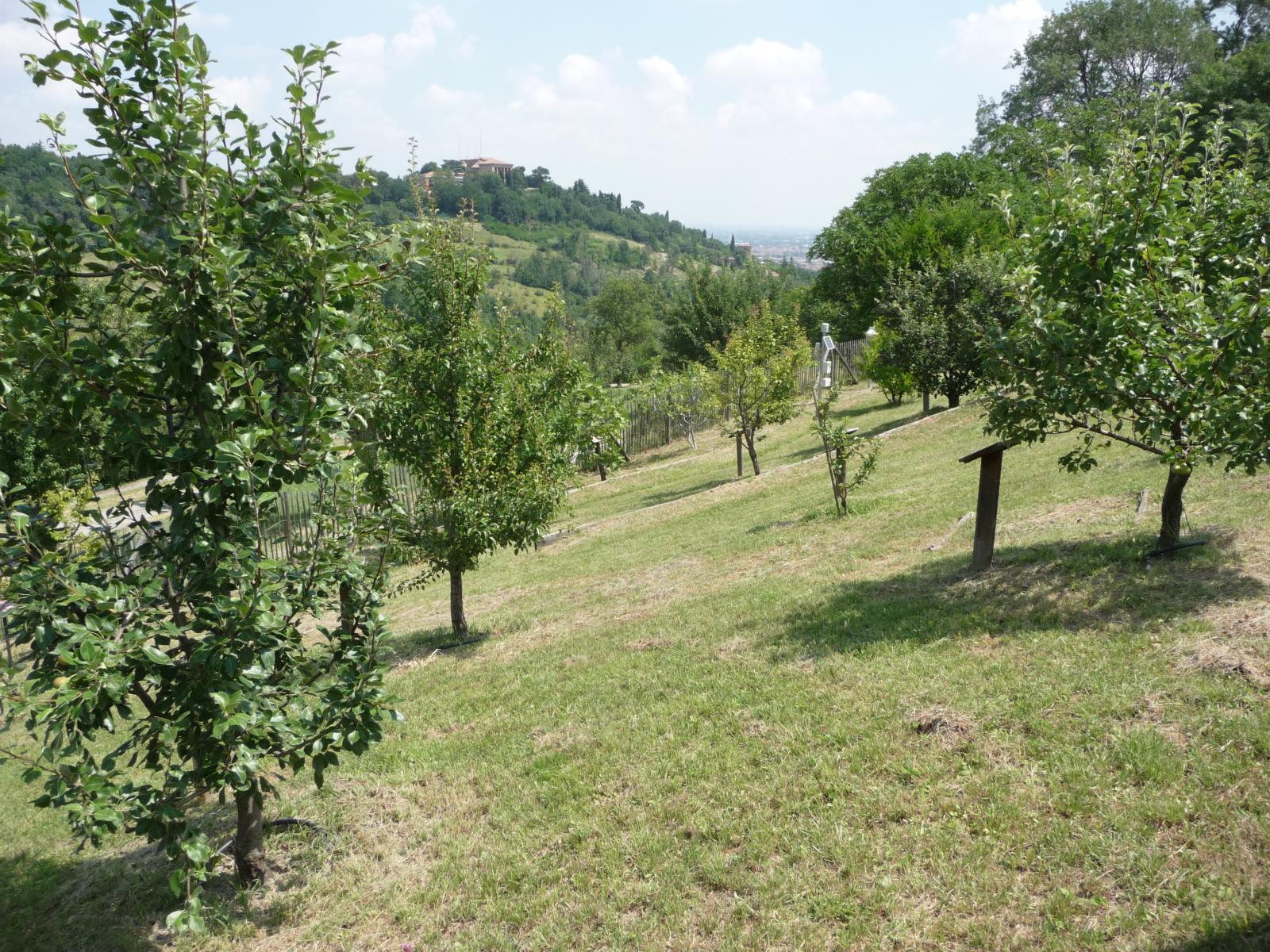
Fruit Garden in Villa Ghigi (2018)
Photographer: Sergio Guidi, retrieved 08/13/2018
Overview
Nature-based solution
- Parks and urban forests
- Large urban parks or forests
- Other
Key challenges
- Green space, habitats and biodiversity (SDG 15)
- Habitat and biodiversity restoration
- Green space creation and/or management
- Health and well-being (SDG 3)
- Creation of opportunities for recreation
- Cultural heritage and cultural diversity
- Preservation of natural heritage
Focus
Creation of new green areas, Protection of natural ecosystems, Knowledge creation and awareness raising, Monitoring and maintenance of habitats and/or biodiversity
Project objectives
There are 4 main purposes of this project:
1) recovery and enhancement of the germplasm of autochthonous fruits of Emilia-Romagna (LR 1/2008);
2) didactic dissemination;
3) memory retention related to cultivation, storage and use; The data will be part of the so-called "Memory Bank" provided by the aforementioned regional law;
4) Scientific research by Arpa of some plants in order to assess the climate change in progress through the observation and analysis of phenological phenomena (opening of buds, flowering, etc.). Stackable fruit trees are therefore important biological indicators not only as "sensors" of climate change, but also environmental quality and in particular air pollutants (5 and 6).
Implementation activities
Over the years several plants risking extinction were introduced in the garden. Plants are constantly monitored and the use of natural pollinators, such as bees, permits the maintenance of biodiversity (4).
Biodiversity conservation or restoration-focused activities
Biodiversity restoration:
- Restore species (native, endangered, or unspecified)
- Restore native species
Main beneficiaries
- Local government/Municipality
- Private sector/Corporate/Company
- Citizens or community groups
Governance
Management set-up
- Led by non-government actors
Type of initiating organisation
- Private foundation/trust
Participatory approaches/ community involvement
- Dissemination of information and education
Details on the roles of the organisations involved in the project
The project was launched and directed by Fondazione Villa Ghigi, in collaboration with Arpa and Regione Emilia-Romagna (1 and 2).
Project implemented in response to ...
... an EU policy or strategy?
Unknown
(It was a regional initiative. )
... a national policy or strategy?
Unknown
(It was a regional initiative.)
... a local policy or strategy?
Yes
(The initiative titled "The Biodiversity Orchard Network" is part of the activities to protect the genetic resources of agricultural interest in the region.
Arpa ER (following an agreement with the Emilia-Romagna Region and in reference to Regional Law 1/2008 for the conservation of genetic resources of agrarian interest) has "woven" a Biodiversity Orchard Network, realizing a series of garden- orchards (6). )
Financing
Total cost
Unknown
Source(s) of funding
- Unknown
Type of funding
- Unknown
Non-financial contribution
Unknown
Impacts and Monitoring
Environmental impacts
- Green space and habitat
- Increased green space area
- Increased conservation or restoration of ecosystems
- Increase in protected green space areas
- Increased number of species present
- Increased protection of threatened species
- Enhanced support of pollination
Economic impacts
- Unknown
Socio-cultural impacts
- Social justice and cohesion
- Improved access to urban green space
- Increased opportunities for social interaction
- Health and wellbeing
- Gain in activities for recreation and exercise
- Cultural heritage and sense of place
- Improvement in people’s connection to nature
- Protection of historic and cultural landscape / infrastructure
- Education
- Increased knowledge of locals about local nature
Type of reported impacts
Achieved impacts
Presence of formal monitoring system
Yes
Presence of indicators used in reporting
Yes
Presence of monitoring/ evaluation reports
Yes
Availability of a web-based monitoring tool
No evidence in public records
References
1. L´Agenzia regionale per la prevenzione, l´ambiente e l´energia dell´Emilia-Romagna (Arpae) (no date), Il Frutteto del Palazzino, nel parco di Villa Ghigi di Bologna, Available at Source link (Accessed 22-7-2021)
2. Fondazione Villa Ghigi, (no date), Natura del Parco Villa Ghigi, Available at Source link (Accessed 19-6-2020)
3. Parisini, F. (2010), “Il giardino dei frutti dimenticati rivive sui colli di Villa Ghigi” in La Repubblica, Available at Source link (Accessed 19-6-2020)
4. Arpa (2013), I frutteti della in biodiversità Emilia-Romagna, Available at Source link (Accessed 19-6-2020)
5. Brenna, L. (2015), Villa Ghigi, un incredibile scrigno di biodiversità a due passi da Bologna, in Lorto giardino di monte renzio blogspot, Available at Source link (Accessed 19-6-2020)
6. Arpae (2015), La rete dei frutteti della biodiversità, Available at Source link (Accessed 19-6-2020)
2. Fondazione Villa Ghigi, (no date), Natura del Parco Villa Ghigi, Available at Source link (Accessed 19-6-2020)
3. Parisini, F. (2010), “Il giardino dei frutti dimenticati rivive sui colli di Villa Ghigi” in La Repubblica, Available at Source link (Accessed 19-6-2020)
4. Arpa (2013), I frutteti della in biodiversità Emilia-Romagna, Available at Source link (Accessed 19-6-2020)
5. Brenna, L. (2015), Villa Ghigi, un incredibile scrigno di biodiversità a due passi da Bologna, in Lorto giardino di monte renzio blogspot, Available at Source link (Accessed 19-6-2020)
6. Arpae (2015), La rete dei frutteti della biodiversità, Available at Source link (Accessed 19-6-2020)

Fruit Garden in Villa Ghigi
Source: http://lortogiardinodimonterenzio.blogspot.com/2015/07/villa-ghigi-bologna-un-articolo.html