

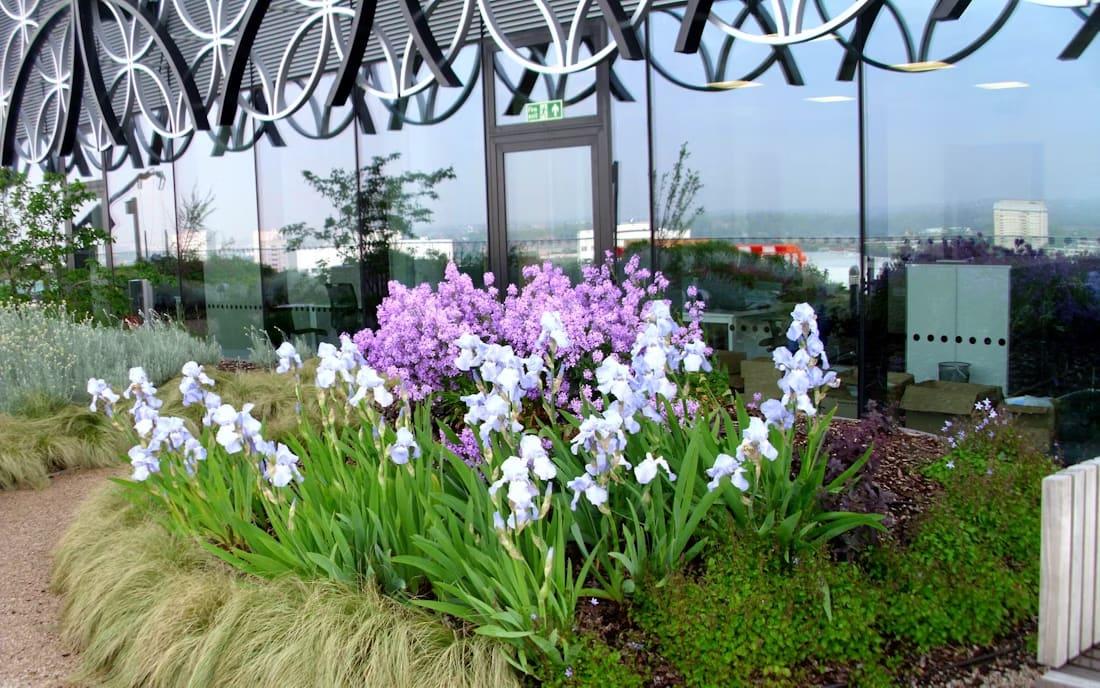
Birmingham faces several immediate risks due to climate change, including heatwaves, water shortages from droughts, floods, and extreme weather (Ref 11). To address these challenges, Birmingham City Council has set a goal to reduce carbon emissions by 60% by 2027. As part of this effort, the new Birmingham Library project, initiated by the council, includes a rooftop garden designed to contribute to this target (Ref 3). The library was designed by the Dutch firm Mecanoo Architecten, with a design process spanning from 2008 to 2012 (Ref 5). The two outdoor rooftop gardens, located on levels 3 and 7, were completed in 2013 (Ref 1). These gardens provide green spaces in the city center, enhance water management through rainwater harvesting, serve as educational facilities for sustainable food innovation, and create natural habitats for wildlife (Ref 1, 3, 4, 6). Their contributions helped the library achieve a BREEAM 'Excellent' rating and have garnered various awards (Ref 1, 10). The new library aligns with Birmingham City Council's Big City Plan to regenerate the city center, with the green roof gardens playing a key role (Ref 4).

Overview
Nature-based solution
- Community gardens and allotments
- Community gardens
- Nature on buildings (external)
- Green roofs
Key challenges
- Climate action for adaptation, resilience and mitigation (SDG 13)
- Climate change adaptation
- Climate change mitigation
- Green space, habitats and biodiversity (SDG 15)
- Green space creation and/or management
- Habitat and biodiversity restoration
- Water management (SDG 6)
- Flood protection
- Stormwater and rainfall management and storage
- Social justice, cohesion and equity (SDG 10)
- Environmental education
- Sustainable consumption and production (SDG 12)
- Sustainable consumption
- Sustainable production
Principal problems in Functional Urban Area (FUA)
- Climate-Related Hazards
- Urban flooding (stormwater)
- Drought
- Heat stress & Extreme temperatures
- Extreme weather events (e.g. storms, hurricanes)
Key priorities
Focus
Project objectives
Implementation activities
Climate-focused activities
Climate change adaptation:
- Implement green walls or roofs to lower indoor temperature and provide insulation
- Implement sustainable urban drainage schemes to manage stormwater
Climate change mitigation:
- Raise public awareness of behaviours, lifestyle and cultural changes with mitigation potential
Biodiversity conservation or restoration-focused activities
Biodiversity restoration:
- Restore species (native, endangered, or unspecified)
- Public engagement
Main beneficiaries
- Local government/Municipality
- Public sector institution (e.g. school or hospital)
- Private sector/Corporate/Company
- Citizens or community groups
- Young people and children
- Marginalized groups: Children, young people or youth groups
Governance
Management set-up
- Government-led
Type of initiating organisation
- Local government/municipality
Participatory approaches/ community involvement
- Co-planning (e.g. stakeholder workshops, focus groups, participatory mapping)
- Taskforce groups
- Consultation (e.g. workshop, surveys, community meetings, town halls)
Details on the roles of the organisations involved in the project
Project implemented in response to ...
Type of enablers
Financing
Total cost
Source(s) of funding
- Public national budget
Type of funding
- Loan
Non-financial contribution
Impacts and Monitoring
Environmental impacts
- Climate change
- Reduced emissions
- Achieved reduced emissions
- Environmental quality
- Improved waste management
- Achieved improved waste management
- Water management and blue areas
- Improved stormwater management
- Achieved improved stormwater management
- Green space and habitat
- Increased green space area
- Achieved increased green space area
Economic impacts
- Increase of green jobs (e.g. paid employment positions)
- Achieved increase of green jobs (e.g. paid employment positions)
Socio-cultural impacts
- Social justice and cohesion
- Improved liveability
- Expected improved liveability
- Increased access to healthy/affordable food
- Expected increased access to healthy/affordable food
- Health and wellbeing
- Enhanced cognitive restoration, relaxation and stress relief
- Expected enhanced cognitive restoration, relaxation and stress relief
- Cultural heritage and sense of place
- Improvement in people’s connection to nature
- Achieved improvement in people’s connection to nature
- Increased appreciation for natural spaces
- Expected increased appreciation for natural spaces
Type of reported impacts
Presence of formal monitoring system
Presence of indicators used in reporting
Presence of monitoring/ evaluation reports
Availability of a web-based monitoring tool
Potential risks of implementation and trade-offs
References



 Information about this nature-based solution was collected as part of the Naturescapes project funded by the European Union under Grant Agreement No 101084341.