

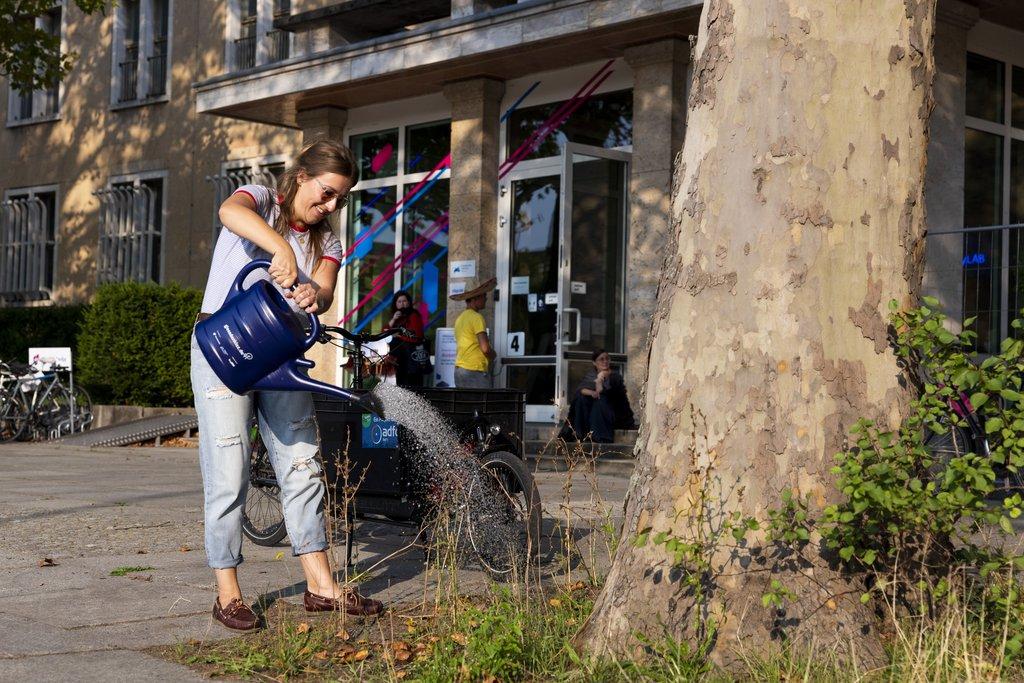
In May 2020, CityLAB Berlin launched "Gieß den Kiez", an interactive platform designed to support Berlin's urban trees by fostering collaboration between citizens and the city. The platform enables voluntary civil society efforts to help water the city's endangered tree population. It features a map that visualizes nearly all of Berlin's street and park trees, complete with data such as water requirements, age, and species. Citizens can create profiles, adopt trees, and mark them as ‘watered’ within the app, making it easy to track contributions to the health of Berlin’s trees. (Ref. 2) Berlin's trees face growing challenges due to increasing temperatures, reduced rainfall, and exposure to road salt in winter. The hot summers of 2018 and 2019 highlighted the urgency of supporting the city’s trees, which provide cooling shade, clean air, and habitats for numerous animal and plant species. To address this, "Gieß den Kiez" was developed as a platform where authorities, volunteers, and civic society could collaborate to prevent tree dehydration. The platform maps over 625,000 trees across Berlin and offers additional tools, such as rainfall data from the last 30 days and the locations of public water fountains, which can be used for watering trees. By connecting data from city authorities, the German Weather Service, and OpenStreetMap, the fully open-source platform allows for transparency and accessibility in its operation. (Ref. 6) The project has proven highly successful in Berlin, with over 10,000 participants actively watering trees, and its model has been adopted in other German cities like Leipzig. "Gieß den Kiez" not only exemplifies a practical response to urban climate challenges but also fosters a sense of shared responsibility and community engagement in caring for urban green spaces. (Ref. 6)
Overview
Nature-based solution
- Grey infrastructure featuring greens
- Alley or street trees and other street vegetation
- Parks and urban forests
- Large urban parks or forests
- Pocket parks/neighbourhood green spaces
Key challenges
- Climate action for adaptation, resilience and mitigation (SDG 13)
- Climate change adaptation
- Climate change mitigation
- Green space, habitats and biodiversity (SDG 15)
- Green space creation and/or management
- Inclusive and effective governance (SDG 16)
- Inclusive governance
- Social justice, cohesion and equity (SDG 10)
- Environmental education
Principal problems in Functional Urban Area (FUA)
- Climate-Related Hazards
- Drought
- Heat stress & Extreme temperatures
- Other
Key priorities
Focus
Project objectives
Implementation activities
Climate-focused activities
Climate change adaptation:
- Increase urban vegetation cover to reduce urban heat island effect
- Other
Climate change mitigation:
- Increase the availability of green urban space for carbon storage (street tree cover)
Main beneficiaries
- Public sector institution (e.g. school or hospital)
Governance
Management set-up
- Led by non-government actors
Type of initiating organisation
- Other
Participatory approaches/ community involvement
- Dissemination of information and education
- Joint implementation (e.g. tree planting)
- Citizen monitoring and review
Details on the roles of the organisations involved in the project
Project implemented in response to ...
Type of enablers
Financing
Total cost
Source(s) of funding
- Public regional budget
Type of funding
- Earmarked public budget
Non-financial contribution
- Provision of labour
- Provision of expertise
- Citizens (e.g. volunteering)
Impacts and Monitoring
Environmental impacts
- Climate change
- Lowered local temperature
- Expected lowered local temperature
- Enhanced carbon sequestration
- Expected enhanced carbon sequestration
- Green space and habitat
- Increased green space area
- Achieved increased green space area
- Other
Economic impacts
- Unknown
Socio-cultural impacts
- Social justice and cohesion
- Increased involvement of locals in the management of green spaces
- Expected increased involvement of locals in the management of green spaces
- Education
- Increased knowledge of locals about local nature
- Expected increased knowledge of locals about local nature
Type of reported impacts
Presence of formal monitoring system
Presence of indicators used in reporting
Presence of monitoring/ evaluation reports
Availability of a web-based monitoring tool
Potential risks of implementation and trade-offs
References


 Information about this nature-based solution was collected as part of the Naturescapes project funded by the European Union under Grant Agreement No 101084341.