

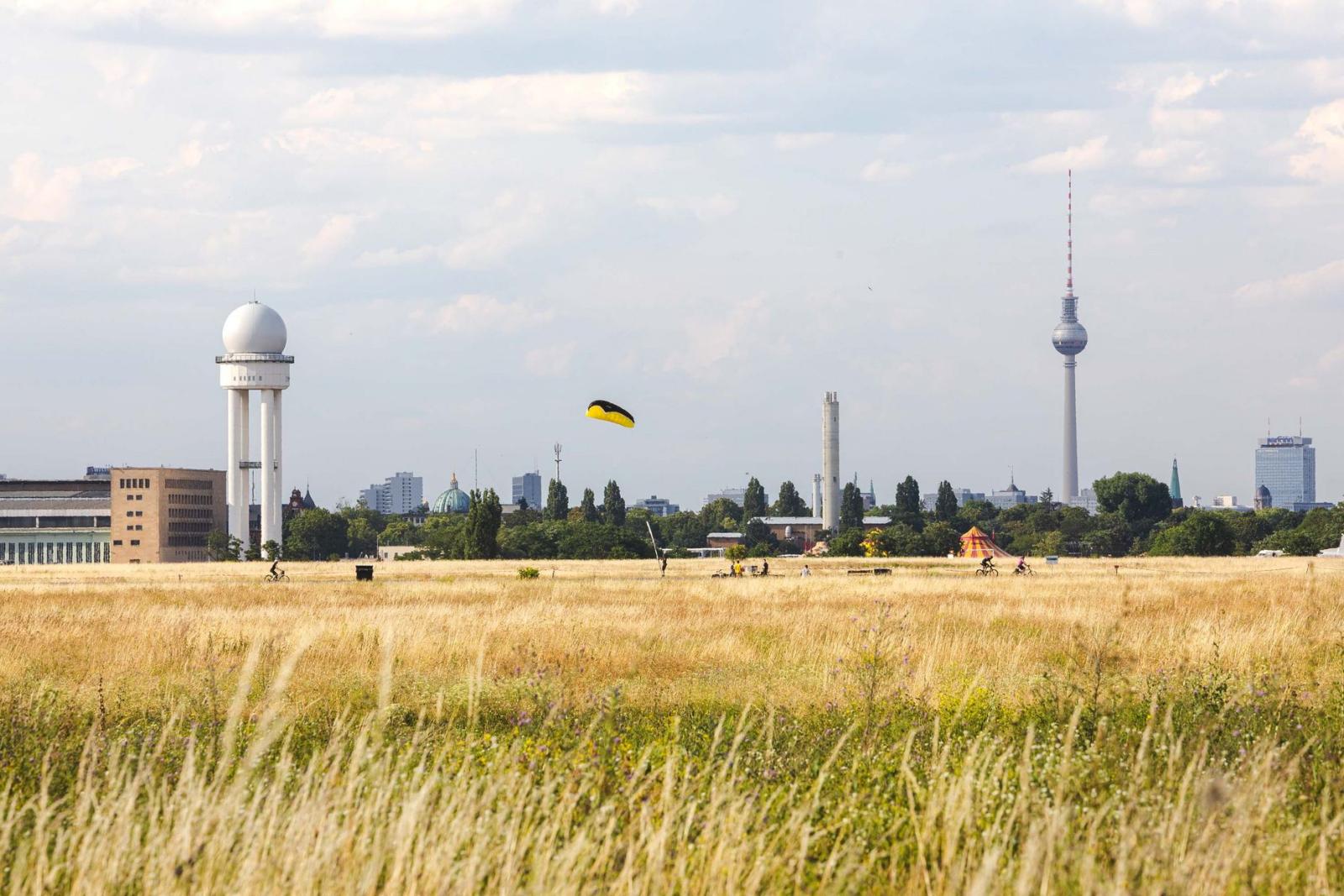
Tempelhofer Feld stands as an innovative green solution in the heart of Berlin, addressing several issues of environmental justice, biodiversity, and urban resilience. Within the S-Bahn ring, only one in 20 residents lives in areas well-served by green spaces, and districts like Neukölln, Kreuzberg, and Tempelhof would face even greater scarcity without this vast expanse. Many residents in these neighborhoods lack access to private green spaces such as gardens or balconies. Without nearby parks, people are compelled to travel to other districts, exacerbating the congestion of green spaces and increasing local traffic. Since its opening in 2010, Tempelhofer Feld has provided Berlin with over 300 hectares of open, green, leisure, and recreational space, making it one of the largest urban open spaces globally. Once the site of bustling air traffic, it is now a sanctuary for activities such as skating, strolling, gardening, picnicking, birdwatching, kiteboarding, and more. These wide-ranging uses showcase its transformation into an accessible, multifunctional green space that serves as a social equalizer, particularly for disadvantaged neighborhoods, a significance amplified during the Covid-19 pandemic. The field is not just a recreational haven but also a vital ecological refuge. With over two-thirds of its area designated as green space, it hosts diverse ecosystems, including extensive natural meadows, lawns, and protected habitats for birds and other species. Certain areas are closed to the public to preserve these sensitive environments, emphasizing the balance between human activity and ecological conservation. Since 2019, animal landscape keepers, including around 100 resident sheep, have contributed to sustainable land management practices, promoting biodiversity and ecological health (Ref. 2). Managed collaboratively by political, administrative, and societal actors, the site exemplifies integrated citizen participation in urban planning. (Ref. 3)

Overview
Nature-based solution
- Community gardens and allotments
- Horticulture
- Parks and urban forests
- Pocket parks/neighbourhood green spaces
- Other
Key challenges
- Climate action for adaptation, resilience and mitigation (SDG 13)
- Climate change adaptation
- Climate change mitigation
- Environmental quality
- Air quality improvement
- Noise reduction
- Green space, habitats and biodiversity (SDG 15)
- Green space creation and/or management
- Habitat and biodiversity restoration
- Regeneration, land-use and urban development
- Regulation of built environment
- Promote natural styles of landscape design for urban development
- Cultural heritage and cultural diversity
- Protection of historic and cultural landscape/infrastructure
- Health and well-being (SDG 3)
- Creation of opportunities for recreation
- Enabling opportunities for physical activity
- Inclusive and effective governance (SDG 16)
- Inclusive governance
- Social justice, cohesion and equity (SDG 10)
- Social justice and equity
- Environmental education
Principal problems in Functional Urban Area (FUA)
- Climate-Related Hazards
- Urban flooding (stormwater)
- Heat stress & Extreme temperatures
- Degradation of carbon sinks
- Environmental Degradation
- Biodiversity loss
- Air pollution
- Land use and Socio-economic change
- Rapid urbanization
- Unequal availability and access to public green spaces
- Health, Well-being and Social cohesion
- Inadequate access to recreational opportunities
Key priorities
Focus
Project objectives
Implementation activities
Climate-focused activities
Climate change adaptation:
- Increase urban vegetation cover to reduce urban heat island effect
Climate change mitigation:
- Increase the availability of green urban space for carbon storage (street tree cover)
Biodiversity conservation or restoration-focused activities
Biodiversity restoration:
- Rehabilitate and restore damaged or destroyed ecosystems
- Restore species (native, endangered, or unspecified)
Main beneficiaries
- Citizens or community groups
- Young people and children
- Marginalized groups: Socio-economically disadvantaged populations (e.g. low-income households, unemployed)
Governance
Management set-up
- Co-governance with government and non-government actors
Type of initiating organisation
- Regional government
- Citizens or community group
- Private sector/corporate actor/company
Participatory approaches/ community involvement
- Co-planning (e.g. stakeholder workshops, focus groups, participatory mapping)
- Deliberative decision-making processes (e.g., consensus building, deliberative polling)
- Dissemination of information and education
- Consultation (e.g. workshop, surveys, community meetings, town halls)
- Co-management/Joint management
Details on the roles of the organisations involved in the project
Project implemented in response to ...
Type of enablers
Financing
Total cost
Source(s) of funding
- Public regional budget
Type of funding
- Earmarked public budget
- Direct funding (grants, subsidies, or self-financed projects by private entities)
Non-financial contribution
- Provision of land
- Public authorities (e.g. land, utility services)
Impacts and Monitoring
Environmental impacts
- Climate change
- Lowered local temperature
- Expected lowered local temperature
- Enhanced carbon sequestration
- Expected enhanced carbon sequestration
- Environmental quality
- Improved air quality
- Expected improved air quality
- Reduced noise exposure
- Expected reduced noise exposure
- Green space and habitat
- Increased green space area
- Achieved increased green space area
- Increased number of species present
- Achieved increased number of species present
Economic impacts
- Other
Socio-cultural impacts
- Social justice and cohesion
- Improved access to urban green space
- Achieved improved access to urban green space
- Increased opportunities for social interaction
- Expected increased opportunities for social interaction
- Health and wellbeing
- Gain in activities for recreation and exercise
- Expected gain in activities for recreation and exercise
- Improved prevention of respiratory problems
- Expected improved prevention of respiratory problems
- Enhanced cognitive restoration, relaxation and stress relief
- Expected enhanced cognitive restoration, relaxation and stress relief
- Other
Type of reported impacts
Presence of formal monitoring system
Presence of indicators used in reporting
Presence of monitoring/ evaluation reports
Availability of a web-based monitoring tool
Potential risks of implementation and trade-offs
References


 Information about this nature-based solution was collected as part of the Naturescapes project funded by the European Union under Grant Agreement No 101084341.