

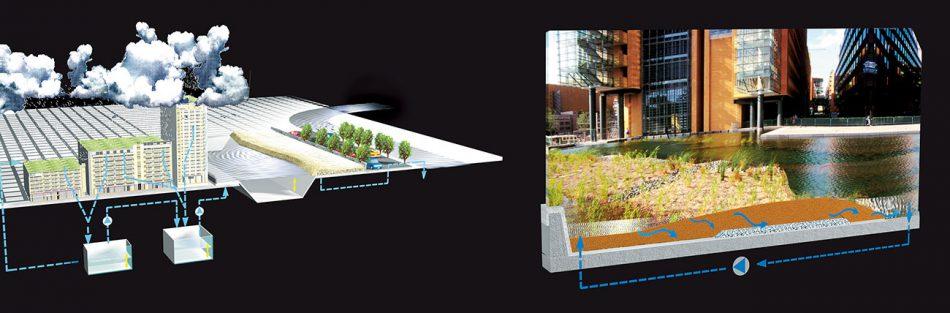
In an architecturally important area of Berlin, situated between the Landwehr Canal, the Kulturforum (the Berliner Philharmonie and the Berlin State Library) and the new construction on Potsdamer Platz, a combination of green and grey infrastructure has been realised to minimise the burden on Berlin’s existing water infrastructure. Green and non-green roofs harvest annual rain, which flows through the site’s buildings and is used for toilet flushing, irrigation, and fire systems. The roofs retain and then release water to the large on-site buffer pond, which has five underground storage tanks. Next to the roofs, a series of urban ponds and connecting canals have been implemented, with a combined area of approximately 1.2 hectares. They are filled with rainwater, creating an oasis for urban life. Vegetated biotopes are integrated into the overland landscape and serve to filter and circulate the water that runs along streets and walkways. The lake’s water quality is excellent, forming a natural habitat for animals and cooling the surroundings, while fresh water usage in the buildings has been reduced. (Ref. 1; Ref. 2; Ref. 3; Ref. 6) The project was implemented in the 1990s as part of the development of Potsdamer Platz in the wake of the reunification of Germany. Several architects collaborated on the implementation that was completely privately funded. Beyond its ecological and technical features, the site is a blue natural site in the heavily built city centre of Berlin and allows people to linger and enjoy natural features. The drainage system won several sustainability prices and is considered a successful integration of nature and technology-based mechanisms to foster climate change adaptation. As the rainwater system stores rainwater in underground tanks and ponds, the urban sewage system is relieved during heavy rain, and water can evaporate. Therefore, the small water circle is closed, and the microclimate is cooled. (Ref. 2; Ref. 6)

Overview
Nature-based solution
- Blue infrastructure
- Lakes/ponds
- Rivers/streams/canals/estuaries
- Green areas for water management
- Swales and filter strips
- Sustainable urban drainage systems
- Nature on buildings (external)
- Green roofs
Key challenges
- Climate action for adaptation, resilience and mitigation (SDG 13)
- Climate change adaptation
- Environmental quality
- Air quality improvement
- Green space, habitats and biodiversity (SDG 15)
- Green space creation and/or management
- Water management (SDG 6)
- Stormwater and rainfall management and storage
- Improvements to water quality
- Health and well-being (SDG 3)
- Creation of opportunities for recreation
Principal problems in Functional Urban Area (FUA)
- Climate-Related Hazards
- Urban flooding (stormwater)
- Heat stress & Extreme temperatures
- Environmental Degradation
- Biodiversity loss
- Air pollution
- Poor water quality
- Physical water retention and availability
- Land use and Socio-economic change
- Rapid urbanization
- Health, Well-being and Social cohesion
- Inadequate access to recreational opportunities
- Resource Scarcity and Competition
- Water stress (increased demand)
Key priorities
Focus
Project objectives
Implementation activities
Climate-focused activities
Climate change adaptation:
- Increase urban vegetation cover to reduce urban heat island effect
- Implement sustainable urban drainage schemes to manage stormwater
- Other
Main beneficiaries
- Private sector/Corporate/Company
- Citizens or community groups
Governance
Management set-up
- Co-governance with government and non-government actors
Type of initiating organisation
- Local government/municipality
- Private sector/corporate actor/company
Participatory approaches/ community involvement
- Co-planning (e.g. stakeholder workshops, focus groups, participatory mapping)
- Taskforce groups
- Joint implementation (e.g. tree planting)
Details on the roles of the organisations involved in the project
Project implemented in response to ...
Type of enablers
Financing
Total cost
Source(s) of funding
- Corporate investment
Type of funding
- Direct funding (grants, subsidies, or self-financed projects by private entities)
Non-financial contribution
- Provision of land
- Public authorities (e.g. land, utility services)
Impacts and Monitoring
Environmental impacts
- Climate change
- Lowered local temperature
- Achieved lowered local temperature
- Water management and blue areas
- Improved water quality
- Achieved improved water quality
- Increased protection against flooding
- Achieved increased protection against flooding
- Improved stormwater management
- Achieved improved stormwater management
- Green space and habitat
- Increased green space area
- Achieved increased green space area
- Increased number of species present
- Achieved increased number of species present
Economic impacts
- Increased property prices
- Achieved increased property prices
Socio-cultural impacts
- Social justice and cohesion
- Improved access to urban green space
- Achieved improved access to urban green space
- Health and wellbeing
- Gain in activities for recreation and exercise
- Achieved gain in activities for recreation and exercise
Type of reported impacts
Presence of formal monitoring system
Presence of indicators used in reporting
Presence of monitoring/ evaluation reports
Availability of a web-based monitoring tool
Potential risks of implementation and trade-offs
References


 Information about this nature-based solution was collected as part of the Naturescapes project funded by the European Union under Grant Agreement No 101084341.