Last updated: November 2024
The former Kulturpark Plänterwald, once the only permanent amusement park in the GDR, closed in 2001 due to declining visitor numbers. Over time, the 23-hectare site became a ‘lost place,’ falling into disrepair. In 2014, the state of Berlin reacquired the area, and two years later, Grün Berlin initiated its redevelopment with a sustainable development concept that places significant emphasis on rainwater management.
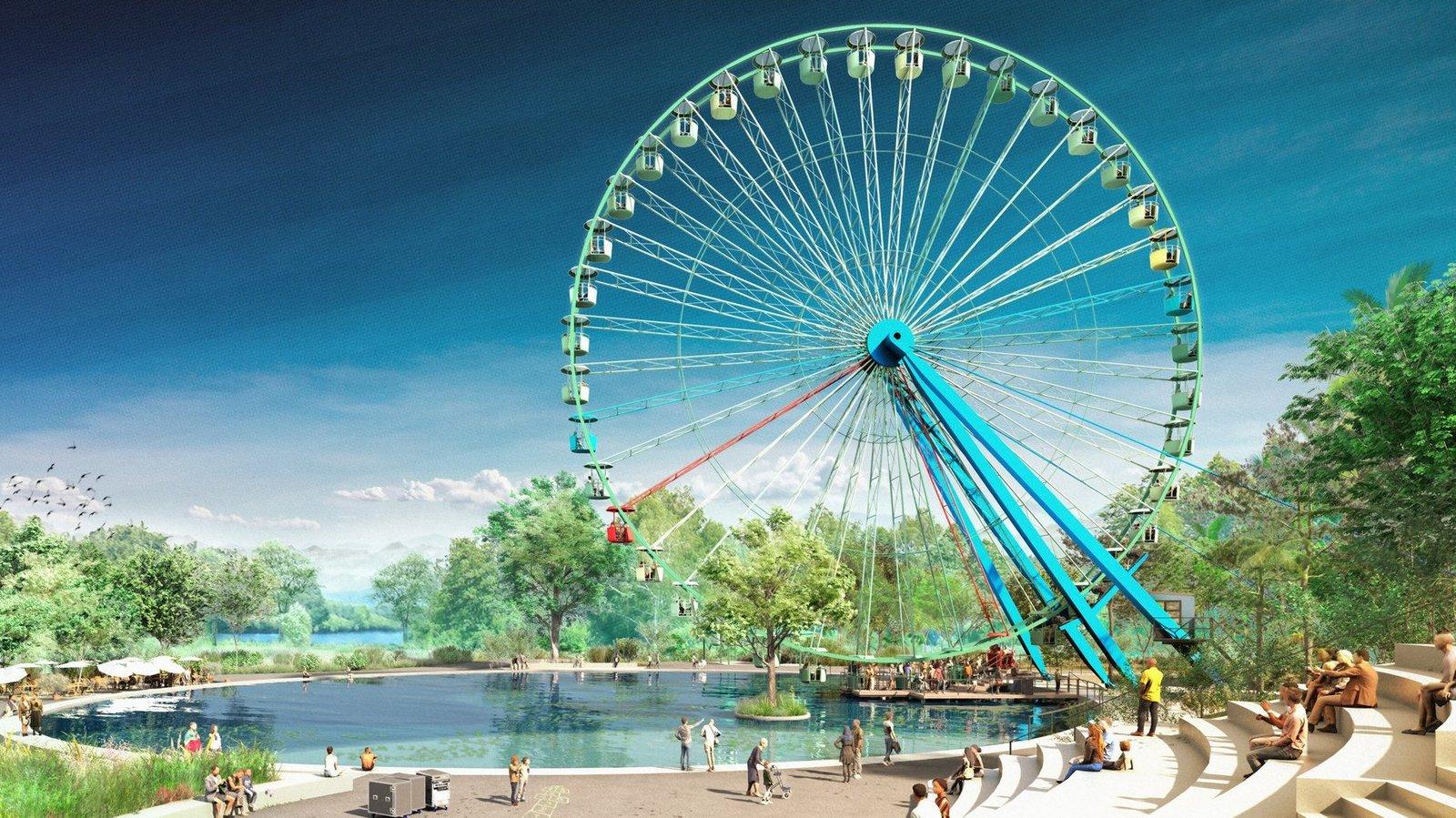
The project’s goal is to avoid discharging rainwater into the sewer system and instead manage all precipitation on-site. This approach addresses both heavy rainfall events and extreme drought conditions, creating a sustainable rainwater management system. A central element of this concept is the historic but dried-up water basin located near the iconic Ferris wheel. Plans include redesigning and reactivating the basin, incorporating terraces and a shallow water zone, transforming it into a key part of the rainwater cycle while providing an attractive recreational and adventure area. (Ref. 1; Ref. 2)
In the future, the water basin will no longer be purely decorative but will serve as a critical artificial water reservoir. To support this function, it will be equipped with a natural horizontal filter system featuring reeds for rainwater purification. Pre-treated water will flow into the newly designed 3,000-square-metre basin near the Ferris wheel. Rainwater collected in the basin, along with water stored in cisterns throughout the park, will irrigate the site’s vegetation. This innovative approach ensures sustainable water use and contributes to the ecological revitalization of the park. (Ref. 1; Ref. 3)
By integrating sustainable rainwater management into its redevelopment, the former Kulturpark Plänterwald is being transformed into a resilient and environmentally conscious space, combining historical preservation with modern ecological practices.
Envisioned look of the Ferris wheel and retention pond
realities:united
Overview
Nature-based solution
- Blue infrastructure
- Lakes/ponds
- In-land wetlands, peatlands, swamps, and moors
- Riverbank/Lakeside greens
Key challenges
- Climate action for adaptation, resilience and mitigation (SDG 13)
- Climate change adaptation
- Green space, habitats and biodiversity (SDG 15)
- Green space creation and/or management
- Water management (SDG 6)
- Stormwater and rainfall management and storage
- Improvements to water quality
- Health and well-being (SDG 3)
- Creation of opportunities for recreation
- Inclusive and effective governance (SDG 16)
- Inclusive governance
Principal problems in Functional Urban Area (FUA)
- Climate-Related Hazards
- Urban flooding (stormwater)
- Drought
- Heat stress & Extreme temperatures
Key priorities
Climate action (adaptation and/or mitigation), Biodiversity (conservation and/or restoration)
Focus
Creation of semi-natural blue areas, Creation of lakes or ponds, Creation of artificial wetlands, Improved governance of green or blue areas, Establishment of inclusive governance mechanisms involving local communities
Project objectives
To refurbish the former water basin into a retention pond as part of a sustainable rainwater management system to relieve the Berlin sewage system. (Ref. 1)
To create diverse biotopes, including a water biotope (water basin) and a wetland biotope (soil filter zone), to support plants and animals. (Ref. 1)
To cool the microclimate through evaporation processes. (Ref. 1)
To irrigate approximately 10,200 square metres of vegetation areas. (Ref. 1)
To create a recreational area around the pond.
To include citizens in decision making processes (Ref. 1)
Implementation activities
In terms of design and function, the new water basin will be linked to the old one. The modelling of the formerly purely decorative water basin will be retained and will be used for water purification in the future by establishing a bottom filter. The new circular water basin will have a future capacity of 3,700 cubic metres. Together with the cisterns distributed throughout the park, the new 3,000 square metre water basin will be used to feed the irrigation systems, among other things to ensure local rainwater management. The available rainwater will be used primarily to irrigate around 10,200 sqm of vegetation.
The development of the water basin and the surroundings will also favour the habitat conditions for plants and animals in the future and ensure the ecological diversity of the site.
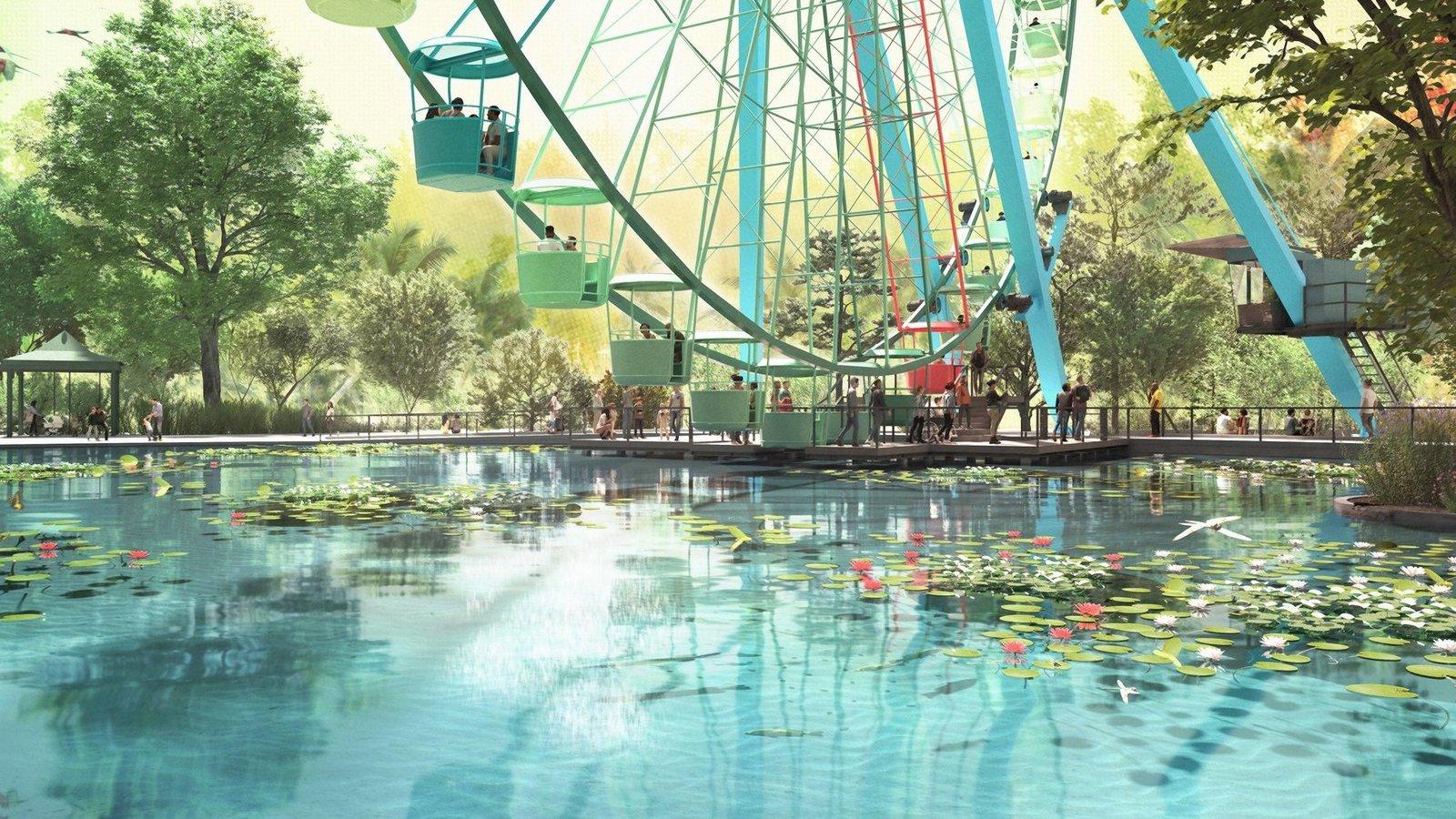
The plausible idea sketch envisages a round water basin with partially shallow bank zones, which are suitable as amphibian habitats, among other things. As an open water area, it also contributes to cooling the microclimate through evaporation and at the same time relieves the Berlin sewerage system. (Ref. 1)
The state of Berlin bought the area in 2014. The reopening of the park is realised with participation of citizens, artists and various stakeholders throughout several implementation steps that included feedback rounds, workshops and voicing preferences from 2016 to 2020. (Ref. 4)
The water basin and adjacent Ferris wheel will be finished in late 2024 and open to the public in 2025.
Climate-focused activities
Climate change adaptation:
- Increase urban vegetation cover to reduce urban heat island effect
- Implement sustainable urban drainage schemes to manage stormwater
Main beneficiaries
- Citizens or community groups
Governance
Management set-up
- Co-governance with government and non-government actors
Type of initiating organisation
- Regional government
- Private sector/corporate actor/company
Participatory approaches/ community involvement
- Co-planning (e.g. stakeholder workshops, focus groups, participatory mapping)
- Deliberative decision-making processes (e.g., consensus building, deliberative polling)
- Dissemination of information and education
- Consultation (e.g. workshop, surveys, community meetings, town halls)
Details on the roles of the organisations involved in the project
The Senate Department for the Environment, Mobility, Consumer and Climate Protection is responsible for the project and the state-owned company Grün Berlin is the official client. The state Berlin and national government funded the project and the state Berlin owns the park space. Two engineering and architecture companies planned the project. (Ref. 1) Citizens and stakeholders from politics, administration, art and nature conservation were invited to various participation workshops, feedback and planning rounds. (Ref. 4) After the official two participation rounds ended, a participation lab was created to ensure a continuous participation of citizens and stakeholders in the implementation and existence of the park. (Ref. 4)
Project implemented in response to ...
... an EU policy or strategy?
Unknown
... a national policy or strategy?
Yes
(Due to the park's location in drinking water protection zone III B, special requirements for infiltration must be observed, which is part of the Federal Water Act (Wasserhaushaltsgesetz, WHG, in German). Priority must be given to finding solutions on the site itself. The aim is to avoid discharging rainwater into the sewerage system and to manage all rainwater that accumulates in the project area directly on site wherever possible. (Ref. 2) The retention pond supports this aim.)
... a local policy or strategy?
Unknown
Financing
Source(s) of funding
- Public national budget
- Public regional budget
Non-financial contribution
Type of non-financial contribution
Who provided the non-financial contribution?
- Public authorities (e.g. land, utility services)
Impacts and Monitoring
Environmental impacts
- Climate change
- Lowered local temperature
- Expected lowered local temperature
- Water management and blue areas
- Increased protection against flooding
- Expected increased protection against flooding
- Green space and habitat
- Increased conservation or restoration of ecosystems
- Expected increased conservation or restoration of ecosystems
Presence of formal monitoring system
Unknown
Presence of indicators used in reporting
No evidence in public records
Presence of monitoring/ evaluation reports
No evidence in public records
Availability of a web-based monitoring tool
No evidence in public records
Potential risks of implementation and trade-offs
Unknown
References
1.
Grün Berlin (2022). Factsheet: Spreepark I Transformation Riesenrad und Wasserbecken . Accessed on September 26, 2024, [
Source link];
2.
Schmidt, C. (2023). Klimaresiliente Stadtentwicklung für Berlin. Accessed on September 26, 2024, [
Source link];
3.
Buro Happold (2021). Spreepark: Nachhaltigkeitskonzeption. Accessed on September 26, 2024, [
Source link];
4.
Grün Berlin (n.d.). Der neue Spreepark: Ein Berliner Gemeinschaftswerk. Accessed on September 26, 2024, [
Source link];
5.
District Office Treptow-Köpenick (n.d.). Treptow-Köpenick in Zahlen. Accessed on September 26, 2024, [
Source link];
Idea of how the pond and adjacent Ferris wheel will look like
realities:united
Spreepark
https://stadtundgruen.de/artikel/klimaresiliente-19031
Spreepark
https://stadtundgruen.de/artikel/klimaresiliente-19031
Spreepark
https://stadtundgruen.de/artikel/klimaresiliente-19031
Spreepark
https://stadtundgruen.de/artikel/klimaresiliente-19031
Spreepark
https://stadtundgruen.de/artikel/klimaresiliente-19031
Spreepark
https://stadtundgruen.de/artikel/klimaresiliente-19031

Information about this nature-based solution was collected as part of the
Naturescapes project funded by the European Union under Grant Agreement No 101084341.