

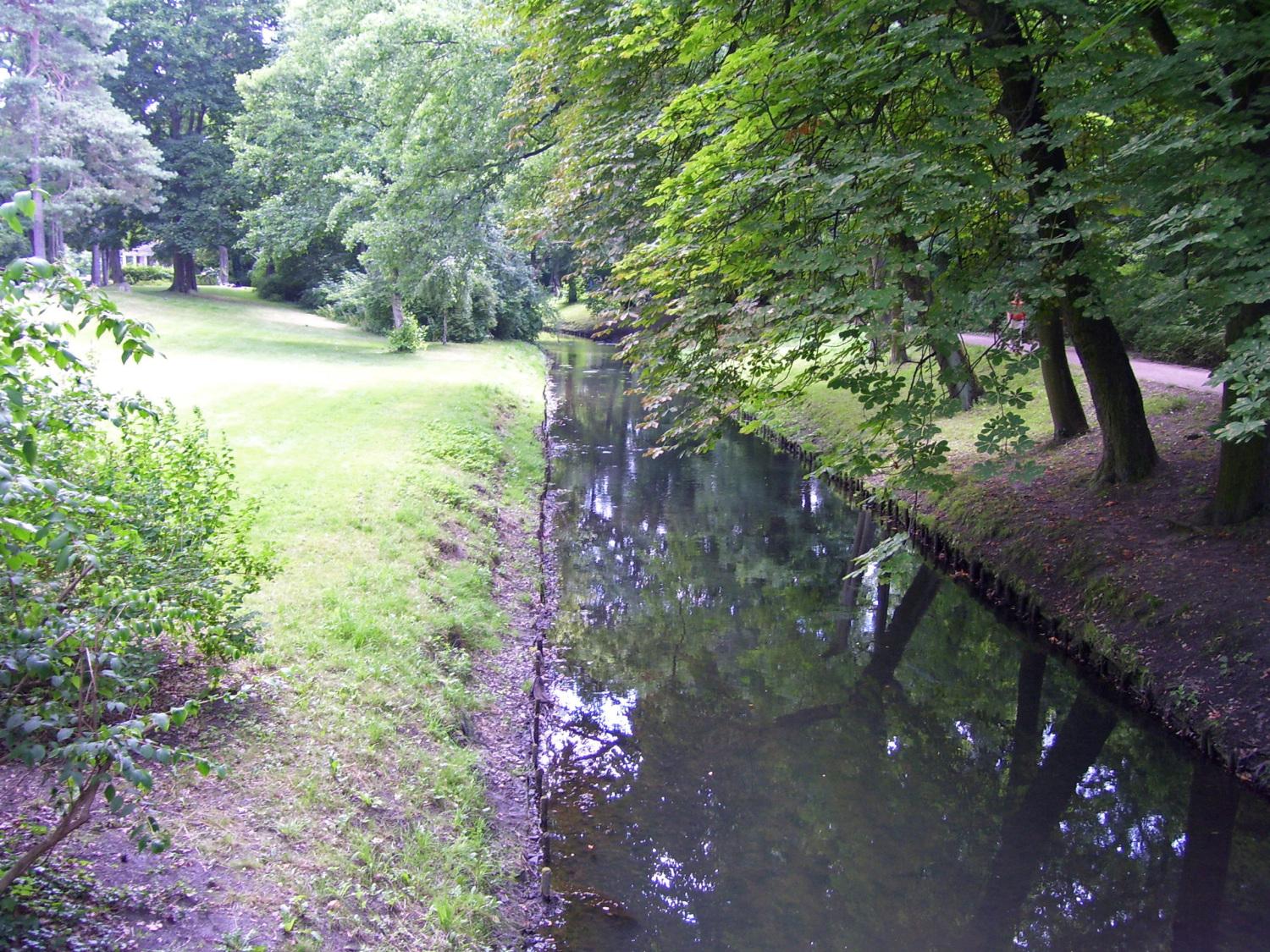
The Panke is a watercourse that rises outside Berlin and reaches the urban area of the city, flows through the districts of Pankow and Mitte and flows into the Berlin-Spandau Ship Canal in Wedding. The length of the Panke is around 29 kilometres. Almost the entire length of the Panke in Berlin (around 17.6 km) is to be renaturalised - on the section from the state border in the north of Berlin to its confluence with the Berlin-Spandauer-Schifffahrtskanal (BSSK). The Panke is currently a small watercourse that has been heavily remodelled by humans. In large parts of the watercourse, the banks have been straightened like a canal and reinforced with sheet piling, among other things. Existing riverbed drops and weirs prevent fish from travelling unhindered through the watercourse. Studies on water body (structural) quality, typification and other biological quality characteristics have shown that the Panke has poor status values in the majority of Berlin's sections, e.g. in terms of the fish population. The negative assessment results are primarily attributed to the lack of habitat and structural diversity, the lack of passability of the watercourse and, in some cases, high nutrient loads. (Ref. 1) The restoration of the river was initiated by the State Berlin, following the European Water Framework Directive. The central aim is to implement flood plains and recreate the pre-straightened water course, to ensure space for flooding, habitats for more diverse flora and fauna, increase water flow for better water quality and create a site for recreation in a densely built city. (Ref. 1; Ref. 2) The project started back in 2003 and is expected to be finished in the 2030s (Ref. 2; Ref. 7).

Overview
Nature-based solution
- Blue infrastructure
- Rivers/streams/canals/estuaries
- Riverbank/Lakeside greens
Key challenges
- Climate action for adaptation, resilience and mitigation (SDG 13)
- Climate change adaptation
- Green space, habitats and biodiversity (SDG 15)
- Green space creation and/or management
- Habitat and biodiversity restoration
- Regeneration, land-use and urban development
- Promote natural styles of landscape design for urban development
- Water management (SDG 6)
- Flood protection
- Improvements to water quality
- Health and well-being (SDG 3)
- Creation of opportunities for recreation
- Inclusive and effective governance (SDG 16)
- Inclusive governance
Principal problems in Functional Urban Area (FUA)
- Climate-Related Hazards
- River flooding
- Environmental Degradation
- Biodiversity loss
- Poor water quality
- Health, Well-being and Social cohesion
- Inadequate access to recreational opportunities
Key priorities
Focus
Project objectives
Implementation activities
Climate-focused activities
Climate change adaptation:
- Increase urban vegetation cover to reduce urban heat island effect
- Restore rivers and other fresh water bodies to reduce flood or drought risk
Biodiversity conservation or restoration-focused activities
Biodiversity restoration:
- Rehabilitate and restore damaged or destroyed ecosystems
- Restore species (native, endangered, or unspecified)
- Restore native species
- Restore ecological connectivity
Main beneficiaries
- Citizens or community groups
Governance
Management set-up
- Government-led
Type of initiating organisation
- Regional government
- Local government/municipality
Participatory approaches/ community involvement
- Co-planning (e.g. stakeholder workshops, focus groups, participatory mapping)
- Dissemination of information and education
- Consultation (e.g. workshop, surveys, community meetings, town halls)
Details on the roles of the organisations involved in the project
Project implemented in response to ...
Type of enablers
Financing
Total cost
Source(s) of funding
- Public regional budget
Type of funding
- Earmarked public budget
Non-financial contribution
- Provision of land
- Provision of expertise
- Public authorities (e.g. land, utility services)
- Citizens (e.g. volunteering)
Impacts and Monitoring
Environmental impacts
- Climate change
- Lowered local temperature
- Expected lowered local temperature
- Water management and blue areas
- Increased protection against flooding
- Expected increased protection against flooding
- Green space and habitat
- Increased conservation or restoration of ecosystems
- Expected increased conservation or restoration of ecosystems
- Increased ecological connectivity across regeneration sites and scales
- Expected increased ecological connectivity across regeneration sites and scales
- Increased number of species present
- Expected increased number of species present
Economic impacts
- Unknown
Socio-cultural impacts
- Unknown
Type of reported impacts
Presence of formal monitoring system
Presence of indicators used in reporting
Presence of monitoring/ evaluation reports
Availability of a web-based monitoring tool
Potential risks of implementation and trade-offs
References


 Information about this nature-based solution was collected as part of the Naturescapes project funded by the European Union under Grant Agreement No 101084341.