

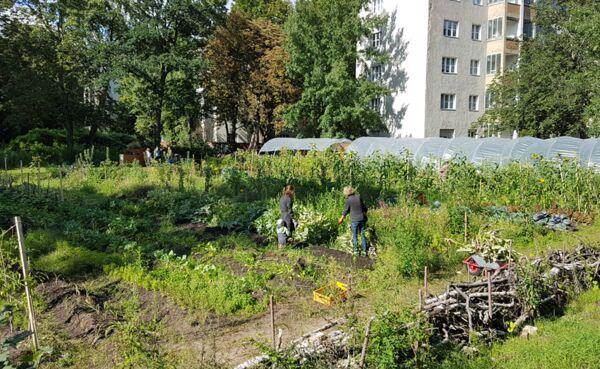
The himmelbeet is an intercultural, inclusive community garden in Berlin that has been inviting people to garden and harvest their own produce since 2013. The garden offers around 200 raised beds that are communal and can be rented by neighbors, individuals and institutions (Ref. 1; Ref. 3). The project aims to familiarize children and adults with ecology, sustainability and healthy eating and to offer space for social exchange and education, while being inclusive to people with different (dis)abilities and backgrounds (Ref. 2; Ref. 6). The design and implementation of environmental education workshops are a vital part of the work. (Ref. 1; Ref. 6) With its own café and vegetable production, himmelbeet is strongly oriented towards the principles of the economy for the common good. The garden team also looks after other gardens in the city - on behalf of educational institutions, social institutions, housing associations and neighborhoods. (Ref. 1; Ref. 6) Originally located in Ruheplatzstrasse, the garden moved in 2021 to Gartenstrasse, because of land disputes with the providing land owners and the demand of the space for other social projects. (Ref. 8; Ref. 11)

Overview
Nature-based solution
- Community gardens and allotments
- Community gardens
Key challenges
- Green space, habitats and biodiversity (SDG 15)
- Green space creation and/or management
- Habitat and biodiversity restoration
- Health and well-being (SDG 3)
- Creation of opportunities for recreation
- Social justice, cohesion and equity (SDG 10)
- Social cohesion
- Social justice and equity
- Social interaction
- Environmental education
- Sense of community and community engagement
- Sustainable consumption and production (SDG 12)
- Sustainable production
Principal problems in Functional Urban Area (FUA)
- Environmental Degradation
- Biodiversity loss
- Land use and Socio-economic change
- Agriculture/ crop production
- Unequal availability and access to public green spaces
- Health, Well-being and Social cohesion
- Social fragmentation and isolation
Key priorities
Focus
Project objectives
Implementation activities
Biodiversity conservation or restoration-focused activities
Biodiversity restoration:
- Restore species (native, endangered, or unspecified)
Main beneficiaries
- Citizens or community groups
- Marginalized groups: Children, young people or youth groups , People with functional diversities, People with invisible disabilities, Socio-economically disadvantaged populations (e.g. low-income households, unemployed), Disadvantaged ethnic or racial groups
Governance
Management set-up
- Led by non-government actors
Type of initiating organisation
- Non-government organisation/civil society
Participatory approaches/ community involvement
- Deliberative decision-making processes (e.g., consensus building, deliberative polling)
- Dissemination of information and education
- Joint implementation (e.g. tree planting)
- Co-management/Joint management
Details on the roles of the organisations involved in the project
Project implemented in response to ...
Type of enablers
Financing
Total cost
Source(s) of funding
- Public national budget
- Public regional budget
- Other funding sources are unclear
Type of funding
- Earmarked public budget
- Direct funding (grants, subsidies, or self-financed projects by private entities)
- Other funding types are unknown
Non-financial contribution
- Provision of land
- Provision of labour
- Provision of expertise
- Exchange of services
- Public authorities (e.g. land, utility services)
- Citizens (e.g. volunteering)
- Private sector (businesses, financial institution)
Impacts and Monitoring
Environmental impacts
- Green space and habitat
- Increased green space area
- Achieved increased green space area
- Increased number of species present
- Achieved increased number of species present
Economic impacts
- Generation of other type of work opportunities (e.g. voluntary, work for rehabilitation)
- Achieved generation of other type of work opportunities (e.g. voluntary, work for rehabilitation)
- Increase in agricultural production (for profit or not)
- Achieved increase in agricultural production (for profit or not)
Socio-cultural impacts
- Social justice and cohesion
- Improved social cohesion
- Expected improved social cohesion
- Improved access to urban green space
- Expected improved access to urban green space
- Increased visibility and opportunity for marginalised groups or indigenous peoples
- Expected increased visibility and opportunity for marginalised groups or indigenous peoples
- Increased opportunities for social interaction
- Achieved increased opportunities for social interaction
- Increased involvement of locals in the management of green spaces
- Achieved increased involvement of locals in the management of green spaces
- Increased access to healthy/affordable food
- Achieved increased access to healthy/affordable food
- Increased sustainability of agriculture practices
- Achieved increased sustainability of agriculture practices
- Education
- Increased knowledge of locals about local nature
- Expected increased knowledge of locals about local nature
Type of reported impacts
Presence of formal monitoring system
Presence of indicators used in reporting
Presence of monitoring/ evaluation reports
Availability of a web-based monitoring tool
Potential risks of implementation and trade-offs
References


 Information about this nature-based solution was collected as part of the Naturescapes project funded by the European Union under Grant Agreement No 101084341.