

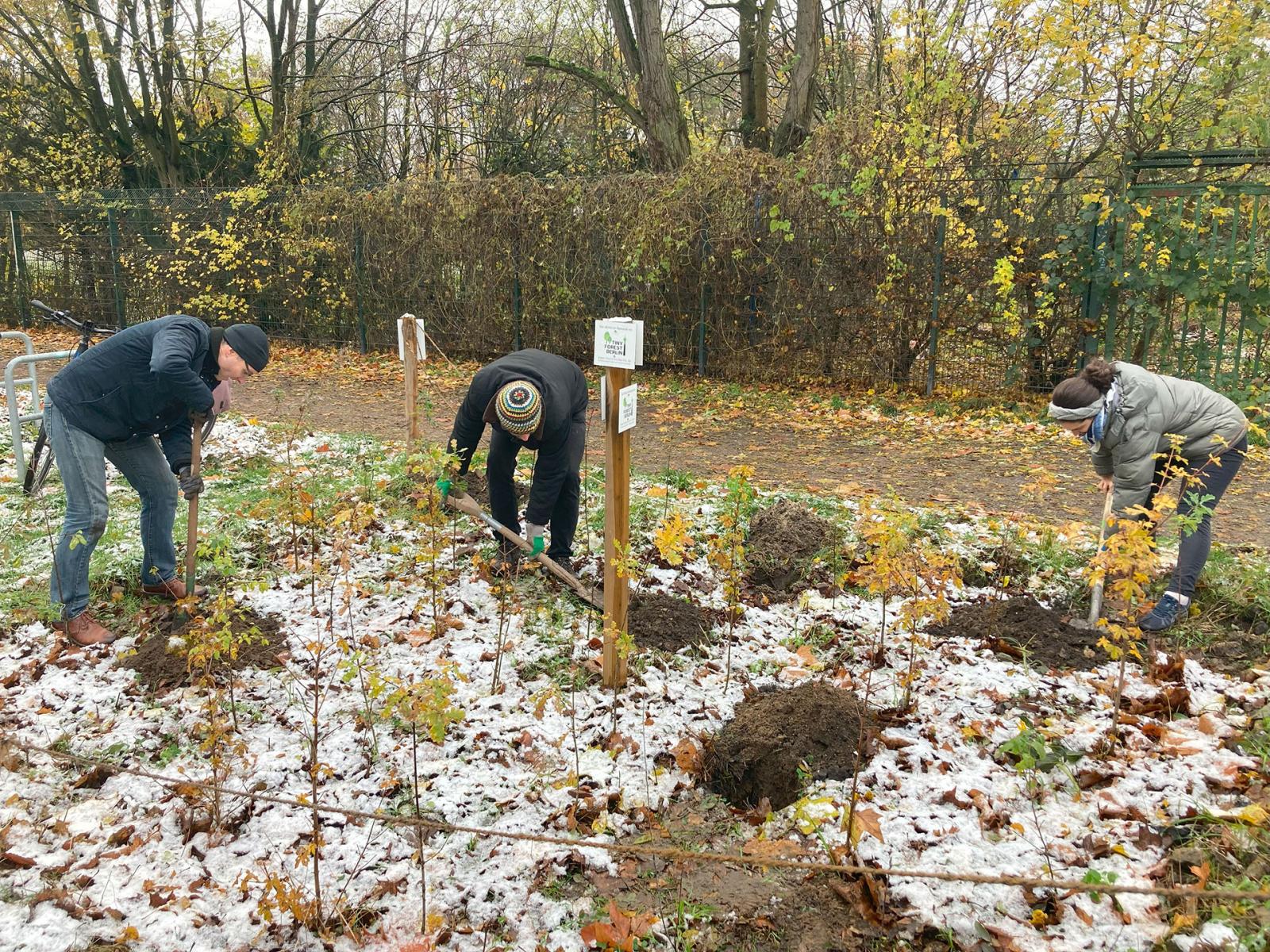
On a small roadside green space in Berlin, a tiny forest was created. The idea of Tiny Forests comes from Japan, there are already some in France and the Netherlands, and since 2020 also in Germany. Tiny forests are constituted of trees planted densely next to each other in small spaces, such as tiny green roadsides. At Oderstraße, the NGO TinyForestBerlin planted an even smaller forest, a nano forest on a roadside where trees cool down the area, filter the air and create a habitat for insects. Trees in urban areas loosen up the dense and degraded soil, allowing it to store carbon and let rainwater properly seep into the ground to prevent urban flooding. Roadsides are hardly utilised or recognized in their environmental potential, such as hosting a nano forest. Projects like the one implemented by TinyForestBerlin present an approach for collaboration between the district and civil society, as the district's park department lack the capacity to maintain small roadsides. The project at Oderstraße is the first official tiny forest in Berlin, as a previous planting campaign in Friedrichshain was not entirely legal due to missing approval of local authorities. (Ref. 2; Ref. 5) The TinyForestBerlin association has set itself the goal of creating such small nano-forests all over Berlin. An ambitious project that aims to enrich the city's green spaces and contribute to improving the urban climate. The trees planted on Oderstraße are one of many smaller planting projects that are spread throughout the city on public as well as private land. (Ref. 3)
Overview
Nature-based solution
- Grey infrastructure featuring greens
- Alley or street trees and other street vegetation
- Parks and urban forests
- Pocket parks/neighbourhood green spaces
Key challenges
- Climate action for adaptation, resilience and mitigation (SDG 13)
- Climate change adaptation
- Climate change mitigation
- Environmental quality
- Air quality improvement
- Soil quality improvement
- Green space, habitats and biodiversity (SDG 15)
- Green space creation and/or management
- Habitat and biodiversity restoration
- Water management (SDG 6)
- Flood protection
- Stormwater and rainfall management and storage
Principal problems in Functional Urban Area (FUA)
- Climate-Related Hazards
- Urban flooding (stormwater)
- Heat stress & Extreme temperatures
- Degradation of carbon sinks
- Environmental Degradation
- Biodiversity loss
- Soil degradation and loss
- Air pollution
- Land use and Socio-economic change
- Rapid urbanization
Key priorities
Focus
Project objectives
Implementation activities
Climate-focused activities
Climate change adaptation:
- Increase urban vegetation cover to reduce urban heat island effect
Climate change mitigation:
- Increase the availability of green urban space for carbon storage (street tree cover)
Biodiversity conservation or restoration-focused activities
Biodiversity restoration:
- Rehabilitate and restore damaged or destroyed ecosystems
- Restore species (native, endangered, or unspecified)
Main beneficiaries
- Citizens or community groups
Governance
Management set-up
- Led by non-government actors
Type of initiating organisation
- Non-government organisation/civil society
Participatory approaches/ community involvement
- The project didn't involve any form of stakeholder participatory activities
Details on the roles of the organisations involved in the project
Project implemented in response to ...
Type of enablers
Financing
Total cost
Source(s) of funding
- Funds provided by non-governmental organization (NGO)
Type of funding
- Donations
- Membership or entrance fees
Non-financial contribution
- Provision of land
- Public authorities (e.g. land, utility services)
Impacts and Monitoring
Environmental impacts
- Climate change
- Lowered local temperature
- Achieved lowered local temperature
- Enhanced carbon sequestration
- Achieved enhanced carbon sequestration
- Environmental quality
- Improved air quality
- Achieved improved air quality
- Improved soil quality
- Achieved improved soil quality
- Water management and blue areas
- Improved stormwater management
- Achieved improved stormwater management
- Green space and habitat
- Reduced biodiversity loss
- Achieved reduced biodiversity loss
- Increased number of species present
- Achieved increased number of species present
Economic impacts
- Unknown
Socio-cultural impacts
- Unknown
Type of reported impacts
Presence of formal monitoring system
Presence of indicators used in reporting
Presence of monitoring/ evaluation reports
Availability of a web-based monitoring tool
Potential risks of implementation and trade-offs
References


 Information about this nature-based solution was collected as part of the Naturescapes project funded by the European Union under Grant Agreement No 101084341.